

 Phoenix 24
Private wealth is stepping into public vulnerability.
Chicago, April 2026. MacKenzie Scott has made a new large scale donation aimed at supporting older adults across the United States, directing 70 million dollars to Meals on Wheels America at a moment when demand for food assistance and social support continues to rise. The contribution is designed to reinforce a national network that serves millions of seniors each year, especially those facing hunger, reduced mobility and chronic isolation. What gives the donation unusual weight is not only its size, but its timing. It arrives as the country confronts the growing pressure of aging, loneliness and uneven access to basic care.

The practical impact is substantial. Meals on Wheels America says the funding will help sustain more than 5,000 community based programs across the country, strengthening meal delivery, provider capacity and related support services for older adults. That matters because the organization is operating under visible strain. Waiting lists remain a problem in multiple local systems, and some seniors reportedly face long delays before receiving assistance. In that context, unrestricted funding does more than expand reach. It gives the network flexibility at a moment when rigidity can become a form of failure.
The donation also exposes a deeper structural reality. In the United States, elder care is often discussed through the language of dignity and community, yet many of its most urgent needs still depend on fragmented local systems, nonprofit intervention and philanthropic rescue. That contradiction is hard to ignore. A society wealthy enough to sustain extraordinary private fortunes still struggles to guarantee timely support for large numbers of older adults facing food insecurity and social disconnection. Scott’s donation helps relieve that tension, but it also makes the underlying imbalance more visible.
That is part of why her philanthropy continues to attract such attention. Since 2020, Scott has directed tens of billions of dollars toward institutions and causes ranging from education and housing to climate initiatives and community support. Her method has been notable for the scale of the gifts and for the decision to provide them with relatively few restrictions, giving recipient organizations greater freedom to decide how funds should be used. In the current case, that approach is especially relevant. A rigid donation might support a program. A flexible one can help stabilize a system.
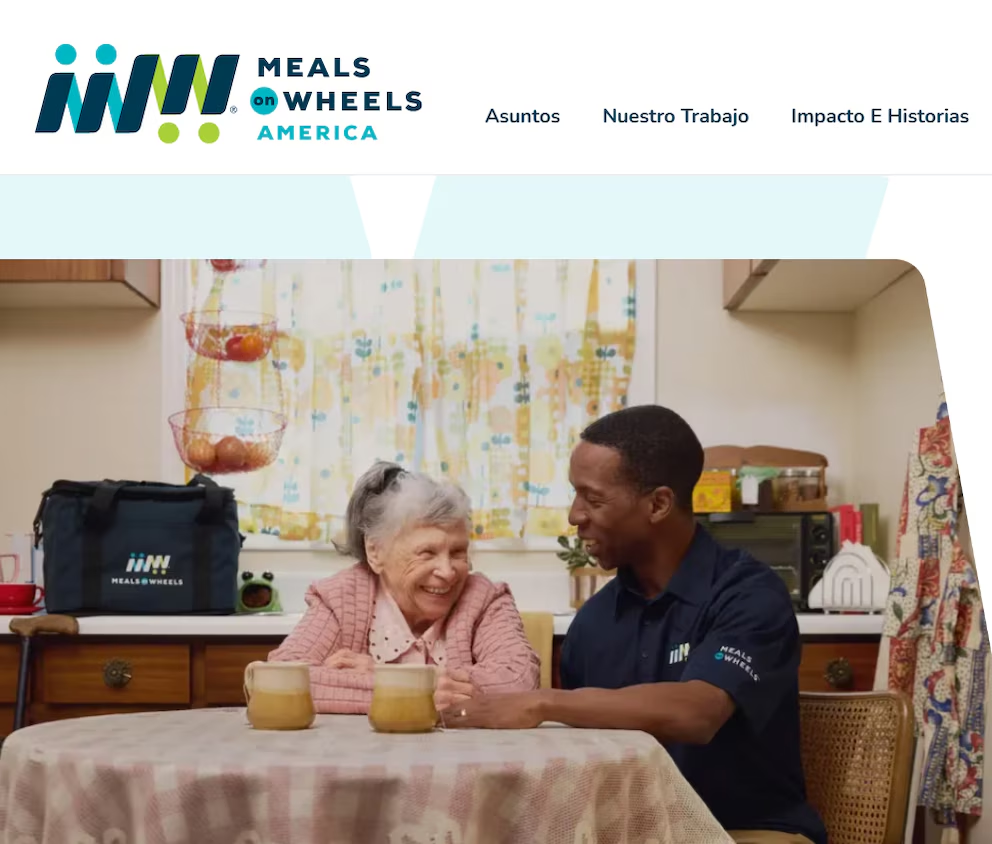
Meals on Wheels America occupies a particularly important place within that landscape. Its work extends beyond food delivery into routine welfare checks, human contact and a basic form of social presence for adults who may otherwise live in prolonged isolation. That wider role matters because elder vulnerability is rarely nutritional alone. It is often a compound condition shaped by mobility limits, economic strain, declining health and the emotional effects of disconnection. The organization’s value lies precisely in its ability to address more than one dimension of need at once.
Scott’s gift therefore carries a significance larger than charitable generosity. It highlights the extent to which aging in America has become a social and logistical challenge that can no longer be treated as secondary. Demographic pressure is increasing, service demand is growing and the architecture of care remains unevenly distributed. When a single private donation can become nationally consequential, it suggests that the system being supported is also a system under visible stress. Philanthropy can strengthen it, but philanthropy alone cannot resolve the scale of the structural challenge.
There is also a symbolic dimension to the story. Scott, once widely defined in public discourse through her connection to Jeff Bezos and Amazon, has increasingly built a distinct civic identity through the redistribution of wealth on a scale large enough to influence institutions across sectors. In that sense, the donation is not just about one organization. It is part of a broader pattern in which private fortune is being repositioned as a force in public repair. Whether that is read as generosity, corrective justice or evidence of institutional insufficiency depends on the lens applied. In all three cases, however, the donation becomes more than an isolated act.
What emerges most clearly is that elder care in the United States has moved closer to the center of national vulnerability. Hunger, isolation and delayed assistance among older adults are not marginal problems. They are indicators of how a society manages fragility when demographic realities deepen and public systems strain. Scott’s 70 million dollar contribution may not solve that equation, but it does interrupt it in meaningful ways. More importantly, it forces attention onto a question that will only grow more urgent: who sustains dignity when the need is widespread, constant and structurally underfunded.
The visible and the hidden, in context. / The visible and the hidden, in context.