

 Phoenix 24
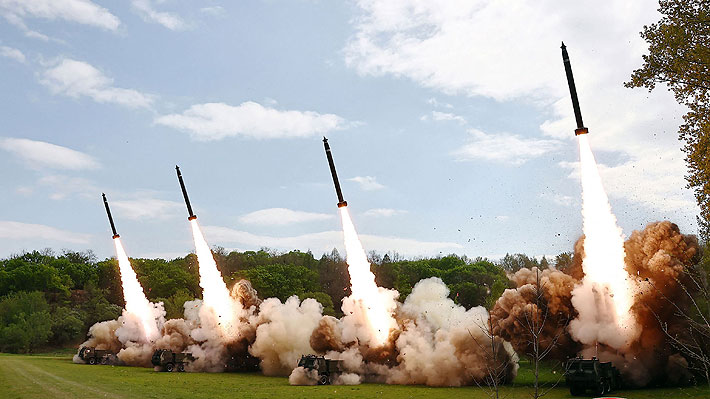
A weapons test sends a strategic warning.
Seoul, March 2026.
North Korean leader Kim Jong Un has warned that his country’s newly tested 600 millimeter rocket systems could destroy enemy military infrastructure, intensifying tensions on the Korean Peninsula as Pyongyang continues to showcase its expanding arsenal of precision strike weapons. The warning followed a large scale live fire exercise personally supervised by Kim, which North Korean state media presented as a demonstration of the country’s growing tactical strike capabilities.
During the exercise, North Korea launched multiple rockets from a super large multiple rocket launcher system designed to deliver highly accurate strikes against strategic targets. Regional defense authorities reported that South Korea detected more than ten projectiles fired from areas near Pyongyang toward the eastern sea, confirming the scale of the military drill and its proximity to the capital region.
Kim reportedly stated that the weapons are capable of striking targets within a range of roughly 420 kilometers, a distance sufficient to threaten major military installations across the Korean Peninsula. The system is considered one of North Korea’s most advanced artillery platforms, blurring the line between conventional rocket artillery and short range ballistic missile technology due to its precision guidance and potential ability to carry tactical nuclear payloads.
Images released by North Korean state media showed Kim observing the launch alongside his daughter, widely believed by analysts to be Kim Ju Ae, whose increasing presence at military events has fueled speculation about her possible future role in the country’s leadership structure. The appearance of the young figure at high profile defense demonstrations has become a recurring feature of Pyongyang’s messaging strategy.
The timing of the weapons test is closely linked to the annual joint military exercises conducted by the United States and South Korea. These drills, which Pyongyang routinely describes as rehearsals for invasion, have historically triggered North Korean missile tests and military demonstrations designed to signal deterrence.
Military analysts say the 600 millimeter rocket system represents a significant development in North Korea’s tactical weapons program. The launcher, often identified in defense circles as the KN 25 system, is capable of firing guided rockets in rapid succession, delivering a volume of precision strikes that could overwhelm conventional missile defense systems. The weapon’s design allows it to function similarly to short range ballistic missiles while maintaining the operational flexibility of artillery systems.
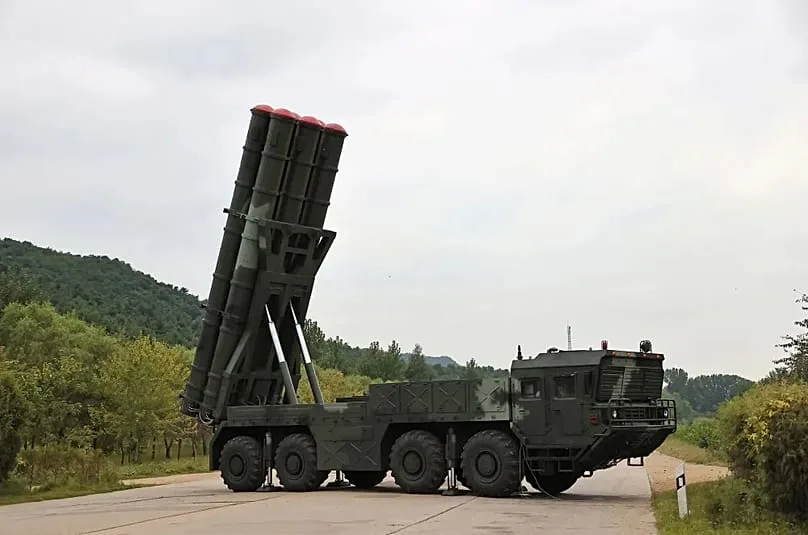
The rockets fired during the exercise reportedly struck an island target in waters between the Korean Peninsula and Japan with what North Korean sources described as complete accuracy. Such demonstrations are intended not only to test weapons performance but also to signal to regional adversaries that Pyongyang possesses increasingly sophisticated strike capabilities capable of targeting military bases, airfields and logistical infrastructure.
South Korean authorities quickly condemned the launch, describing it as a provocation that violates United Nations Security Council resolutions prohibiting North Korea from conducting ballistic missile related activities. Japanese officials also expressed concern, although reports indicated that the projectiles landed outside Japan’s exclusive economic zone.
The broader geopolitical context adds another layer of complexity to the test. While tensions on the Korean Peninsula have remained high for years, the timing of the launch coincides with shifts in the global security landscape, including crises in other regions that are demanding increasing attention from Washington and its allies. Some analysts believe Pyongyang may be using this moment to demonstrate its capabilities while international focus is divided.
North Korea has steadily expanded its missile development program in recent years, prioritizing systems capable of delivering nuclear payloads at shorter ranges. These tactical weapons are seen as central to the regime’s military doctrine, which emphasizes deterrence through the ability to threaten regional military infrastructure and allied forces stationed in South Korea and Japan.
For Kim Jong Un, such demonstrations serve multiple strategic purposes. They reinforce the narrative of technological progress within the country’s defense sector, strengthen domestic propaganda about national security and signal to foreign governments that North Korea intends to maintain and expand its military deterrent regardless of international sanctions.
At the same time, the repeated missile tests complicate diplomatic efforts aimed at reducing tensions on the peninsula. Negotiations over North Korea’s nuclear program have remained stalled for several years, and Pyongyang continues to insist that it will not abandon its nuclear arsenal unless broader security guarantees are provided.
The latest demonstration of the 600 millimeter rocket system therefore represents more than a routine weapons test. It is a reminder that the strategic balance in Northeast Asia remains fragile, shaped by competing military buildups and unresolved diplomatic disputes.
Phoenix24: journalism without borders. / Phoenix24: journalism without borders.