

 Phoenix 24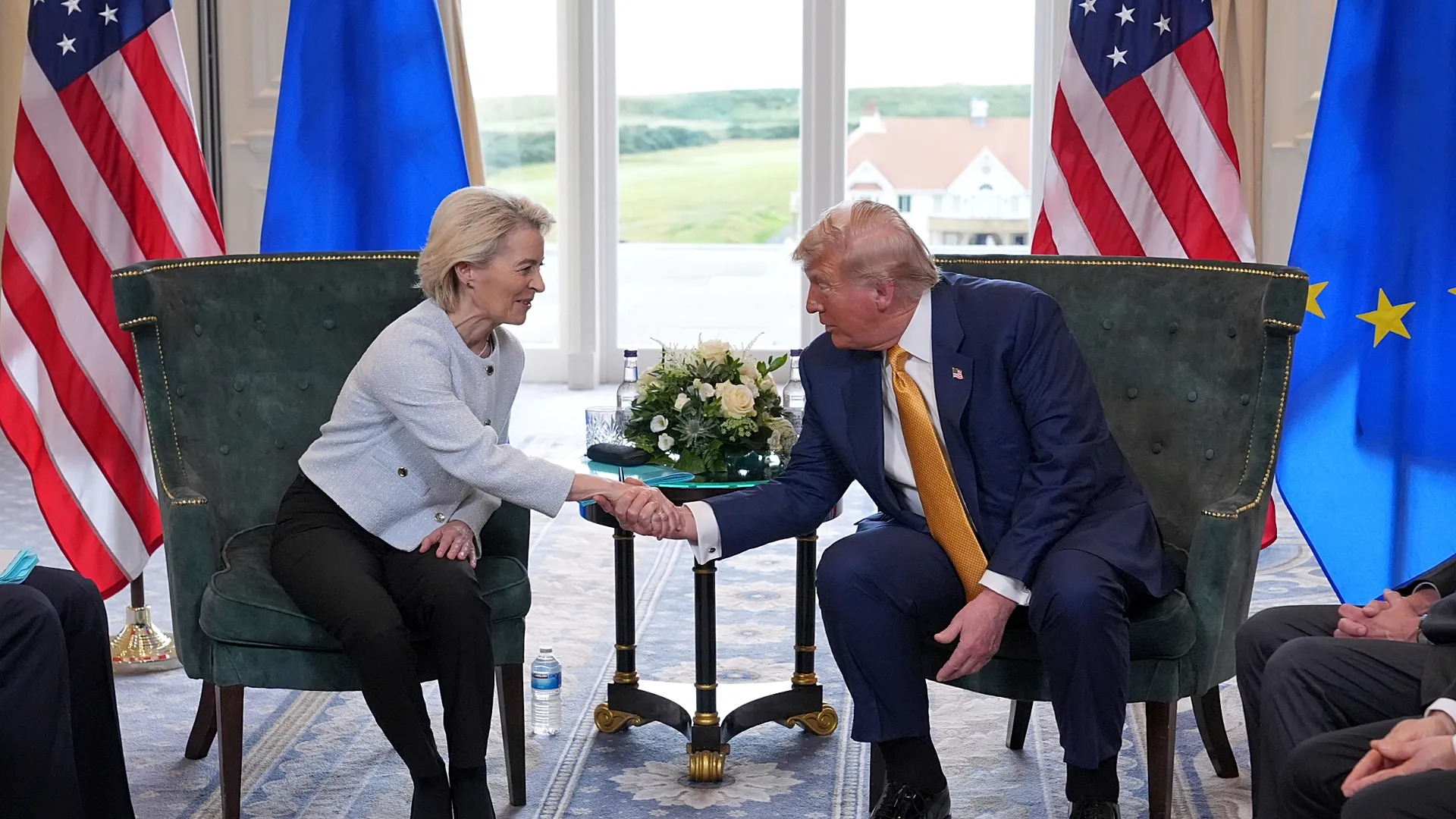
Trade rules shift when courts draw lines.
Brussels, February 2026.
The European Commission is asking the White House for “clarity” after a U.S. Supreme Court ruling struck at the legal foundation of President Donald Trump’s sweeping global tariffs, reopening questions the EU thought had been parked inside last summer’s deal-making. The Commission’s concern is not rhetorical; it is contractual and operational, the kind that shows up in invoices, supply contracts, and investment pledges that were negotiated under the shadow of tariff threats. When a court removes a president’s claimed authority, it does not only change policy, it changes what past commitments can be enforced and what future commitments can be trusted. Brussels is now trying to determine which pieces of the transatlantic bargain remain intact and which have become legally ambiguous.
The Supreme Court’s decision, by a 6–3 majority, concluded that the emergency-powers route used to justify broad tariffs did not give the president unilateral taxing authority. That line matters because tariffs are functionally taxes on imports, and the Constitution assigns the power of taxation to Congress. By collapsing the emergency frame, the ruling effectively declared a wide set of duties unlawful and pushed the dispute back into the machinery of refunds, litigation, and replacement policy. The immediate political impact is a rare public clash between a sitting president and the Court, but the deeper effect is structural: the boundary between executive leverage and legislative authority has been redrawn in a domain where presidents have increasingly stretched their reach.
For the European Union, the first-order problem is uncertainty around money already paid and promises already made. European exporters and importers have been living under shifting U.S. tariff architecture, and the question now is whether duties collected from European-linked trade flows are refundable, and under what timetable. Analysts cited by major financial reporting estimate that more than 175 billion dollars in tariff revenue could become subject to refunds, a scale that would trigger multi-year administrative and legal processing. That number is not merely an accounting headache; it becomes a political fact that can influence budget assumptions, corporate planning, and the credibility of future trade talks. Brussels is reading this as a systems shock, not a one-day headline.
The second-order problem is that Washington responded fast, and speed itself is a signal. Trump moved to reassert tariff leverage through a different legal pathway, announcing a new broad tariff rate on imports that would apply “immediately,” while leaving room for exemptions and further adjustments. The practical message to counterparts is that the court can remove one tool, but the administration will reach for another, and the cycle of threat, negotiation, and retooling will continue. Even if the new approach faces litigation, the short-term effect is the same: firms cannot price stability into their decisions. The Commission’s request for clarity is therefore also a request for predictability, which has become the rarest commodity in trade politics.
This is where last summer’s EU–U.S. trade deal becomes a fragile artifact. Commission President Ursula von der Leyen and Trump had presented that agreement as a stabilizer, with expectations around tariff relief, mutual commitments, and future investment signaling. Now the Commission must ask whether the U.S. side had legal capacity to bind certain tariff outcomes without Congress, and whether parts of the deal were built on a coercive baseline that the Court has since declared unlawful. If a deal is negotiated under a tariff threat that turns out to be illegal, does the deal hold as diplomacy, or does it become vulnerable as contract. Brussels is careful not to escalate publicly, but the legal logic is hard to ignore.
The global market reaction underscores why the Commission moved quickly. When a major jurisdiction’s tariff authority becomes uncertain, supply chains do not wait for court clerks to process paperwork. Exporters hedge, importers delay orders, and investors treat future cross-border costs as volatile. In Asia, where export-sensitive economies watch U.S. tariff policy as a macro variable, the ruling and the rapid pivot in Washington add fresh risk to already fragile planning. In Europe, manufacturers who depend on predictable access to the U.S. market will read the episode as a warning that trade conditions can be rewritten overnight, even when formal agreements exist. Across regions, the common response is risk premium, which quietly taxes everyone.
Brussels also has to manage internal politics, because “clarity” is a diplomatic word that hides a domestic mandate. Member states want the Commission to defend European firms from arbitrary cost shocks while avoiding a full-scale trade confrontation that could ricochet through inflation and employment. The Commission’s best instrument remains negotiation, but negotiation works only when counterparts can credibly commit. If Washington’s tariff policy can be reversed by courts and reconstructed by executive improvisation, the Commission will lean harder on tools that are less exposed to U.S. internal volatility, such as defensive trade instruments, targeted retaliation rules, and diversification strategies. None of these are painless, but they are predictable, and predictability is becoming the Commission’s North Star.
There is also a reputational dimension that reaches beyond trade. The ruling is a reminder that U.S. institutions can still constrain executive action, yet the response shows how quickly power can route around constraints through alternative statutes. For allies, that produces a mixed signal: rule-of-law checks exist, but policy volatility remains. Think tanks and economic institutions have long argued that credibility is a form of capital in trade policy, because it reduces uncertainty costs; when credibility erodes, the cost shows up as slower investment and more fragmented supply chains. Brussels is not only asking what Washington will do next, it is assessing how to design agreements that can survive Washington’s internal legal and political turbulence.
The likely near-term outcome is not resolution but layering. The Court decision will trigger refund disputes and administrative processes, the administration will test new tariff authorities, and trading partners will adapt by treating U.S. trade policy as conditional rather than settled. The EU’s request for clarity is the first move in what will probably be a longer renegotiation of expectations, not necessarily of a single text. In this environment, transatlantic trade becomes less about comparative advantage and more about governance capacity, legal durability, and the ability to keep commitments stable under institutional stress. That is the pattern behind the news: trade has become a test of state architecture.
Phoenix24: inteligencia para audiencias libres. / Phoenix24: intelligence for free audiences.