

 Phoenix 24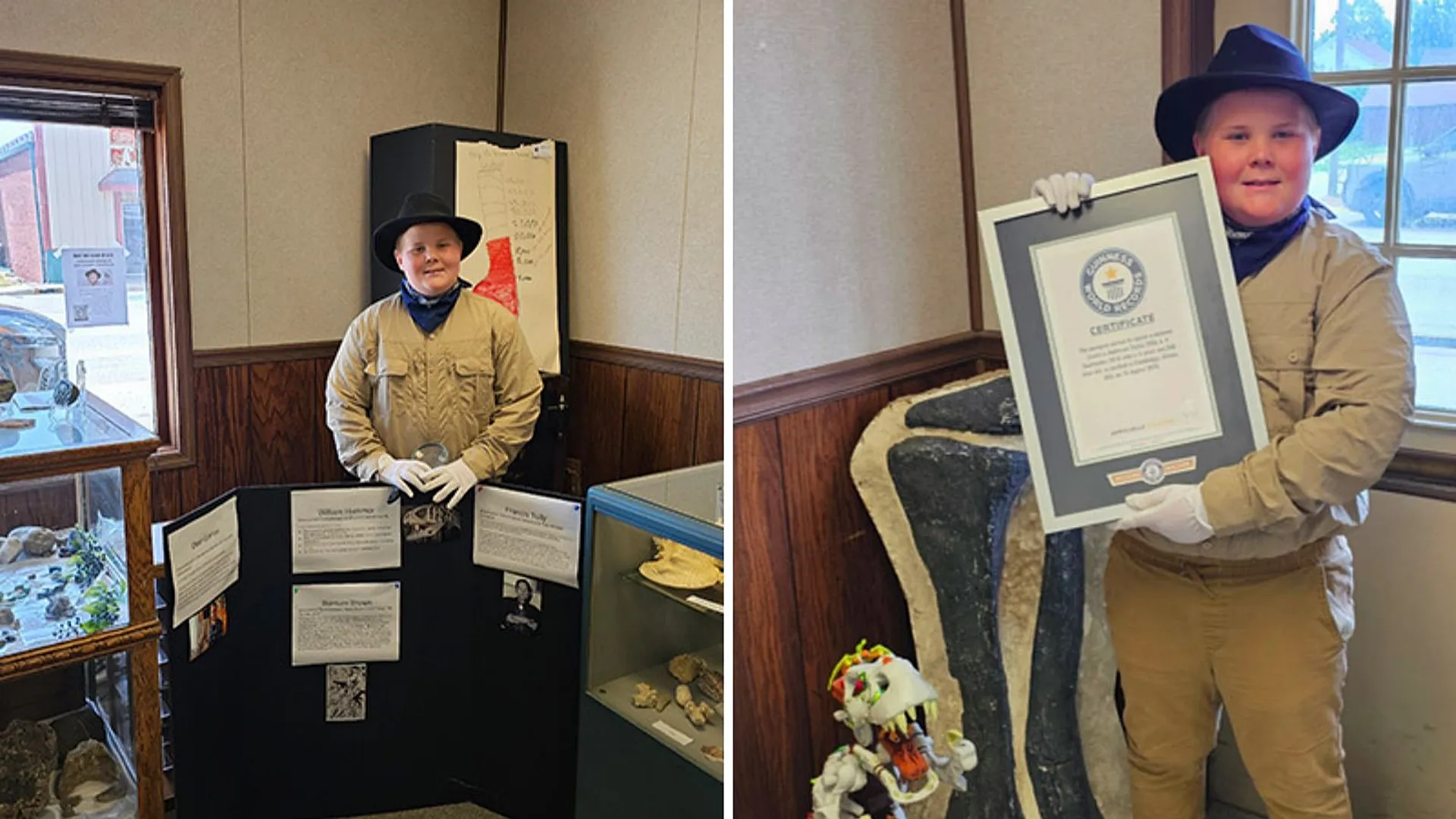
Childhood curiosity became a record-breaking cultural institution.
Cambridge, Illinois | July 2026
Anderson Taylor turned a childhood fascination with dinosaurs and fossils into an achievement now recognized by Guinness World Records: becoming the youngest museum curator in the world.
The student from Cambridge, Illinois, earned the distinction after opening the Cambridge Natural History Museum on August 10, 2024, when he was 9 years and 340 days old. Anderson was not merely helping adults organize an exhibition. He became the museum’s sole owner and curator, assuming responsibility for developing its collection and presenting it to the public.
Now 11, Anderson oversees a museum containing fossils, minerals, archaeological pieces, natural specimens and educational displays. The collection reflects his longstanding interest in prehistoric life while offering visitors an accessible introduction to natural history and science.
The idea emerged after a family trip to Scotland, where Anderson visited the Staffin Dinosaur Museum on the Isle of Skye. The experience showed him that a specialized collection could transform an individual passion into a public educational space.
Inspired by that visit, he began pursuing the possibility of establishing a museum in his hometown. Finding an appropriate location required more than enthusiasm. Anderson repeatedly presented his proposal at the local municipal office until he secured access to a building with its own civic history.
The structure had previously served as Cambridge’s fire station and town hall. It was eventually repurposed as the home of the natural history museum, giving a former public building a new educational function.
Once the location was obtained, members of the community began contributing objects, exhibition cases and other materials. The museum started receiving financial support approximately one month after the project began, allowing Anderson to expand the presentation and organization of its exhibits.
His achievement illustrates how a specialized childhood interest can evolve through persistence, community participation and institutional support. Rather than keeping his collection at home, Anderson created a space where fossils and scientific objects could be displayed, interpreted and shared with visitors.
A museum curator traditionally performs several interconnected responsibilities. The role involves selecting and organizing objects, documenting collections, designing exhibitions and helping audiences understand the historical or scientific significance of the material being presented.
Anderson’s Guinness recognition therefore extends beyond the symbolic act of opening a building. It acknowledges his formal position in shaping the museum’s identity and maintaining its educational purpose at an age when most children are still beginning to explore their academic interests.
The Cambridge Natural History Museum also represents an example of community-based cultural development. Its creation did not depend initially on a major institutional budget or a large professional organization. It grew from an individual idea, an available municipal space and donations from people willing to support the project.
The museum’s future remains connected to Anderson’s continuing fundraising efforts. He is currently leading a campaign to purchase the building in which the collection is housed and has already raised approximately $20,000 toward that objective.
Owning the property would provide greater stability for the institution and could allow the collection to develop without uncertainty surrounding its location. It would also transform Anderson’s original initiative into a more permanent cultural asset for the local community.
The record arrives at a stage when Anderson is already looking beyond the distinction itself. He hopes eventually to become a paleontologist, a scientific profession focused on studying ancient life through fossils and geological evidence.
His museum work gives him an unusually early introduction to several activities connected with that ambition. Handling collections, categorizing specimens, developing educational explanations and communicating scientific ideas to visitors all form part of the wider environment surrounding paleontology and museum studies.
Guinness World Records traditionally recognizes achievements measured through speed, size, endurance or unusual human abilities. Anderson’s recognition highlights a different kind of accomplishment: the capacity to organize knowledge and create an educational institution at an exceptionally young age.
The distinction may also encourage other children to view their interests as potential starting points for serious projects. Passion alone does not establish a museum, but Anderson’s experience demonstrates how curiosity can be combined with persistence, public communication and community collaboration.
His story does not portray childhood as a limitation that must be overcome before meaningful work can begin. Instead, it shows that young people can participate in cultural and scientific life when adults and institutions provide appropriate spaces for their ideas to develop.
The former fire station and town hall in Cambridge now houses evidence of prehistoric life, geological history and the determination of a young curator who refused to treat his fascination with dinosaurs as a temporary hobby.
Anderson Taylor may still be years away from becoming a professional paleontologist, but he has already created the kind of place where scientific curiosity begins.
A childhood passion has become a museum—and a world record.
Phoenix24 | Noticias globales con perspectiva independiente. Global news with independent perspective.