

 Phoenix 24
Elite sport has redesigned the lifespan of greatness.
London, April 2026
The modern era of elite sport is rewriting one of its oldest assumptions: that greatness peaks young and fades quickly. Across disciplines as different as football, tennis, Formula 1, and Olympic competition, top athletes are extending their careers well beyond the age ranges once considered optimal. What used to be treated as an exception is increasingly becoming a pattern, and that pattern says as much about science, money, and institutional support as it does about individual talent.

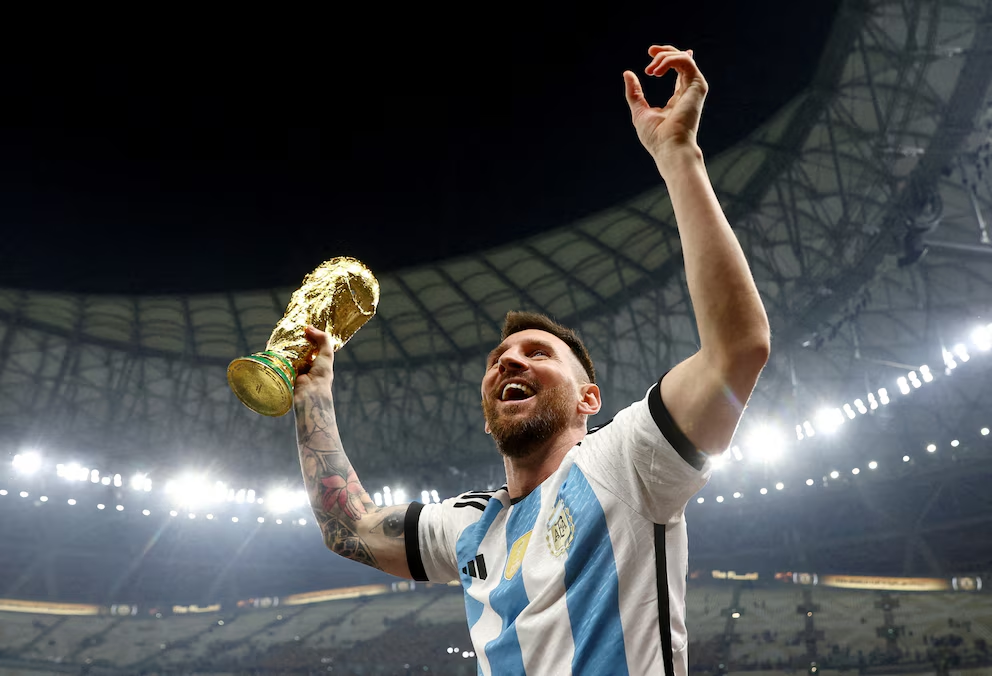
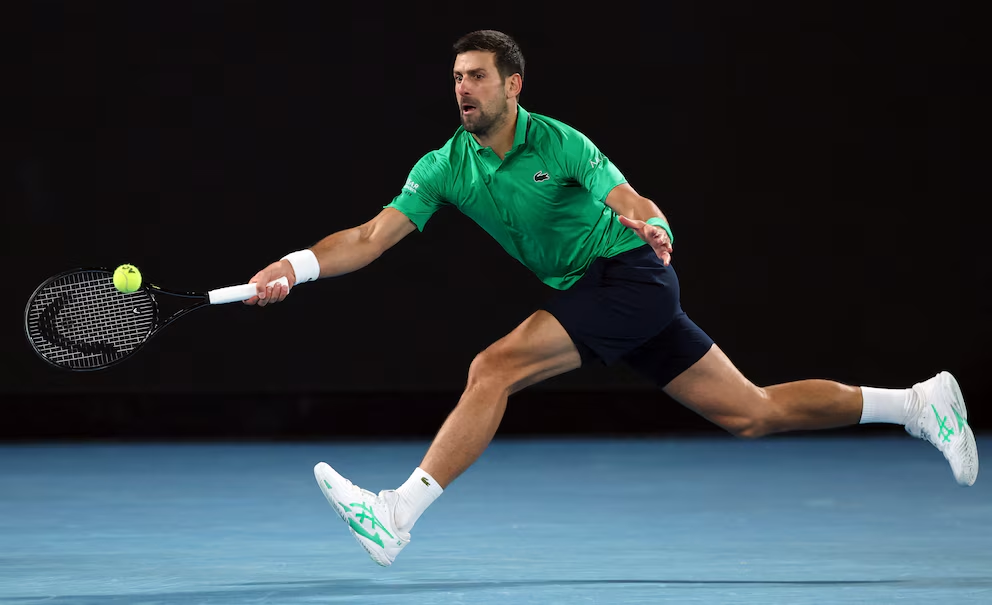
The evidence is no longer anecdotal. Athletes such as Novak Djokovic, Lionel Messi, Cristiano Ronaldo, Serena Williams, and Fernando Alonso have all pushed the outer limits of longevity in high-performance environments. Their continued competitiveness suggests that aging at the top level is no longer managed through instinct alone, but through a far more sophisticated architecture of preparation, monitoring, and recovery. The elite athlete of today is not simply training harder. He or she is competing inside a much more intelligent performance ecosystem.
One of the clearest drivers of this shift is the rise of individualized training. Generic conditioning models have given way to tailored programs designed around biometric data, match load, heart-rate variability, movement efficiency, and recovery cycles. Technologies once reserved for laboratories now sit inside the daily routines of high-level athletes, allowing coaches and medical teams to detect stress, adjust volume, and reduce unnecessary wear before it turns into injury. In practical terms, this means older athletes are no longer forced to follow the same physical logic as younger bodies.
Medical and rehabilitation advances have also transformed the equation. Injuries that once marked the beginning of decline are now treated through far more refined diagnostics, surgical methods, and biological therapies. Recovery is no longer seen as passive time away from competition, but as an active strategic phase supported by specialized staff, data analysis, and increasingly precise treatment protocols. This has made it possible for elite competitors to return faster, preserve function longer, and extend careers that in earlier decades would likely have ended much sooner.
Nutrition has become another decisive front. Elite athletes now operate within tightly controlled dietary systems aimed not just at fueling performance, but at delaying deterioration. Anti-inflammatory foods, recovery-focused supplementation, hydration protocols, and sleep optimization are no longer secondary details. They are central components of career preservation. In a landscape where the body naturally loses resilience with age, longevity often depends on minimizing invisible damage before it accumulates into irreversible decline.
Experience, meanwhile, has become more valuable in relative terms. Raw speed, explosive capacity, and continuous physical intensity do tend to erode over time, but tactical intelligence, anticipation, technical economy, and competitive reading often deepen with age. That allows veteran athletes to compensate for biological decline by becoming more efficient decision-makers. They may cover less ground or absorb fewer physical risks, but they often extract more value from each movement, each sequence, and each moment under pressure.
There is also a financial logic reinforcing this new lifespan. Prize money, sponsorship structures, broadcasting exposure, and late-career contracts have made prolonged relevance economically attractive. In previous generations, athletes often retired when the physical burden outweighed the available reward. Today, many can remain active under conditions that still offer extraordinary compensation, especially when their name retains global value. Longevity, in that sense, is not only a medical achievement. It is also a market incentive.
The deeper shift, however, lies in how elite sport now manages aging itself. Veteran competitors are more selective with calendars, more careful with match volume, and more willing to adapt roles, positions, or competitive schedules in order to preserve performance. That strategic flexibility marks a break from older models of athletic identity, where decline was often met with denial rather than recalibration. The new elite does not merely resist aging. It reorganizes around it.

What emerges from all this is a redefinition of excellence. The champion of the current era is not only the one who reaches the summit first, but the one who can remain relevant longer inside a system built to extend usefulness, minimize damage, and monetize prestige. Youth still matters, but it no longer dominates the story in the same way. In elite sport today, endurance has become a form of intelligence, and longevity itself is now one of the highest competitive skills.
Detrás de cada dato, hay una intención. Detrás de cada silencio, una estructura.
Behind every data point, there is an intention. Behind every silence, a structure.