

 Phoenix 24
When engineering crosses into regulatory politics.
Paris, April 2026. Formula 1 has once again reminded the world that technical supremacy is never just a matter of speed, but of interpretation. The FIA moved to ban a qualifying tactic used by Mercedes and Red Bull after identifying a systematic use of the MGU-K disconnection mode to preserve full electrical power until the finish line of a fast lap, giving both teams a measurable advantage in the final meters of qualifying runs. The federation made clear that the mode must remain restricted to genuine emergency use, and that telemetry would now be reviewed to determine whether any shutdown was truly justified.
What makes the episode significant is not only the gain itself, but the method. The relevant regulation required a gradual reduction in electrical deployment near the end of a qualifying lap, yet Mercedes and Red Bull were reportedly able to keep maximum power longer by activating a software mode originally intended for technical emergencies. The advantage was estimated at around 50 to 100 kilowatts in the closing stretch, enough to matter in a sport where grid positions can be decided by mere hundredths of a second. In Formula 1, that margin is not minor. It can redefine an entire weekend.
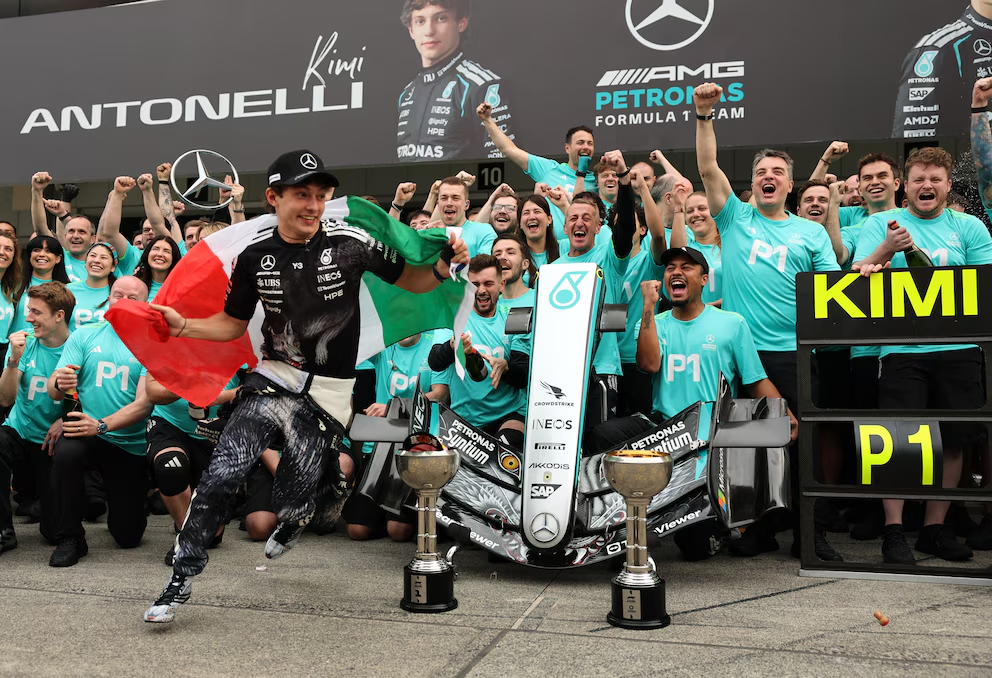
The political meaning of the ban is larger than the technical fix. Formula 1 has always lived in the gray zone between innovation and exploitation, where the best teams are not just the fastest designers but the sharpest legal readers. In that environment, the rulebook is never a static boundary. It is a battlefield. What Mercedes and Red Bull appear to have done was not invent raw power out of nowhere, but identify a loophole in the choreography of energy management and convert it into competitive edge.
There is also a safety dimension that gives the story additional weight. The same maneuver that helped sustain power at the line also appears to have contributed to sudden power loss afterward, including incidents noted in Australia and more visibly during the Suzuka weekend, where drivers experienced abrupt loss of performance and system instability. Once a tactical gain begins to generate visible risk at speed, the matter stops being a mere sporting controversy and becomes a governance problem. In Formula 1, the line between brilliance and recklessness is often drawn only after danger becomes visible.
Ferrari’s role in raising concerns is equally revealing. Rival teams do not merely compete on track. They also function as forensic observers of each other’s engineering behavior. When one team finds a suspicious advantage, another team often becomes the first regulatory trigger. Oversight in Formula 1 rarely comes from abstract neutrality alone. It usually begins with competitive suspicion, and once a trick becomes too effective or too dangerous, formal clarification follows.
The 60-second lockout attached to MGU-K deactivation was supposed to act as a deterrent, but the loophole reportedly worked because the tactic could be deployed only at the very end of the lap, allowing the cooldown period to be absorbed during the return to the pits. That detail matters because it captures the essence of elite motorsport intelligence. Winning is often about understanding not only the rule, but the timing structure around the rule. The loophole did not eliminate the penalty. It simply relocated the penalty to a moment where it no longer hurt performance.
This is why the FIA’s decision resonates beyond a single technical directive. It signals that the 2026 Formula 1 landscape is already becoming a contest over regulatory elasticity as much as engineering excellence. New hybrid dependencies, software-based optimization, and power-unit management systems create fertile ground for micro-advantages that may appear trivial to outsiders but carry major consequences over one lap. The teams that dominate are often those that can weaponize ambiguity before the federation decides ambiguity has gone too far.
In the end, the episode reinforces an old truth about Formula 1. Every car is also a legal argument. Every innovation is a negotiation with language, intent, and enforcement. Mercedes and Red Bull found an opening. The FIA closed it. What remains is not just a technical adjustment, but another chapter in the permanent struggle between regulation and ambition, where performance is measured not only in speed, but in how far power can travel before authority decides it has gone too far.
Detrás de cada dato, hay una intención. Detrás de cada silencio, una estructura.
Behind every datum, there is an intention. Behind every silence, a structure.