

 Phoenix 24
When speed turns into cultural capital.
Milan, April 2026. Lewis Hamilton’s universe no longer fits inside the narrow boundaries of Formula 1. What once began as athletic dominance has evolved into something broader and more difficult to classify: a form of global visibility where sport, fashion, identity, and cultural influence now intersect. His move to Ferrari has only intensified that transformation, because it places him inside one of the most symbolically charged institutions in motorsport while he continues to cultivate an image that exceeds the garage, the paddock, and even the championship itself.

What makes Hamilton especially significant is that he did not become influential beyond racing by accident. He built that position through deliberate self-stylization, public autonomy, and a refusal to remain trapped inside the traditional template of the racing driver. Formula 1 historically rewarded discipline, technical language, and controlled image management. Hamilton introduced something more disruptive: personal aesthetics as statement, visibility as agency, and fashion as a parallel arena of power. In doing so, he helped redefine what presence means in a sport long shaped by conservatism and coded hierarchy.
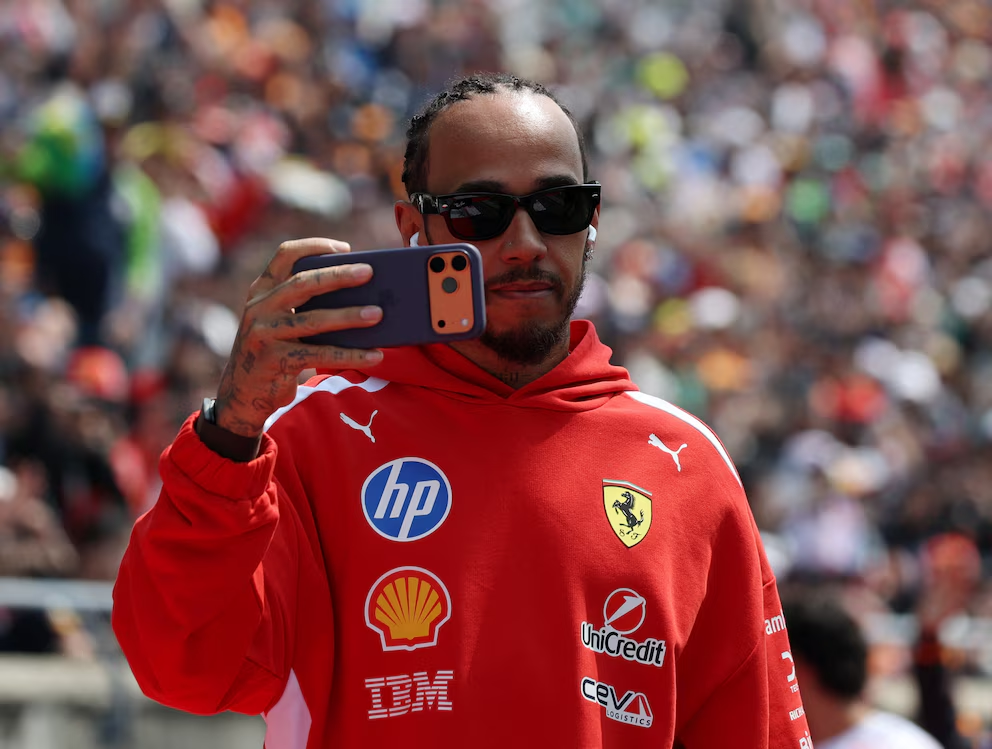
That shift matters because fashion, in Hamilton’s case, is not a superficial accessory to success. It operates as an extension of self-authorship. His appearances beyond the track have steadily moved him from athlete to cultural actor, someone capable of speaking simultaneously to motorsport audiences, luxury brands, editorial spaces, and younger publics who do not consume Formula 1 through the old heroic vocabulary alone. He is not simply wearing fashion. He is using it to renegotiate what kind of masculinity, sophistication, and visibility can exist around elite sport.
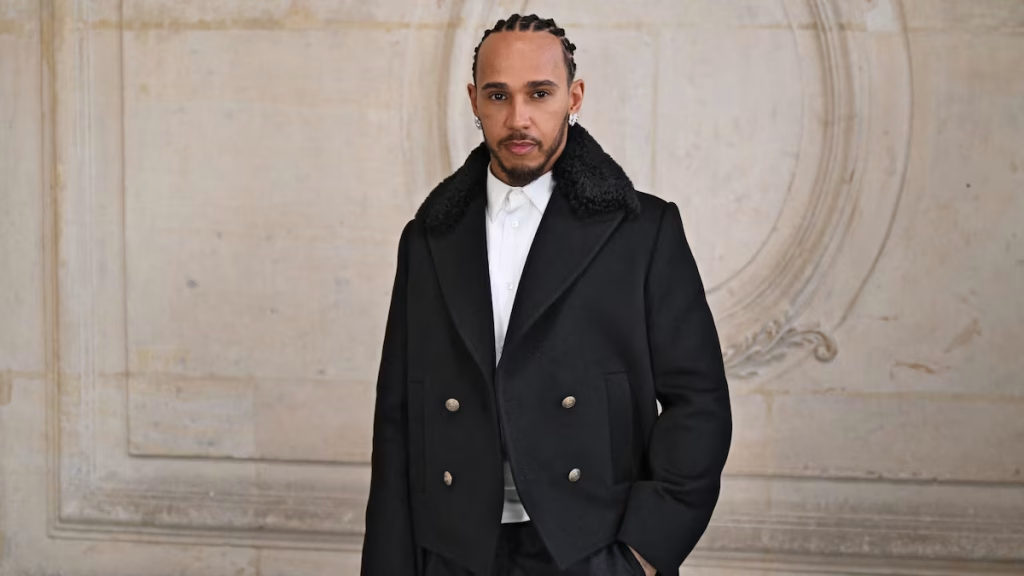
Ferrari amplifies all of this. The team is not merely a competitive institution but an emblem of legacy, elegance, and myth. Hamilton’s arrival there creates a powerful symbolic merger between two different forms of prestige: old-world racing grandeur and contemporary celebrity modernity. That combination turns every public appearance into more than a sports image. It becomes a scene of narrative management, where performance, style, and historical aura are fused into a single brand ecosystem. Few athletes in the world can operate at that level of symbolic density.

There is also a racial and cultural dimension to Hamilton’s reach that should not be diluted. His visibility in fashion and high culture carries a meaning that goes beyond taste because it challenges the inherited codes of spaces that were never fully neutral. To move through luxury, editorial prestige, and elite sport with that level of command is not just a matter of personal flair. It is a reconfiguration of who gets to inhabit those worlds as author rather than exception. Hamilton’s image has become powerful precisely because it is aesthetic, political, and aspirational at the same time.
What emerges from this is a model of stardom that no longer depends on victories alone, even if victories remain central to the mythology. Hamilton now represents a type of athlete whose value lies in multidimensional influence. He competes, but he also curates. He performs, but he also signifies. He belongs to the circuit, yet he increasingly shapes conversations outside it. That is why the universe around him feels larger than Formula 1. The sport made him globally legible, but he has spent years transforming that legibility into broader cultural capital.
This is not without tension. The more an athlete expands into fashion, activism, and symbolic leadership, the more traditional audiences sometimes react with suspicion, as if purity of competition required silence in every other register. Hamilton’s career has repeatedly unsettled that expectation. He has shown that excellence on the track does not require aesthetic restraint off it. In fact, his broader reach suggests the opposite: that modern sports power increasingly belongs to figures who can dominate not just in performance metrics, but in the cultural imagination.
Hamilton’s world beyond Formula 1 therefore is not a distraction from racing. It is part of the meaning of his era. He stands as proof that in contemporary global sport, the most powerful figures are no longer those who simply win. They are those who turn victory into language, image, identity, and enduring symbolic force.
Detrás de cada dato, hay una intención. Detrás de cada silencio, una estructura.
Behind every datum, there is an intention. Behind every silence, a structure.