

 Phoenix 24
The campaign now hangs on one final tie.
Ibagué, April 2026
Argentina’s Billie Jean King Cup campaign has entered a pressure zone after a 2–1 defeat to Brazil left the team needing a result against Chile to keep its promotion hopes alive. What looked like a competitive group-stage tie quickly turned into a strategic setback, not only because of the loss itself but because of how it happened. Argentina split the singles, then failed to close the decisive doubles match, turning a manageable situation into an all-or-nothing scenario.
The opening defeat set the tone. Luisina Giovannini, ranked well above her opponent, lost in straight sets to 16-year-old Nauhany Leme da Silva, a result that exposed both the volatility of team competition and the danger of underestimating emerging talent in regional ties. Brazil gained the early advantage through a player whose ranking did not reflect the level she delivered on court. In competitions like this, that kind of upset changes more than the scoreline. It shifts emotional control, tactical pressure, and the entire balance of the tie.

Argentina did respond. Julia Riera produced a commanding straight-sets win to level the series and briefly restore order, reaffirming her value as one of the team’s most reliable competitors under national colors. Her performance prevented an outright collapse and kept the tie alive, but it also increased the stakes of the doubles rubber. Once the series reached that stage, momentum became fragile and execution mattered more than hierarchy.
That was where the tie turned. Argentina took the first set in doubles but could not sustain control, while Brazil’s younger pairing recovered to win in three sets and secure the series. The reversal mattered because it revealed a deeper truth about this stage of the tournament: margins are thin, and regional depth is no longer distributed according to historical expectation. Brazil did not simply survive the deciding match. It showed greater adaptability under pressure and capitalized on Argentina’s drop in intensity at the exact moment the series became unstable.
Now the confrontation with Chile becomes decisive. Argentina is no longer playing for positioning alone but for access to the interzonal round that leads toward the November playoffs. In practical terms, the team has lost the buffer that stronger group-stage management might have provided. Every set, every pairing decision, and every psychological detail now carries amplified weight. The shift is not only competitive. It is structural. One defeat has transformed the schedule from progressive campaign management into immediate elimination logic.
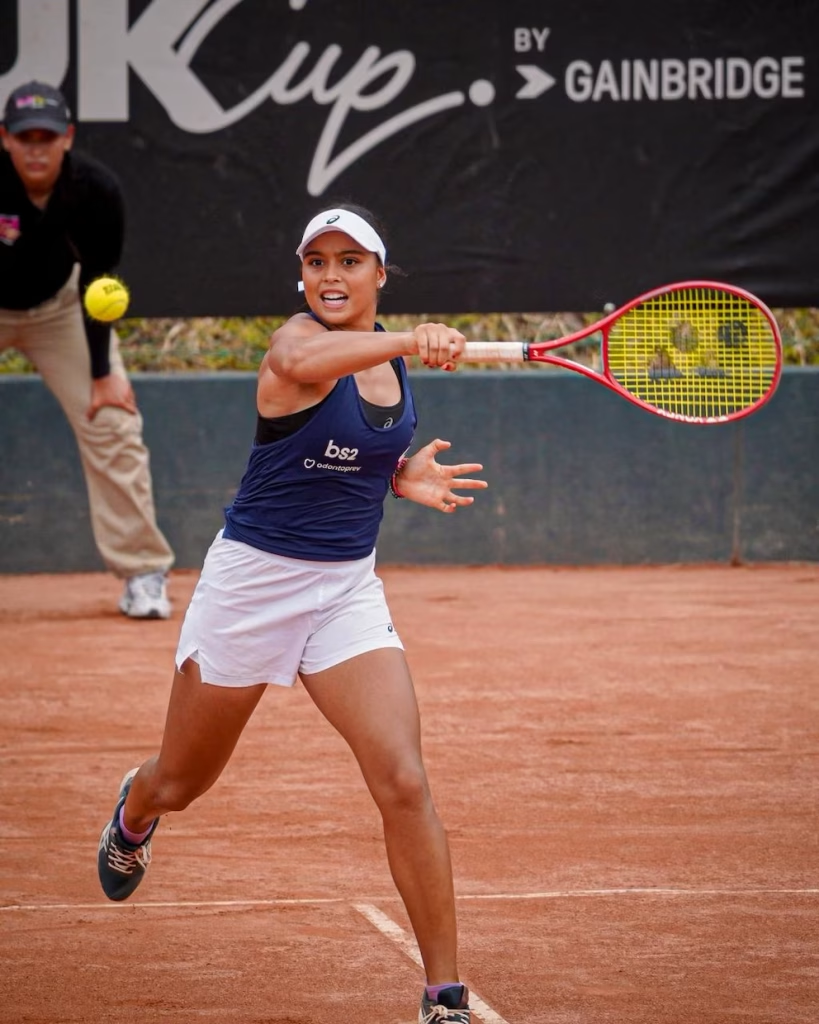
The broader significance lies in what this result says about women’s tennis in the region. The traditional hierarchy is becoming less predictable, younger players are accelerating the competitive cycle, and national teams can no longer rely on rankings alone to control ties. Argentina still has a path forward, but that path is narrower now and demands a cleaner, more composed response against Chile than the one it managed against Brazil.

What comes next is not just another group match. It is a test of resilience, tactical clarity, and emotional control in a format where a single bad sequence can alter the trajectory of an entire week. Argentina is still alive, but the margin for error is gone.
Behind every fact, there is an intention. Behind every silence, a structure.