

 Phoenix 24
Oil diplomacy redraws power lines faster than pipelines.
Caracas, February 2026.
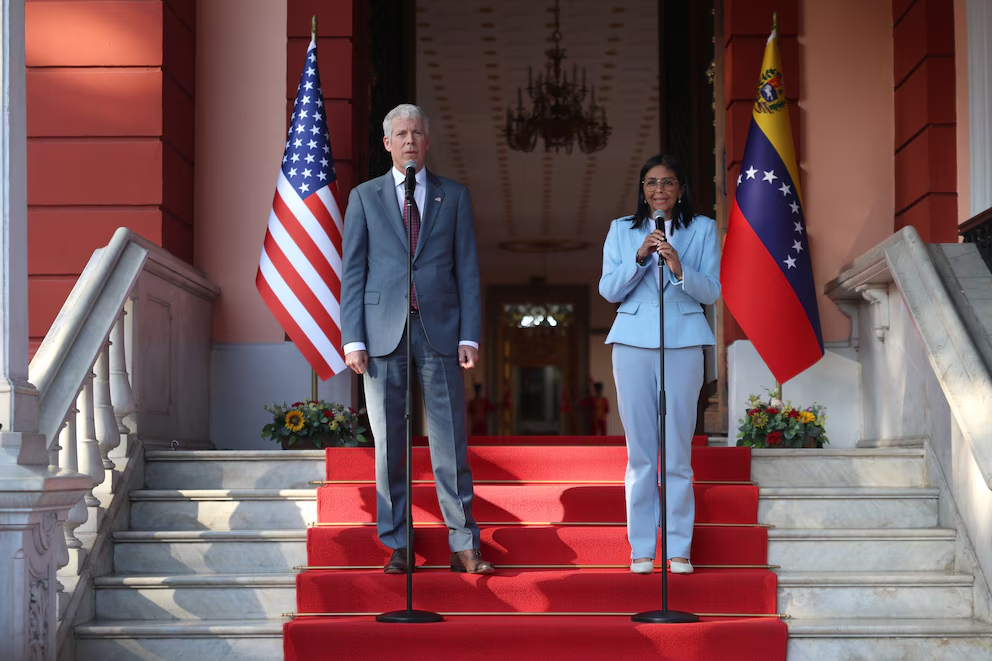
A senior U.S. cabinet visit to Venezuela would have been unthinkable a few years ago, which is why the language used in Caracas this week mattered as much as the trip itself. The U.S. Energy Secretary, Chris Wright, said the United States would push for a drastic increase in Venezuela’s production of oil, natural gas, and electricity after meeting with Venezuela’s acting leader Delcy Rodríguez. Both sides framed the encounter as a long term, practical partnership, not a symbolic thaw. In energy politics, that framing is never neutral, because it implies a new set of permissions, enforcement mechanisms, and beneficiaries.
Wright’s public message was built around prosperity rather than geopolitics, emphasizing jobs, higher wages, and a better quality of life for Venezuelans if production rises. At the same time, he explicitly carried a message from President Donald Trump that the administration wants to transform the bilateral relationship as part of a broader agenda for the Americas. That combination, social uplift plus hemispheric doctrine, is a familiar diplomatic pattern in resource states under stress. It signals that energy is being used as the primary interface for a wider reset, with industrial recovery serving as the narrative vehicle.
Rodríguez, speaking alongside Wright, described the outcome as a productive long term association that would allow an energy agenda to become the engine of the bilateral relationship. She said officials discussed projects not only in oil and gas but also in mining and electricity, and she presented this first visit as the opening of many more technical exchanges. She also invoked the historical depth of U.S. Venezuelan energy ties, arguing that politics has fluctuated while energy links have endured. That is an important claim because it attempts to normalize the new arrangement as continuity, not capitulation, even as the underlying power asymmetry is obvious.
The operational reality behind the rhetoric is that Venezuela’s energy sector is not a switch that can be flipped. Years of underinvestment, maintenance failures, and degraded power infrastructure have turned production into a systems problem, not merely a drilling problem. Heavy oil output depends on stable electricity, reliable upgrading capacity, functioning logistics, and access to specialized services and inputs that sanctions and financial restrictions can choke. Even when capital is available, timelines are stubborn because equipment replacement, field rehabilitation, and workforce rebuilding do not compress neatly into political slogans. That is why talk of a drastic increase functions as a strategic target, not a guaranteed near term outcome.
Still, Washington’s signal is not empty, because the United States can alter the constraint environment in ways that directly affect production. The Trump administration has moved to loosen certain restrictions and authorize broader categories of support, enabling U.S. companies to provide goods, technology, software, and services tied to oil and gas operations while keeping other limits in place. This is how modern sanctions strategy often evolves, from blanket pressure to calibrated licensing that shapes who can operate and under what conditions. In practice, licensing becomes a gate that converts geopolitical alignment into commercial opportunity. Once that gate opens, a recovery pathway becomes imaginable, even if it remains technically difficult.
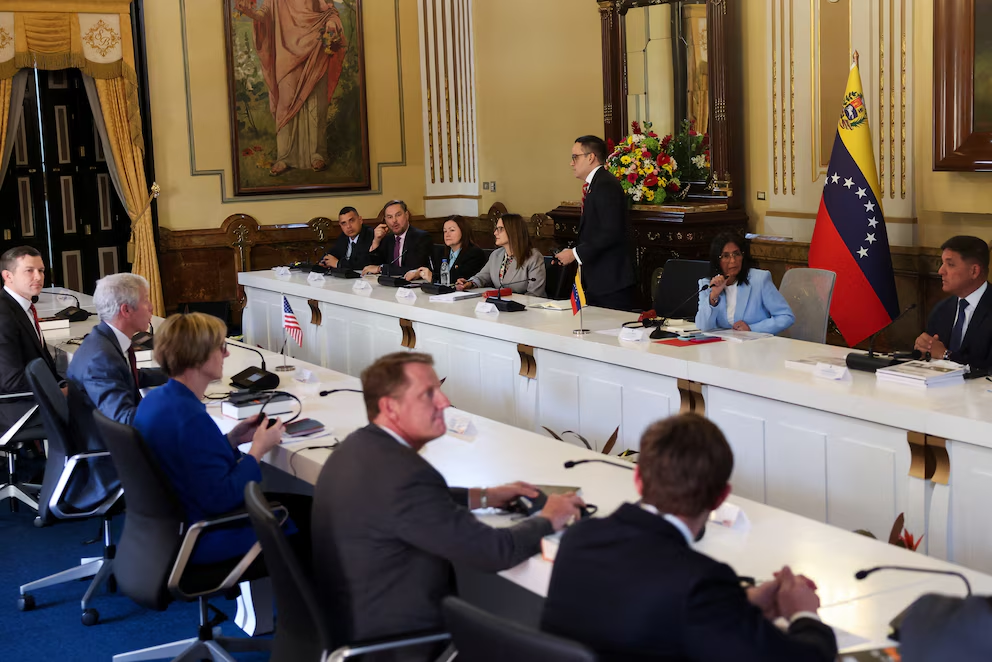
Caracas has also been working on the legal layer that investors demand before committing serious money. Recent reforms have been presented as an effort to attract private investment by changing long standing rules around state monopoly, production control, and dispute resolution. For international firms, the most sensitive issues are expropriation risk, contract enforceability, and the ability to repatriate value without triggering compliance violations. By foregrounding a long term association and rapid technical engagement, Rodríguez is signaling a willingness to provide a framework that foreign operators can defend. The strategic question is whether that framework will be stable enough to outlast the current political moment.
The international dimension matters because Venezuela’s isolation years expanded the role of non Western networks in trading, financing, and operational workaround practices. A deeper U.S. role is therefore not only about barrels, it is about influence over supply chains, service ecosystems, and export routes that connect the Americas to global markets. European stakeholders are part of that picture as well, with firms such as Spain’s Repsol positioned to benefit if conditions become permissive and projects become scalable. Meanwhile, broader geopolitical competition, including pressure strategies aimed at Russia, gives the United States an incentive to reshape Western Hemisphere supply dynamics even if the absolute volume increase is modest in global terms. In that sense, Venezuela becomes a geopolitical lever as much as an energy project.
The domestic Venezuelan risk is that energy revival can reproduce inequality if the rents are captured by narrow networks rather than translated into public goods. Every petro state carries the same dilemma: production growth can finance recovery, but it can also entrench patronage if governance remains weak. That is why Wright’s emphasis on wages and opportunity is not merely a talking point, it is a preemptive defense against the accusation of foreign extraction. The credibility of that defense will be measured less by speeches and more by whether electricity reliability improves, fuel shortages ease, and household conditions change in observable ways. If those improvements do not materialize, the partnership will be attacked as optics, and the political cost will rise for both sides.
The deeper structural lesson is that energy diplomacy is now acting as the scaffolding for political reintegration. Caracas is offering a partnership narrative that implies continuity and sovereignty, while Washington is offering a recovery narrative that implies conditional access and strategic alignment. The near term outcome will likely be incremental, technical, and bureaucratic, not cinematic. Yet the long term consequence could be profound: a reordering of who sets the terms for Venezuela’s reentry into regional markets, and who controls the institutional gates through which capital, technology, and legitimacy will flow. In energy politics, the barrels matter, but the architecture around the barrels determines the real winner.
Phoenix24: claridad en la zona gris. / Phoenix24: clarity in the grey zone.