

 Phoenix 24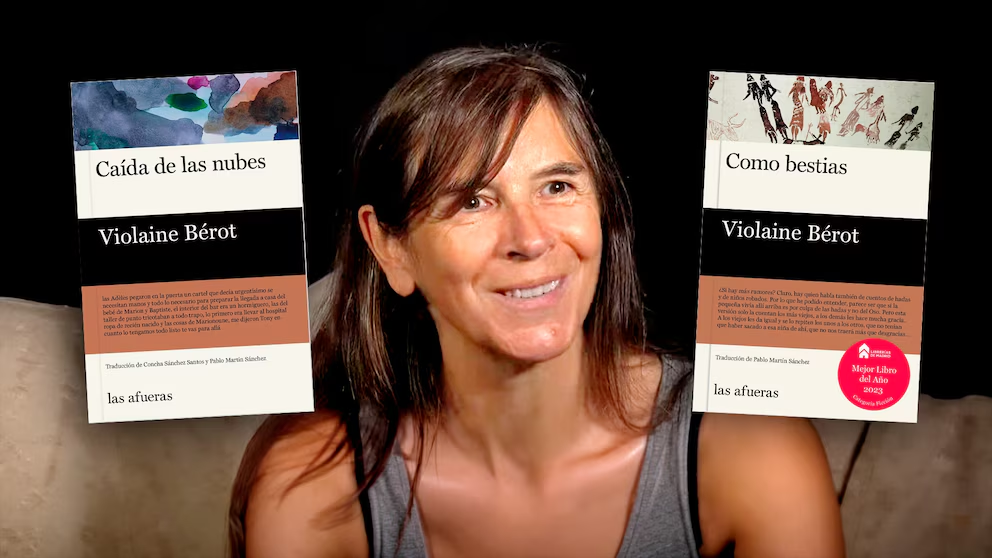
The mountain reshaped both her work and her fear.
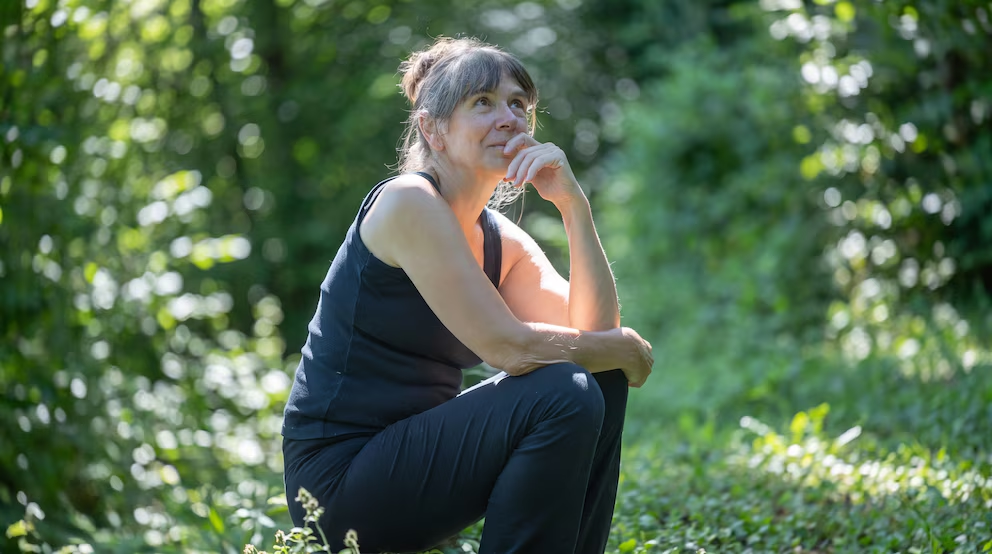
Buenos Aires, August 2026. French writer Violaine Bérot once worked as an artificial intelligence researcher before leaving technology and urban life for an isolated existence in the Pyrenees. She moved into a mountain valley without conventional comforts, raised goats and gradually transformed her experience of animals, solitude and human behavior into literature.
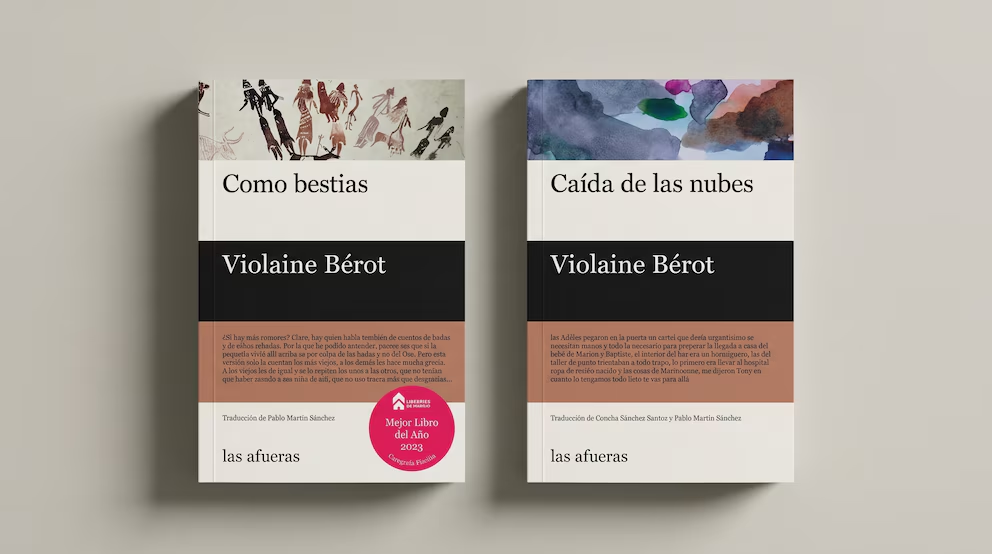
Bérot arrived in Buenos Aires to participate in the 2026 Feria de Editores, where she discussed writing, motherhood and the limits separating civilization from the natural world. Her appearance followed growing recognition in Argentina generated by translations of her novels and a theatrical adaptation of Comme des bêtes, published in Spanish as Como bestias.
Born in 1967 in Bagnères-de-Bigorre, Bérot studied philosophy and computer engineering before working in artificial intelligence. She later abandoned the professional structure of the technology sector and returned to the mountains. There, she learned to interpret weather, use available sunlight and assist animals during birth.
Her years raising goats became more than biographical background. They altered the way she understood labor, attention and the relationship between humans and other living beings. The responsibility never followed an office schedule because the animals remained present in her thoughts at every hour.
Bérot sees a parallel between animal care and writing. Both occupations can absorb an entire life, making it difficult to separate private time from professional responsibility. When she cared for goats, she was continuously thinking about them; now, she describes herself as continuously writing, even when she is not physically seated at a page.
The mountain also changed her understanding of fear. Although she lives alone in a remote forest, Bérot says she feels less afraid there than in a city. Wild animals, including boars, do not disturb her as much as the unpredictability she associates with human beings.
Her home is difficult to reach, accessible through a narrow and largely unknown path. The isolation that might appear threatening to an urban resident instead provides her with security. Distance from human concentration has become both a physical refuge and a central dimension of her literary imagination.
That imagination is visible in Como bestias, a novel about a girl raised by a man whom a mountain community considers monstrous. The villagers fear his difference even though he has not harmed them, while his unusual ability to care for animals complicates the boundary between presumed savagery and actual compassion. The story examines how communities create outsiders and attach danger to people they cannot easily classify.
The Argentine theatrical adaptation, developed by Claudia Piñeiro and Marcelo Moncarz, preserved the complete text of the novel at Bérot’s request. That condition treated the production not as a loose reinterpretation but as another vehicle for the rhythm and language of the original work. Its reception helped introduce the French writer to a wider Spanish-speaking audience.
Motherhood is another recurring concern in Bérot’s fiction. Her books present radically different maternal figures, including a woman who sacrifices her previous life for a child and another who appears unable or unwilling to love hers. Instead of resolving these contradictions through moral judgment, Bérot leaves readers with questions that remain open after the final page.
One of her translated works centers on a woman who gives birth without having known she was pregnant. The premise allows Bérot to explore the body as a territory capable of withholding knowledge even from the person who inhabits it. It also challenges familiar narratives in which motherhood automatically produces certainty, attachment or emotional fulfillment.
Her narrative structures can be as unconventional as her characters. One novel offers different paths through the text, allowing readers to proceed conventionally or follow numbered sequences connected to individual voices. Bérot initially wrote the material as an interwoven whole and only later reorganized it so that each character’s perspective could be read independently.
The idea developed after she met writer and translator Pablo Martín Sánchez during a residency in France. When she described her plan for multiple reading routes, he introduced her to Julio Cortázar’s Hopscotch. Bérot then reconstructed the manuscript so that both forms of reading would remain coherent.
Her work also reflects uncertainty surrounding contemporary fatherhood. Bérot observes that the traditional paternal model has lost authority for many people, while a widely accepted alternative has not fully emerged. Younger generations may encounter fathers who remain distant and conventional or others who participate much more directly in family life.
Despite having left artificial intelligence as a profession, Bérot continues to examine its cultural consequences. She rejects the idea that current systems possess intelligence in the human sense, describing them instead as mechanisms of logic and calculation. Their usefulness, in her view, depends on whether users preserve the ability to question their outputs.
Her concern is not limited to technical performance. Search engines increasingly present generated summaries as immediate answers, encouraging users to read a synthesized paragraph without examining its origin. The result can create an impression of certainty even when the authorship, evidence and reasoning behind the information remain unclear.
Bérot considers that apparent authority dangerous because it weakens the distance required for critical judgment. Artificial intelligence can be constructive when people treat its responses as material to evaluate rather than truth to accept. The danger emerges when convenience replaces verification and the machine’s confident language becomes indistinguishable from knowledge.
Her movement from artificial intelligence to an isolated mountain life does not represent a simple rejection of modernity. It reveals two different systems for interpreting the world: one built through computation and another formed through prolonged attention to bodies, animals, weather and silence. Both can produce information, but they demand very different relationships with uncertainty.
Bérot’s fiction occupies the space between those systems. It examines characters who resist classification, bodies that conceal their own transformations and communities that fear what they cannot domesticate. Her mountain is not an escape from human questions, but a place from which those questions become more visible.
La verdad es estructura, no ruido. / Truth is structure, not noise.