

 Phoenix 24
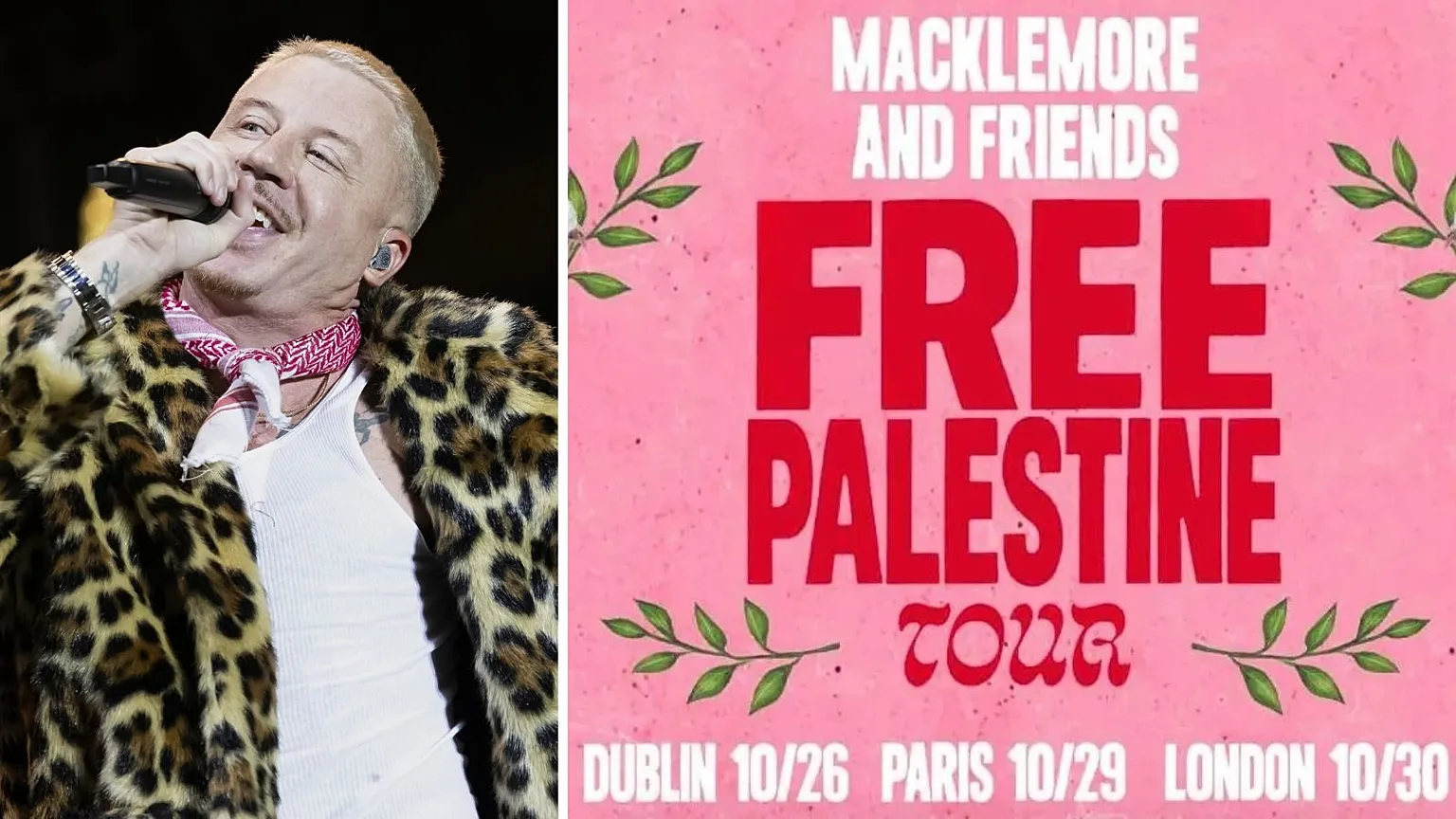
Music, humanitarian solidarity and freedom of expression converge onstage.
DUBLIN, IRELAND.
American rapper Macklemore launched his Free Palestine European tour with a sold-out concert at Dublin’s 3Arena on Monday evening, bringing together approximately 13,000 spectators and a lineup of international musicians in support of Palestinians affected by the war in Gaza. The performance followed his removal from Ed Sheeran’s North American tour after publicly expressing solidarity with Palestinians, turning the opening concert into a wider discussion about artistic expression, political controversy and humanitarian responsibility.
The Grammy-winning musician, whose real name is Benjamin Haggerty, organized the European performances shortly after his departure from Sheeran’s Loop Tour in September. What began as an unexpected interruption to his touring schedule developed into a three-city initiative combining live entertainment with fundraising for humanitarian organizations and groups supporting Palestinian communities.
The Dublin concert featured appearances by Irish singer-songwriter Hozier, Belfast hip-hop group Kneecap and folk ensemble Beoga. Palestinian singer Lina Makhoul and Palestinian American DJ Habibeats also participated, bringing together artists whose musical backgrounds and experiences differ considerably. Actor Liam Cunningham appeared during the event, while Mark Ruffalo delivered a video message emphasizing equality as a necessary condition for peace.
Throughout the evening, Macklemore addressed the audience about the humanitarian situation in Gaza and his decision to continue speaking publicly about the conflict. Carrying a Palestinian flag during portions of his performance, he described the concert as an expression of solidarity with people affected by violence and displacement. His remarks reflected a commitment to advocacy extending beyond his professional activities as a recording artist.
The controversy preceding the tour began during a performance at MetLife Stadium in New Jersey, when Macklemore voiced support for Palestinian freedom and characterized Israel’s military campaign in Gaza as genocide. His statements attracted criticism and prompted concerns among concert venues associated with Sheeran’s remaining American dates.
Tour promoter Messina Touring Group subsequently announced that venues had indicated they would not host shows featuring Macklemore. Sheeran later stated that the decision to remove the rapper had not been his, complicating initial interpretations that he had personally dismissed the performer because of his political views.
The distinction matters because responsibility for major concert productions is distributed among artists, promoters, venue operators and commercial partners. Decisions concerning performers can involve contractual arrangements, venue policies and operational considerations. The publicly reported circumstances establish that Macklemore was removed following the controversy, although they do not independently resolve every contractual or organizational decision behind the cancellation.
The incident generated considerable debate among musicians and audiences. Some viewed his removal as an unacceptable response to political expression, while others questioned how concert organizers should manage controversial statements made during commercial performances. The disagreement reflects broader tensions surrounding artistic independence and the expectations placed on performers appearing before large international audiences.
Macklemore responded by announcing a series of concerts dedicated to Palestinian solidarity. The European itinerary began in Dublin on October 26 and continues at the Accor Arena in Paris on October 29, followed by London’s OVO Arena Wembley on October 30. Organizers have also indicated that additional performances, including potential dates in the United States, may be announced.
The initiative has a defined humanitarian component. Organizers have pledged that proceeds from the performances will benefit organizations providing medical assistance, emergency relief, education, community support and advocacy connected to Palestinian communities. Beneficiaries include Anera, Gaza Soup Kitchen, HEAL Palestine, Medical Aid for Palestinians, the Palestine Children’s Relief Fund, Taawon and UNRWA USA, alongside several other groups.
These organizations operate across different areas of humanitarian assistance and civil society activity. Some focus on medical treatment, food distribution and emergency support, while others work on education, community development or public advocacy. The tour’s fundraising model therefore combines immediate relief objectives with broader forms of institutional and social assistance.
The amount ultimately distributed will depend on the financial results of the concerts and the accounting arrangements governing proceeds. Announcing charitable beneficiaries demonstrates the intended destination of the funds, but it should not be confused with independently verified disbursements or completed humanitarian outcomes.
Ireland provided a particularly significant setting for the opening performance. Public expressions of solidarity with Palestinians have featured prominently in Irish cultural and political life, including within the country’s music community. The participation of Hozier, Kneecap and Beoga reflected an existing tradition of artists engaging publicly with international humanitarian and political issues.
For Macklemore, the event also represents a continuation of activism that has become increasingly visible in his music. His 2024 release Hind’s Hall addressed student demonstrations supporting Palestinians and criticized US policy toward Israel. Subsequent recordings and public appearances reinforced his willingness to engage directly with the conflict, even when doing so generated commercial and reputational controversy.
The humanitarian context remains central to understanding the initiative. Israel launched its military campaign in Gaza following the Hamas-led attacks of October 7, 2023, in which approximately 1,200 people were killed in Israel and 251 were taken hostage. The subsequent war has caused extensive destruction and a substantial civilian death toll in Gaza, intensifying international demands for humanitarian protection and accountability.
Gaza’s health authorities have reported more than 73,000 deaths since the beginning of the Israeli military campaign, according to figures cited in recent reporting. International humanitarian organizations and United Nations bodies have documented severe consequences for civilians, including widespread displacement, damaged healthcare infrastructure and prolonged restrictions affecting access to essential services.
The legal characterization of Israel’s actions remains contested. Organizations including Amnesty International and Human Rights Watch, along with a United Nations commission of inquiry, have concluded that Israeli conduct in Gaza constitutes genocide. Israel rejects those accusations. The existence of these findings and denials should be distinguished from a final judicial determination of responsibility in the proceedings before international courts.
Within that environment, artists who publicly address the conflict frequently encounter polarized responses. Supporters regard cultural platforms as legitimate spaces for humanitarian advocacy, while critics question whether particular statements adequately acknowledge the experiences and security concerns of all communities affected by the violence.
Macklemore’s concert does not resolve those disagreements. It demonstrates, however, how musicians can use their audiences, professional networks and commercial visibility to influence public discussion and mobilize resources. The involvement of multiple performers also shows how an individual controversy can develop into a collaborative cultural initiative with international reach.
The tour’s significance extends beyond the immediate relationship between Macklemore and Sheeran’s concert organizers. It raises questions about the boundaries of artistic expression within commercial entertainment, the influence of venue operators over public performances and the ability of musicians to respond independently when professional opportunities are withdrawn.
For the entertainment industry, these questions are becoming increasingly relevant as political and humanitarian conflicts circulate rapidly through social media and international fan communities. Artists operate within commercial structures that depend on sponsorships, venue partnerships and audience relationships, yet their public identities may also be shaped by social commitments that do not align neatly with those interests.
The Dublin performance offered a practical demonstration of that tension. Macklemore’s removal from one touring arrangement was followed by the creation of another, organized around a cause he considers central to his public responsibilities. Whether the initiative achieves substantial fundraising results will depend on its financial execution, but the opening concert has already established an alternative platform for his message.
As the tour moves to Paris and London, its development will be measured not only by audience participation but also by the assistance delivered through the organizations designated to receive its proceeds. The distinction between public solidarity and measurable humanitarian impact remains important, particularly when cultural events explicitly present charitable objectives.
Macklemore’s opening night in Dublin illustrates how contemporary music can function simultaneously as entertainment, public expression and a mechanism for collective action. The controversy that preceded the tour has not disappeared, but it has been transformed into an international series of performances whose significance reaches beyond the concert stage.
Behind Every Fact, a Deeper Story.