

 Phoenix 24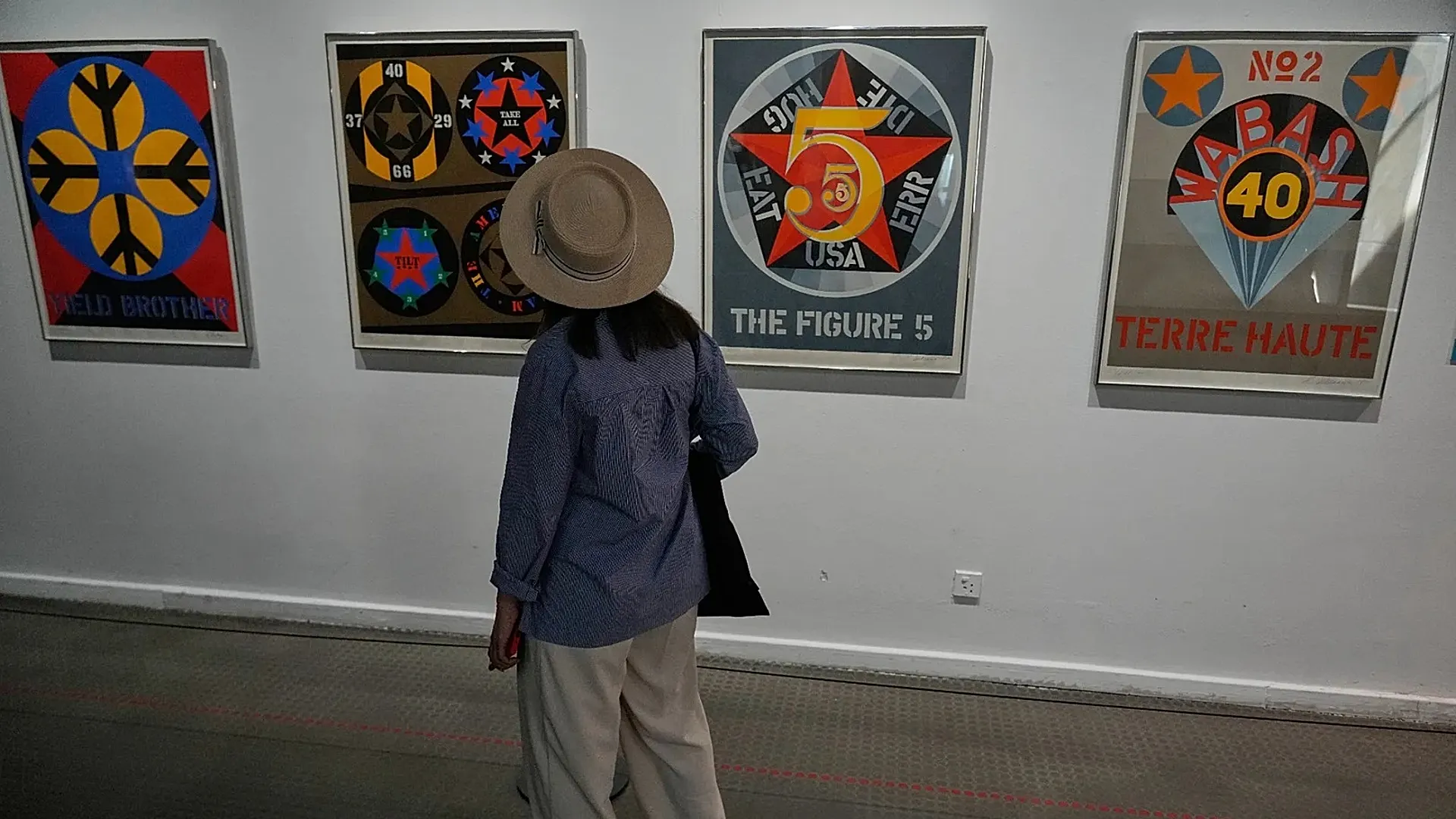
Art reopened where politics could not breathe.
Tehran, May 2026. An anti-war exhibition featuring American artists has opened in Tehran at a moment when the city’s streets remain marked by anti-U.S. imagery and the region continues to absorb the shock of confrontation. The exhibition, titled Art and War, brings works by Roy Lichtenstein, Robert Indiana and James Rosenquist into public view inside one of Iran’s main museums. Its power lies in the contradiction: American art is being used in Iran not as cultural surrender, but as a language of resistance against war itself.
The works come from Iran’s major collection of modern American and European art, acquired in the 1970s under Farah Pahlavi, wife of the last shah. After the 1979 Islamic Revolution, much of that collection remained hidden from public life for decades, caught between artistic value, ideological suspicion and the political burden of appearing too close to Western cultural codes. That history makes the current exhibition more than a museum event. It is a controlled return of buried memory.
The selected works are not decorative gestures. Rosenquist’s F-111 confronts the viewer with the machinery of the U.S. military-industrial complex through the image of a warplane, a nuclear mushroom cloud and a child’s face. Lichtenstein’s Brattata transforms aerial combat into a comic-style explosion, making violence appear absurd without making it harmless. These pieces were born from the American pop art movement of the 1960s, but in Tehran they now operate inside a very different emotional climate.
That displacement gives the exhibition its force. What once criticized American militarism from inside the United States is now being read by Iranian audiences under the pressure of war, uncertainty and national vulnerability. The art does not erase political hostility between Washington and Tehran. Instead, it reveals a more uncomfortable truth: societies can recognize the brutality of war even when their governments remain trapped in confrontation.
The museum’s decision also reflects the fragile reopening of Iranian cultural life after weeks of conflict. During the war, museums and other cultural activities were closed, turning public space into a geography of suspension. Since the ceasefire, institutions have begun reopening, but with caution. The number of works on display has reportedly been kept limited so they can be moved quickly to secure storage if violence resumes.
That operational detail says almost everything. Even art is being exhibited under emergency logic. A painting or print is no longer only an object of contemplation; it becomes something to protect, evacuate and preserve amid the possibility of renewed escalation. The museum is not simply presenting culture. It is managing cultural survival under conditions of political volatility.
For younger visitors, the exhibition appears to offer something beyond aesthetic experience. It creates a temporary space where war can be examined without being reduced to official slogans, military communiqués or nationalist reflexes. In a city surrounded by propaganda and pressure, the gallery becomes a quieter form of public intelligence. It allows viewers to think about violence through images rather than commands.
The irony is profound. American artists, long stored away in post-revolutionary Iran, are now helping Iranian audiences process the cost of war. That does not soften the conflict, nor does it turn culture into diplomacy by default. But it shows that art can survive ideological rupture and return when language has become too militarized to carry human meaning. In Tehran, the museum has reopened a vault. What emerged was not only a collection, but a reminder that even adversarial histories contain tools against destruction.
Contra la propaganda, memoria. / Against propaganda, memory.