

 Phoenix 24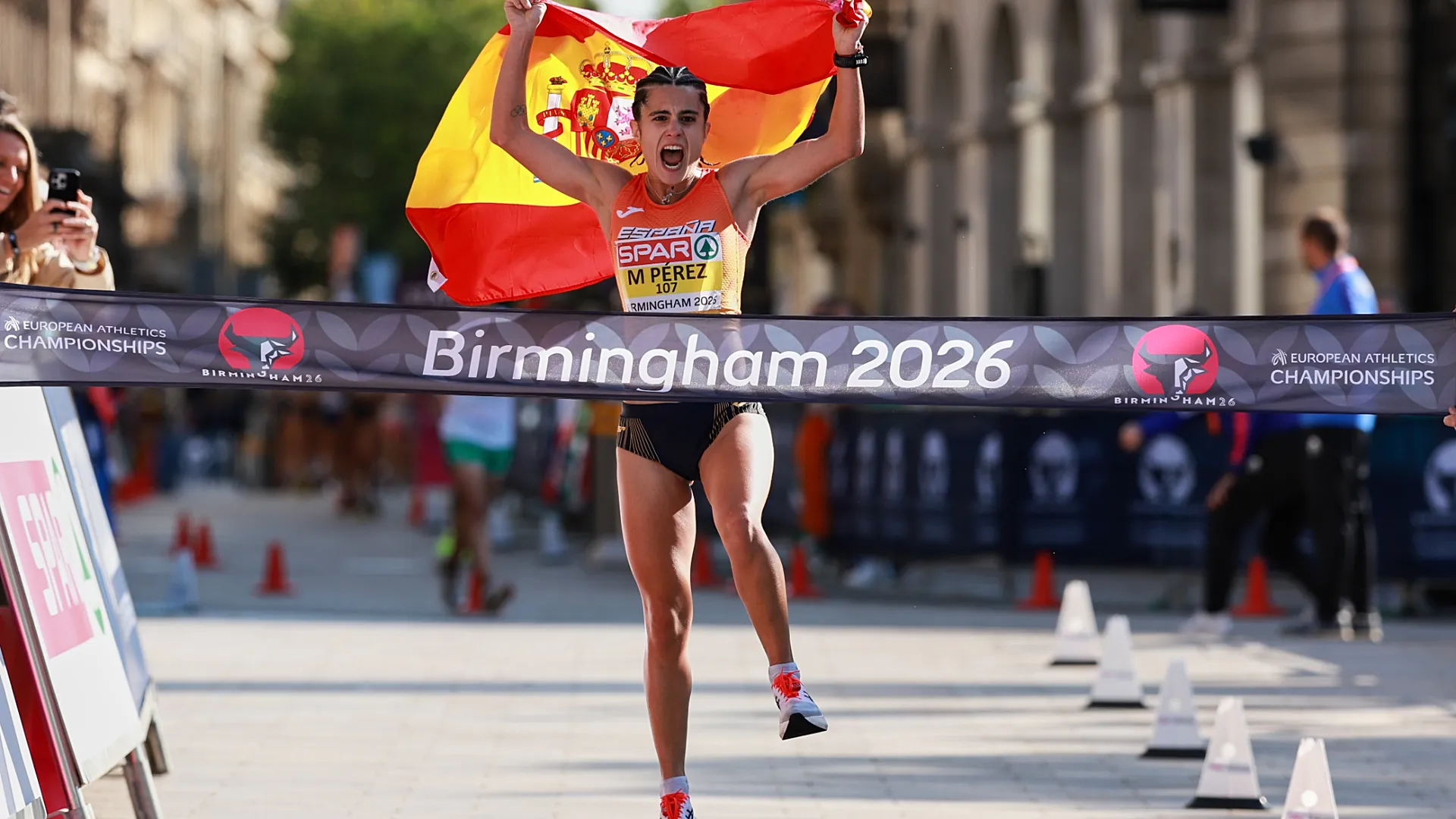
Endurance became Spain’s strongest route to the podium.
Birmingham, August 2026
Spain concluded the European Athletics Championships in Birmingham with seven medals, led by an exceptional display in the race walking events. The national delegation collected two golds, two silvers and three bronzes, combining individual brilliance with a decisive team performance. María Pérez and Paul McGrath delivered both Spanish victories, while the country’s endurance specialists accounted for most of the final medal total. Birmingham confirmed that Spain remains one of Europe’s most technically accomplished nations in events where rhythm, discipline and tactical patience determine the result.
Pérez produced the most significant performance of the Spanish campaign by winning the women’s half-marathon race walk in 1 hour, 30 minutes and 6 seconds. Her time established a new world record for the recently introduced distance, improving the official standard required by World Athletics. The athlete from Granada controlled the competition alongside Italy’s Antonella Palmisano before accelerating around the 11-kilometer mark. Once the decisive separation occurred, none of her rivals could match the pace that carried her to another continental title.
The victory returned Pérez to the top of the European podium eight years after her first continental championship in Berlin in 2018. It also extended a remarkable sequence of major international successes that has consolidated her position among the most accomplished race walkers of her generation. Her Birmingham performance combined tactical control with the physical confidence to attack before the final stage of the race. The world record transformed an already important gold medal into one of the defining achievements of the championships.
Paul McGrath secured Spain’s second gold in the men’s half-marathon race walk after finishing second at the previous European Championships in Rome. He remained with the leading group before launching an aggressive move shortly before the tenth kilometer. Germany’s Leo Köpp initially followed the attack but was later disqualified, leaving McGrath alone at the front. The Spaniard built a margin of approximately 30 seconds and resisted a late Italian pursuit to cross the finish line 13 seconds ahead of his closest challenger.
McGrath’s triumph represented his third consecutive summer with a medal at a major European or global competition. More importantly, it demonstrated his transition from a promising contender into an athlete capable of controlling a championship final. His acceleration changed the shape of the race, forcing the remaining competitors to abandon their preferred strategies and begin an early pursuit. Spain’s two gold medals therefore emerged from similar qualities: disciplined positioning, precise timing and the willingness to break away before the final kilometers.
Miguel Ángel López added a silver medal in the men’s marathon race walk while establishing a Spanish record of 2 hours, 56 minutes and 57 seconds. He recovered substantial ground during the second half of the race and caught Hungary’s Bence Venyercsán around the 26-kilometer mark. Italy’s Massimo Stano ultimately launched the decisive attack and defeated López by only eight seconds. Even without the title, the performance gave the Spaniard his third European medal following the golds he won in 2014 and 2022.
Raquel González completed Spain’s individual race walking success with bronze in the women’s marathon distance. Competing at her fifth European Championships, she moved steadily from fifth place into the medal positions and reached third around the 24-kilometer mark. Her ability to maintain pace while others began to weaken allowed her to defend the position through the demanding final stage. The result added another medal to Spain’s long tradition in an event that rewards technical consistency as much as physical endurance.
Beyond race walking, Marta García earned silver in the women’s 5,000 meters, while Mohamed Attaoui secured bronze in the men’s 800 meters. Spain’s women also captured the team bronze in the marathon through the combined performances of Carolina Robles, Fátima Azzaharaa Ouhaddou, Ester Navarrete and Meritxell Soler. Their collective time placed Spain behind Great Britain and Italy on a demanding urban course through central Birmingham. That final podium completed the national total of seven medals and widened the achievement beyond individual victories.
Several Spanish athletes also finished close to the podium or improved their personal marks, reinforcing the depth beneath the medal-winning group. Álvaro López and Diego García Carrera placed among the leading finalists in the race walking program, while Daniel Chamosa, José Manuel Pérez, Aldara Meilán, Lucía Redondo and Laura Monje produced competitive performances. Those results did not alter the medal table, but they showed that Spain’s strength is not concentrated exclusively in two or three established champions. A broader generation is gaining experience in events that have historically delivered international success for the country.
Birmingham ultimately offered Spain more than a respectable medal count. The championships revealed a coherent sporting identity built around endurance, technical preparation and the capacity to remain composed over long distances. Pérez’s world record supplied the historic moment, McGrath’s breakthrough delivered confirmation of a rising champion and the remaining medals demonstrated institutional continuity. Spain did not dominate every discipline, but wherever the contest demanded patience and precision, its athletes became difficult to displace.
Hechos que no se doblan. / Facts that do not bend.