

 Phoenix 24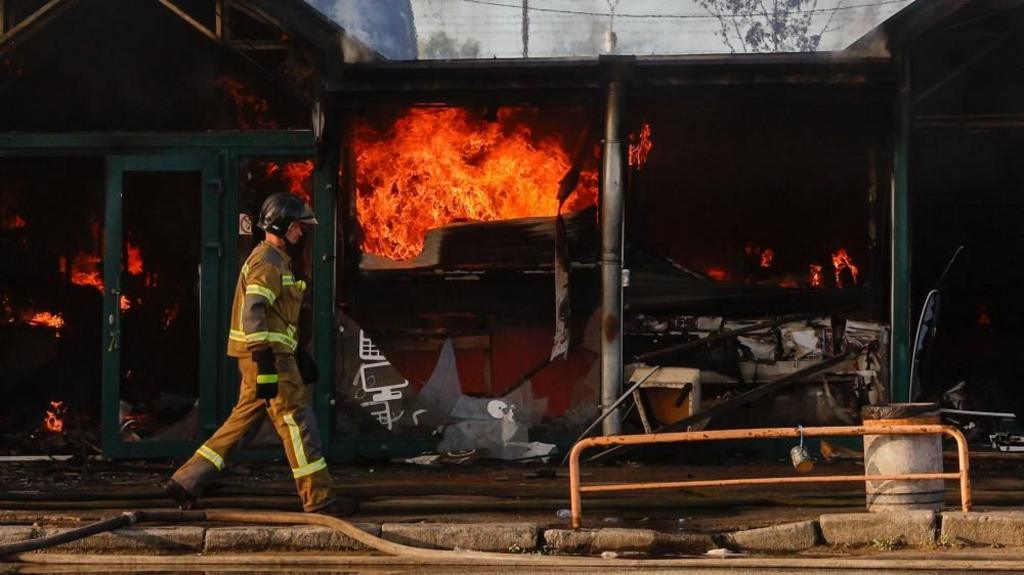
Long-range warfare is overtaking the frozen front.
Kyiv, August 2026
Russia and Ukraine exchanged one of the most intense overnight waves of missiles and drones in recent months, leaving at least 12 people dead across both countries. The attacks struck industrial facilities, residential areas, energy infrastructure and commercial sites far from the main battlefield. As territorial movement along the front line slows, both militaries are increasingly attempting to weaken the other side through deep strikes. The result is a conflict whose destructive reach continues expanding beyond conventional combat zones.
In Ukraine, two people were killed when Russian forces struck a major steel plant in Kryvyi Rih, one of the country’s largest industrial complexes and a critical part of its wartime economy. Russia said its operation targeted military and industrial facilities connected to the production of Ukrainian missiles, while local authorities reported extensive damage and at least 14 injuries. Two additional deaths were recorded in the Zaporizhzhia region, and another person was killed in Sumy. The overnight assault also reached Kyiv, where several areas suffered damage and emergency crews responded to fires.
A missile strike in the Ukrainian capital hit a historic and heavily frequented book market, igniting a large blaze and destroying part of a space associated with the city’s cultural life. The attack illustrated how the boundaries between military infrastructure, civilian commerce and symbolic urban locations are becoming increasingly blurred. Ukrainian President Volodymyr Zelenskyy condemned the offensive and said Russia had launched more than 1,500 drones against Ukraine during the previous week. The scale of those operations is placing sustained pressure on Ukrainian air defenses, emergency services and civilian populations.
Ukraine simultaneously launched hundreds of drones into Russian territory in what was described as one of its largest aerial offensives since Moscow began its full-scale invasion in 2022. Russian authorities reported five deaths in the southern Rostov region, where approximately 150 drones were reportedly directed against multiple targets. Two additional fatalities were registered in the Moscow and Belgorod regions. Ukraine said the operation was aimed at military factories, energy infrastructure and logistical facilities supporting Russian forces.
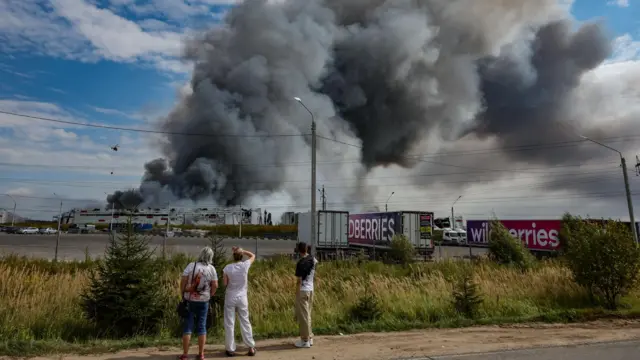
Among the affected sites was a Wildberries distribution warehouse in Podolsk, south of Moscow, where a drone strike triggered a major fire. Ukrainian forces have accused the Russian electronic commerce company’s logistical network of contributing to military supply operations, an allegation that broadens the category of infrastructure Kyiv considers strategically relevant. The destruction of commercial warehouses reflects the growing importance of transportation, storage and distribution systems within modern warfare. Supply chains have become military targets because they can sustain both civilian markets and battlefield operations.
Russia’s Defense Ministry claimed that its forces intercepted 822 Ukrainian drones, including approximately 600 believed to have been directed toward Moscow. That figure has not been independently confirmed, but it indicates the enormous scale of the attack described by Russian authorities. Operations around the capital disrupted aviation and forced security systems to respond across a wide geographical area. Ukraine’s ability to send large numbers of domestically produced drones deep inside Russia is steadily reducing the sense of distance that once protected major Russian cities from the war.
The exchange also reveals a shift in the strategic balance of the conflict. Russia retains the capacity to deploy large combinations of ballistic missiles, cruise missiles and drones against Ukrainian cities, industrial plants and energy networks. Ukraine, meanwhile, is compensating for its limitations in traditional aviation and long-range weaponry by expanding an increasingly sophisticated drone arsenal. Both sides are now using volume, range and technological adaptation to exhaust air defenses and impose economic costs beyond the battlefield.
The expanding drone war creates dangers that reach outside Russia and Ukraine. Unmanned aircraft associated with attacks near Ukraine’s western and southern borders have repeatedly approached or entered the airspace of neighboring European countries. Each incursion raises the possibility of miscalculation, accidental confrontation or a wider NATO response. The conflict is no longer contained solely by geography when weapons can cross borders, disrupt civilian aviation and force allied aircraft into defensive operations.
Diplomatic negotiations remain stalled while long-range attacks continue to intensify. Neither side appears prepared to abandon the strategy of striking industrial capacity, logistical networks and urban infrastructure behind the front. These operations may weaken military production and complicate supply systems, but they also expose civilians to fires, debris, displacement and psychological pressure. The death toll from a single night therefore represents more than another wartime statistic: it reflects the normalization of an aerial battlefield extending across two vast countries.
The visible stalemate on the ground should not be confused with a reduction in the war’s intensity. The conflict is changing its architecture, moving from territorial advances toward continuous technological attrition conducted through missiles, drones and attacks on interconnected systems. Distance no longer provides the same protection, while civilian and military infrastructure increasingly occupy the same strategic map. Every new exchange deepens the possibility that escalation will travel faster than diplomacy.
Más allá de la noticia, el patrón. / Beyond the news, the pattern.