

 Phoenix 24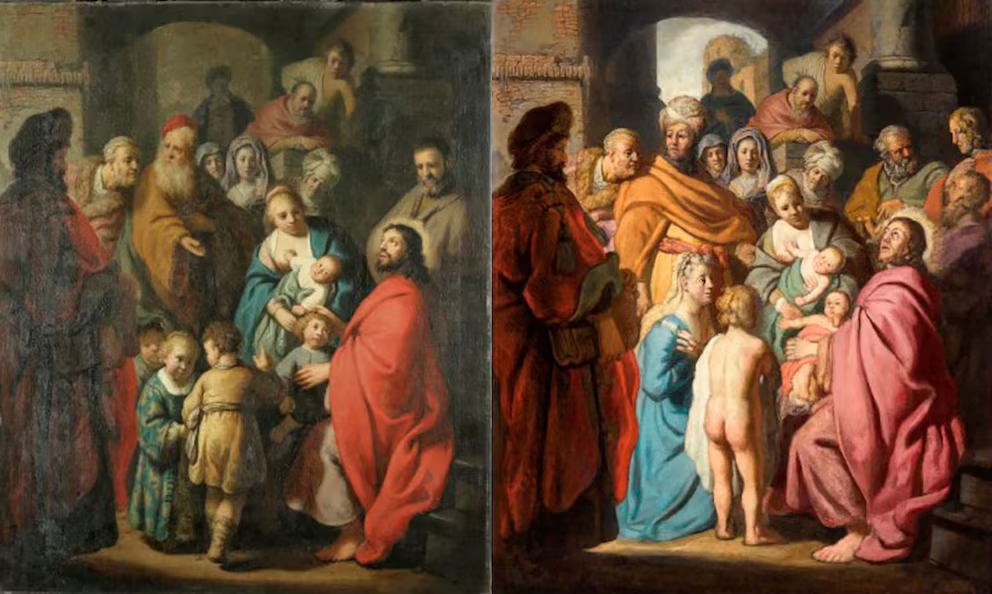
A decade of research uncovered the artist, his parents and a transformed message of religious tolerance beneath later layers of paint.
London, June 2026
A major early painting by Rembrandt has emerged from years of restoration with a more personal and politically resonant identity than experts initially understood. Let the Little Children Come Unto Me, a biblical scene depicting Christ welcoming children, was once catalogued simply as a seventeenth-century Dutch work and offered at a German auction with an estimate of about 20,000 euros. After extensive technical examination and the removal of later additions, specialists confirmed that the upper and central sections were painted by the young Rembrandt around 1627. The work will now be offered by Sotheby’s in London on July 1 with an estimated value of between eight and twelve million pounds.
The painting attracted attention in 2014 when Dutch art dealer Jan Six recognized characteristics associated with Rembrandt despite the uneven quality visible across the canvas. Some passages displayed sophisticated handling of faces, light and expression, while the lower portion appeared comparatively crude and conventional. Scholars eventually concluded that Rembrandt had left the ambitious composition unfinished and that another painter completed or altered it within the following decades. Restoration carried out between 2020 and 2026 progressively removed those later interventions, revealing the young master’s original decisions more clearly.
One of the most striking discoveries was that Rembrandt inserted members of his own family into the crowded biblical scene. Researchers identified the artist as a young man leaning forward near the top of the composition and looking directly toward the viewer. His mother and father are also believed to appear among the gathered figures, while other individuals may represent his godparents and godsister. Specialists now describe the painting as possibly the most complete visual gathering of Rembrandt’s family known to survive.
The family references give the work an unusually intimate quality for a large religious composition. Rembrandt had recently returned to Leiden after studying with the prominent Amsterdam painter Pieter Lastman, and he was still attempting to establish his professional reputation. One interpretation suggests that the ambitious canvas may have served as a demonstration of what he had learned and what his parents’ investment in his artistic training had made possible. By placing himself and his relatives inside the sacred narrative, he may have transformed a biblical commission into both a declaration of ability and a personal tribute.
The restoration also revealed a major change made by the unidentified painter who later completed the work. Rembrandt had originally depicted a tall, dark-skinned man with a black beard and a turban near the center of the scene. The later intervention replaced him with a lighter-skinned figure wearing a traditional Dutch cap, substantially changing the appearance and possible meaning of the composition. Conservators also discovered that a naked child painted by Rembrandt had subsequently been given clothing, softening the vulnerability present in the original design.
The rediscovered turbaned figure has prompted renewed discussion about religious diversity and tolerance in Rembrandt’s work. His original crowd appears to include people associated with Jewish, Christian and possibly Muslim traditions, creating a broader image of families approaching Christ. The biblical subject itself concerns inclusion, as Jesus rebukes his disciples for preventing parents from bringing their children to him. Restoring the diverse figure therefore returns a dimension of the narrative that had been obscured by a later, more conventional interpretation.
The historical setting strengthens that reading because Leiden was experiencing significant religious tension and demographic change when Rembrandt began the painting. The Thirty Years’ War was generating large refugee movements across Europe, and thousands of displaced people arrived in the Dutch Republic seeking security and economic opportunity. Leiden alone absorbed a substantial influx of refugees, provoking both humanitarian responses and hostility among parts of the local population. Against that background, a scene showing Christ receiving children and families from different communities may have carried contemporary social meaning.
Art historian Andrew Graham-Dixon has argued that the work reflects Rembrandt’s sympathy for vulnerable people and his connection with movements advocating religious tolerance. The painter came from a family with mixed confessional roots, with a Protestant father and a mother associated with Catholic tradition. He also lived in a society where theological divisions could shape political power, public behavior and personal identity. The diversity of the original figures may therefore represent more than visual variety, suggesting a moral position centered on compassion and inclusion.
The painting’s unfinished condition remains one of its greatest mysteries. Rembrandt appears to have advanced much of the composition before abruptly abandoning it, leaving certain areas unresolved despite the scale of the undertaking. No document explains why he stopped, although experts have suggested that another commission, financial pressure or changing professional circumstances may have interrupted the project. The canvas now preserves an unusual moment in which the artist’s creative process appears suspended rather than fully resolved.
That incompleteness also allows viewers to distinguish more clearly between Rembrandt’s hand and the later painter’s additions. The restoration exposed variations in brushwork, modeling and psychological intensity that had previously been concealed beneath overpainting. Rembrandt’s figures possess greater individuality and emotional complexity, while the subsequent completion simplified parts of the scene and made the composition more conventional. The contrast offers valuable evidence of how later generations sometimes altered unfinished works to satisfy changing expectations.
The work measures approximately 106 by 80.5 centimeters and is considered one of the most important early Rembrandts remaining in private ownership. Its reappearance provides collectors with a rare opportunity to acquire a painting connected not only to the artist’s youth but also to his personal history and developing moral imagination. The valuation reflects both its revised attribution and the exceptional discoveries produced through restoration. A painting once overlooked as an anonymous Dutch work has been transformed into a major object of scholarly and commercial attention.
Its path from obscurity to international auction also illustrates how attribution can change the economic life of an artwork. The original low estimate reflected uncertainty, visible damage and the assumption that the painting belonged to a broader seventeenth-century school. Once specialists identified Rembrandt’s hand and reconstructed the canvas’s history, its market value increased dramatically. Restoration did not create the artistic importance, but it allowed that importance to become visible again.
The family portraits may prove especially compelling to bidders because they connect the historical master with the ordinary relationships that shaped his early life. Rembrandt is frequently remembered through monumental self-portraits, biblical dramas and images of Amsterdam’s elite, yet this painting presents him as a young artist still seeking recognition from those closest to him. His direct gaze toward the viewer adds a self-conscious element, as though he wanted his presence inside the composition to be discovered. The hidden family becomes both part of the sacred crowd and part of the artist’s argument for his own future.
The restored canvas now carries several intertwined narratives: a biblical lesson about welcoming children, a possible statement about religious tolerance, an unfinished experiment by an ambitious young painter and a concealed family portrait. Later alterations attempted to regularize that complexity, but conservation has returned much of the original tension and diversity. The painting’s forthcoming sale will determine its monetary value, while its historical significance has already been transformed by what the restoration uncovered. What appeared to be an incomplete religious scene now functions as one of the most personal surviving documents of Rembrandt’s early career.
La restauración no solo recuperó una pintura, sino también a la familia, las ideas y la voz de un joven maestro. / The restoration recovered not only a painting, but also the family, ideas and voice of a young master.