

 Phoenix 24
The filmmaker argues that cinema advances only when artists and studios accept uncertainty instead of repeating formulas already proven successful.
Los Angeles, June 2026
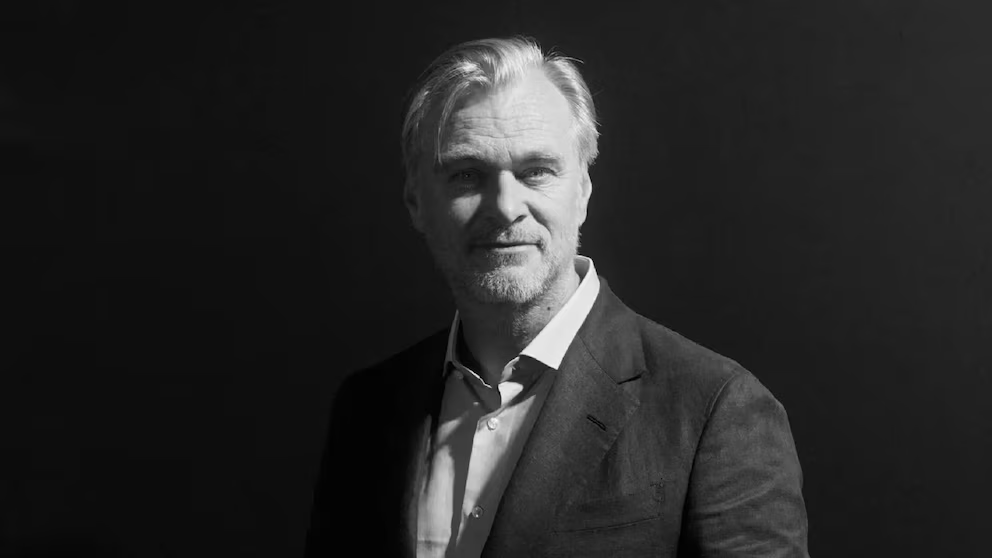
Christopher Nolan has defended creative risk as an essential condition for meaningful filmmaking while preparing for the release of The Odyssey, his ambitious adaptation of Homer’s ancient Greek epic. The director argued that anyone genuinely committed to cinema must be willing to make decisions that can fail, because artistic success rarely emerges from absolute safety. His comments reflect a career built around large-scale productions that combine commercial spectacle with complex narrative structures. They also arrive as the film industry increasingly depends on franchises, recognizable intellectual property and carefully tested formulas designed to reduce financial uncertainty.
For Nolan, risk does not mean abandoning discipline or treating production decisions recklessly. It means committing resources, time and personal credibility to an idea whose results cannot be guaranteed in advance. A filmmaker may use experienced collaborators, advanced technology and extensive preparation, yet the central creative decision must still involve uncertainty. Without that element, he suggests, movies become exercises in repetition rather than attempts to discover something new.
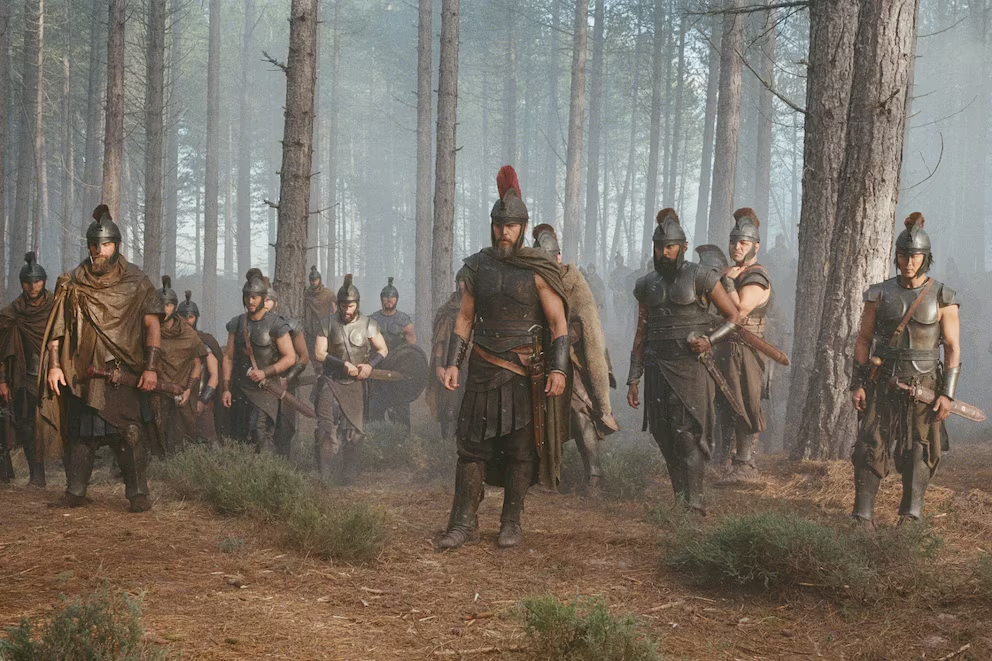
The Odyssey represents one of the clearest examples of that philosophy within Nolan’s career. The film adapts a foundational work of Western literature whose episodes, characters and symbols have influenced storytelling for nearly three thousand years. Translating that material into contemporary cinema requires balancing respect for the poem with the demands of modern dramatic structure, visual spectacle and audience accessibility. The project therefore carries the risk of disappointing literary specialists, mainstream viewers or both if its interpretation appears either too conventional or excessively transformed.
The production follows Odysseus, the king of Ithaca, during his long journey home after the Trojan War. Matt Damon plays the central character, while Anne Hathaway portrays Penelope and Tom Holland appears as Telemachus. The ensemble also includes Zendaya, Robert Pattinson, Lupita Nyong’o, Charlize Theron and several other internationally recognized performers. Their participation gives the film enormous commercial visibility, but it also raises expectations that no cast can satisfy without a coherent cinematic vision.
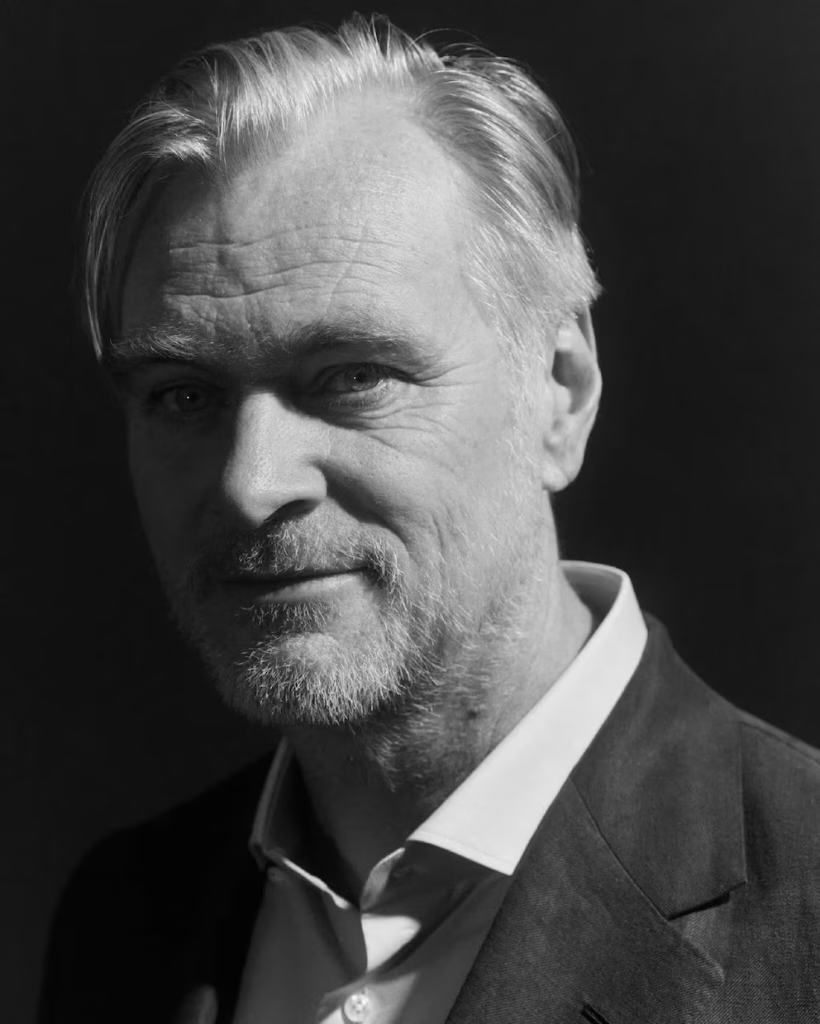
Nolan has approached the material as both a mythological adventure and a human story about endurance, identity, temptation and the desire to return home. Homer’s poem includes monsters, gods, shipwrecks, warfare and supernatural punishment, yet its emotional foundation lies in separation and the difficulty of recovering one’s place after prolonged conflict. Odysseus survives through intelligence, deception and persistence rather than through physical strength alone. That moral complexity prevents him from fitting comfortably into the simplified model of the modern heroic protagonist.
The director has described the ancient Greek heroes as predecessors of contemporary superheroes, figures whose extraordinary abilities coexist with ambition, pride and vulnerability. This connection allows The Odyssey to speak to audiences familiar with modern spectacle while preserving the disturbing qualities of its original mythology. Unlike many current franchise heroes, Odysseus is not morally uncomplicated and does not return from every decision without consequences. His journey forces viewers to consider whether survival and heroism always deserve the same moral judgment.
The film also embraces the nonlinear structure of Homer’s poem rather than reorganizing every event into a simple chronological progression. The original story begins in Ithaca, where Penelope and Telemachus wait while Odysseus remains absent, before gradually revealing earlier stages of his journey. Nolan’s previous films have frequently treated time as a structural force rather than a neutral sequence. Adapting a work already built through memory, delayed information and competing perspectives therefore aligns naturally with his cinematic interests.
Technically, The Odyssey extends Nolan’s commitment to large-format filmmaking and theatrical exhibition. The production was filmed entirely with IMAX 70-millimeter cameras, an undertaking requiring specially adapted equipment and complex logistical planning. Shooting took place across locations in Greece, Italy, Morocco, Iceland, Malta, Scotland and other regions chosen to provide physical landscapes rather than digitally manufactured substitutes. The approach emphasizes scale, texture and environmental exposure while reinforcing Nolan’s preference for capturing as much as possible in front of the camera.
Filming at sea introduced some of the production’s greatest physical challenges. Cast and crew members worked in changing weather, difficult water conditions and locations where conventional studio control was impossible. Matt Damon has described an environment in which major stars received no protection from the discomfort experienced by everyone else. The demanding conditions were not treated merely as obstacles, but as part of an effort to place physical strain and uncertainty inside the finished images.
That method reflects Nolan’s belief that audiences can perceive when performers interact with real spaces, objects and environmental forces. Digital effects remain part of the production, but they are used to extend photographed reality rather than replace every physical element. A ship moving through actual water produces unpredictable movement, light and bodily reactions that are difficult to simulate completely. The risk of working under those conditions becomes connected to the authenticity Nolan wants the audience to experience.
The director’s position also carries economic implications because The Odyssey is among the most expensive productions of his career. Large budgets normally encourage studios to minimize uncertainty by relying on familiar characters, sequels and established market categories. Nolan has instead used his commercial influence to support an adaptation of an ancient poem filmed through costly and technically demanding methods. The project demonstrates how success can create the opportunity to take greater risks rather than simply repeat the choices that produced earlier achievements.
His relationship with Universal Pictures became particularly important after Oppenheimer combined critical prestige with exceptional box-office performance. That film transformed a historical drama about nuclear physics, war and political persecution into a global theatrical event. Its success challenged assumptions that adult audiences would avoid long, serious films without conventional franchise branding. Nolan’s transition from Oppenheimer to The Odysseytherefore continues his attempt to prove that scale and intellectual ambition do not have to operate separately.
The risks surrounding the new film are nevertheless substantial. Homer’s poem contains divine intervention, brutality, enslavement, sexual politics and moral values that do not align neatly with contemporary expectations. Any adaptation must decide what to preserve, reinterpret or confront directly. Simplifying those elements could weaken the story’s historical strangeness, while reproducing them without context could distance modern audiences.
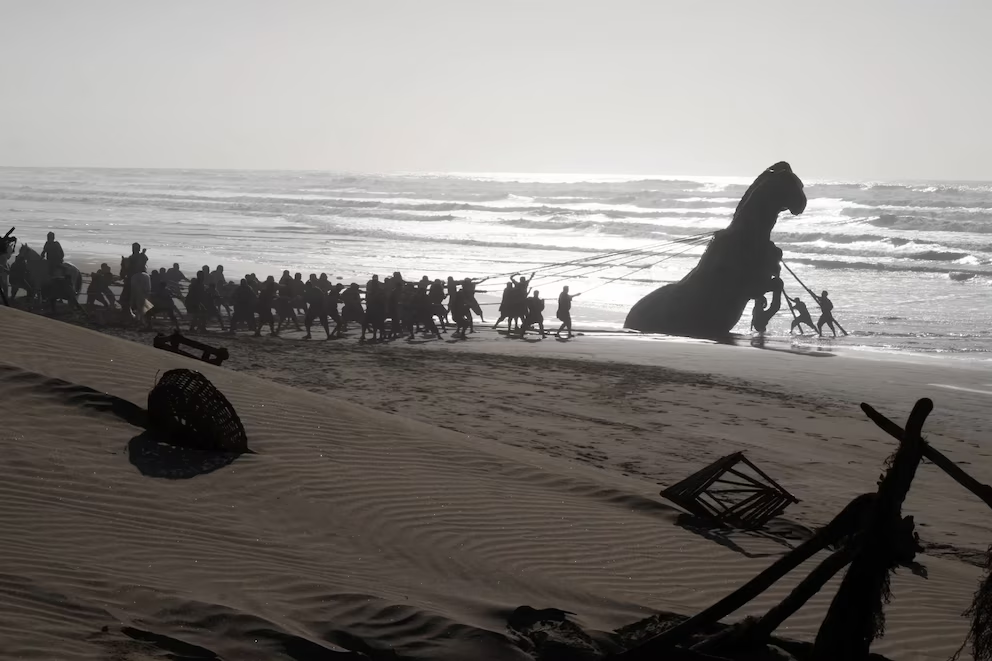
Nolan must also manage the tension between familiarity and discovery. Many viewers recognize the Cyclops, the sirens, Circe and the Trojan Horse even if they have never read the complete poem. The challenge is to make those famous episodes feel dangerous and emotionally immediate rather than like illustrations from a cultural textbook. Spectacle alone will not distinguish the film unless each encounter changes the characters and advances the deeper theme of an impossible return.
His defense of risk also addresses the broader condition of contemporary cinema. Studios increasingly analyze audience behavior through data, early testing and global marketing models intended to predict commercial performance. Those tools can help identify demand, but they may also encourage imitation by treating past success as the safest guide to future production. Nolan’s argument suggests that cinema loses cultural energy when financial protection becomes more important than artistic possibility.
The filmmaker does not reject popularity or commercial achievement. His career demonstrates a sustained interest in reaching mass audiences through action, suspense and large-scale images. What he rejects is the assumption that broad appeal requires intellectual simplification or creative caution. Films such as Inception, Interstellar, Dunkirk and Oppenheimer became major events precisely because they offered audiences experiences that were difficult to predict through conventional formulas.
Risk, in this framework, becomes both an artistic and industrial necessity. A movie must give audiences a reason to leave their homes, enter a theater and submit themselves to a shared experience that cannot be completely replicated elsewhere. Familiarity may attract initial attention, but surprise, scale and emotional commitment create lasting cultural impact. Nolan’s insistence on theatrical presentation emerges from that same belief that cinema must offer more than passive content consumption.
The release of The Odyssey will test whether those principles can once again produce both artistic recognition and commercial success. Its cast, budget and literary foundation guarantee attention, but they cannot eliminate uncertainty about how audiences will respond to Nolan’s interpretation. That uncertainty is precisely the condition he considers necessary for meaningful achievement. A film designed only to avoid failure may never develop the qualities required to become unforgettable.
Nolan’s statement therefore functions as more than promotional language before a major premiere. It summarizes a philosophy in which preparation and uncertainty coexist, and in which success must be pursued without assuming that it can be engineered completely. The Odyssey carries the weight of ancient literature, modern technology and enormous expectations, but its value will depend on whether it feels like a genuine act of cinematic discovery. For Nolan, taking that chance is not a departure from serious filmmaking; it is the reason serious filmmaking remains possible.
El cine avanza cuando el riesgo deja de ser un obstáculo y se convierte en parte esencial de la creación. / Cinema moves forward when risk stops being an obstacle and becomes an essential part of creation.