

 Phoenix 24
Augusta still listens when experience speaks.
Augusta, April 2026
José María Olazábal began his latest appearance at Augusta with the kind of round that immediately activates memory, sentiment and quiet expectation. At 60 years old and in his 37th participation at the Masters, the Spanish golfer once again showed that experience at Augusta is not a decorative credential, but a competitive language of its own. His start was encouraging enough to briefly place him among the best performers of the day, reviving the old fascination with players who know how to survive this course not through power, but through tempo, intelligence and emotional familiarity.
That is what made the opening stretch so meaningful. Olazábal reportedly completed the first nine holes in 34 strokes, the best front-nine score of his career at Augusta in several of the years most closely linked to his glory there. For a younger player, that number might be read simply as a promising opening. For Olazábal, it carries something more symbolic. It reconnects the present with the rhythm of a golfer who once won two green jackets and who still seems able, in flashes, to unlock the old geometry of the course. Augusta is not only a test of execution. It is also a test of memory, and few players of his generation carry that memory so deeply.
The emotional force of the round lies precisely in that contrast between age and command. Modern golf is dominated by power, physical preparation and increasingly aggressive course management. Olazábal does not belong to that model. His game has long depended more on precision, touch and strategic restraint than on raw distance from the tee. At Augusta, however, those older virtues can still matter, especially when the wind, the greens and the pressure punish excess. His early performance suggests that time has taken away some physical margin, but not the deeper craft that allows a player to read this course with unusual sensitivity.
That does not mean the round was a full-scale competitive rebirth. The hopeful beginning reportedly gave way to a more difficult closing segment, including mistakes that pushed his final card back into more modest territory. That arc matters because it protects the story from sentimentality. Olazábal did not suddenly become a favorite to contend for the tournament. What he did show was something more subtle and perhaps more compelling: that a veteran can still shape the emotional weather of Augusta with a few exceptional holes, even if the final score reminds everyone of the limits imposed by age and the cruelty of elite golf.
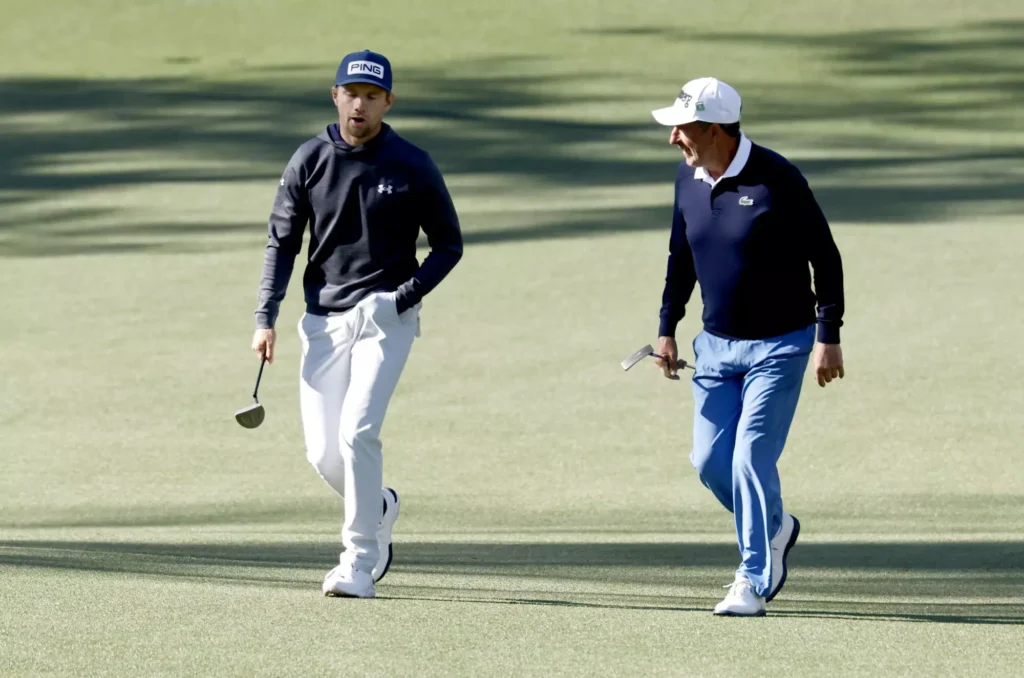
In that sense, the phrase “hopeful return” is appropriate, but only if understood with discipline. The hope here is not the fantasy of turning back time. It is the hope of seeing a player of historic stature remain genuinely legible inside a modern field that often seems built for another athletic generation. When Olazábal opens well at Augusta, the tournament acquires a second layer of meaning. It stops being only about current contenders and starts becoming a dialogue between eras. The course becomes a stage where history does not merely sit in the gallery; it briefly reenters play.
There is also something distinctly Augustan about this kind of moment. The Masters has always fed on continuity, ritual and the return of familiar figures whose past triumphs remain woven into the landscape. Olazábal belongs to that tradition more deeply than most. His victories in 1994 and 1999 are part of the tournament’s institutional memory, and his bond with the place has long carried an emotional depth intensified by his connection to Seve Ballesteros. Every respectable round he produces there feels larger than one day’s golf. It becomes a reminder that Augusta is one of the few sporting spaces where legacy can still exert pressure on the present.
That legacy, however, can also create a trap. Audiences often romanticize veteran performances so quickly that they stop reading them honestly. A strong front nine becomes a resurrection narrative. A brief appearance near the top of the leaderboard becomes evidence of one more miracle in waiting. Golf is rarely that generous. Augusta, in particular, can reward patience and punish nostalgia within the same hour. Olazábal’s day seems to have followed that exact logic. The first part of the round suggested possibility. The later holes reimposed reality. Both things can be true at once.
What deserves emphasis is the manner of the performance. Reports around the day pointed to his constancy in preparation and the quality of his short game, features that have always defined his best golf. That matters because it shows the round was not an accident produced by ceremonial goodwill or an indulgent crowd. It came from craft. Even now, Olazábal appears able to extract competitive value from discipline, repetition and course understanding. In an era that often celebrates violence off the tee above all else, that has its own quiet dignity.
For Spanish golf, the moment also carries symbolic weight. Olazábal remains one of its great living references, a figure who links generations and keeps alive a certain tradition of strategic, emotionally intelligent golf. Seeing him open Augusta with authority, even temporarily, reinforces that continuity. It reminds audiences that Spanish golf’s place in the major championship imagination was not built only on isolated victories, but on enduring personalities capable of shaping the atmosphere of the sport.
In the end, Olazábal’s opening round matters less for where it leaves him on the leaderboard than for what it reveals about competitive memory. Augusta still has room for players who understand it from the inside. It still rewards touch, instinct and patience in ways that can momentarily suspend the normal hierarchy of age. Olazábal may not have finished the day in full control of the tournament, but he did something more enduring. He made Augusta remember him again, and for a few holes, it answered.
Detrás de cada dato, hay una intención. Detrás de cada silencio, una estructura.
Behind every data point, there is an intention. Behind every silence, a structure.