

 Phoenix 24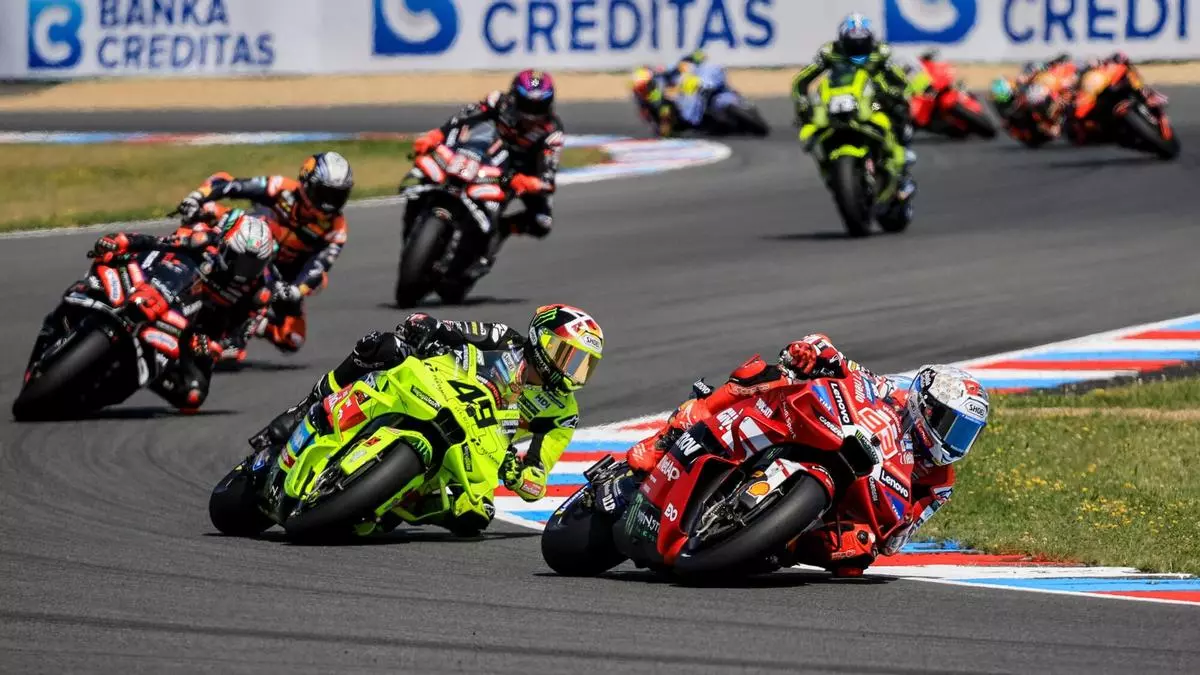
Immediate changes target safer launches after recent first-corner crashes.
ASSEN, Netherlands | June 2026
MotoGP has officially banned holeshot devices from race starts beginning with the 2026 Dutch Grand Prix at Assen, accelerating a technical restriction originally scheduled to arrive with the championship’s broader 2027 regulations. The Grand Prix Commission confirmed the measure after riders and teams raised growing concerns about safety during recent starts. The devices lower the motorcycle to improve acceleration away from the grid, but they can complicate braking and increase congestion before the first corner. MotoGP has now decided that the competitive advantage no longer justifies the associated risk.
The change takes effect immediately during the Dutch Grand Prix weekend from June 26 to 28. Riders will therefore begin races without the mechanical systems previously used to lower the motorcycle at the moment of launch. The decision follows discussions held across several recent rounds and practical evaluations carried out before the final approval. Teams must now adapt their starting procedures, settings and rider preparation within a very short period.
Holeshot systems were developed to reduce wheelies and improve traction during acceleration. By lowering the front or rear of the motorcycle, engineers could create a more stable geometry and transfer power to the track more efficiently. The technology became increasingly sophisticated as manufacturers searched for marginal gains at the start. What began as a specialized mechanical solution eventually became a standard part of the MotoGP launch sequence.
The problem emerges when riders approach the first braking zone at extremely high speed while several motorcycles remain tightly grouped. If a device does not disengage correctly or changes the motorcycle’s normal behavior under braking, the rider may have less control during the most crowded moment of the race. Even when every system functions as designed, improved acceleration can send the entire field toward the first corner in a more compressed formation. That concentration increases the consequences of a mistake or contact.
Recent incidents in Barcelona and Hungary intensified demands for action. Multi-rider crashes during opening laps renewed questions about whether modern launch technology had made the first corner unnecessarily dangerous. Riders argued that the motorcycles were arriving too close together and with less room to react. Serious injuries and damaged machines transformed a technical discussion into an immediate safety priority.
The ban represents an early step toward the philosophy already established for the 2027 technical regulations. Next season, MotoGP will introduce 850cc engines, tighter aerodynamic limits and a complete prohibition on ride-height and holeshot systems. Those reforms are intended to reduce complexity, improve overtaking opportunities and return greater control to the rider. Removing the start devices now allows the championship to address one specific danger without waiting for the entire regulatory package.
The practical effect will be visible from the moment the starting lights go out. Riders will need to manage clutch release, throttle application and front-wheel lift without relying on the lowering mechanism. Manufacturers with particularly effective launch systems may lose part of their existing advantage. Teams will also need to recalibrate electronics and mechanical settings around a more traditional starting position.
The change may produce greater variation between riders. A successful launch will depend more heavily on individual technique and the underlying balance of the motorcycle. Some competitors may adapt quickly because of their experience with different categories or previous generations of machinery. Others may initially struggle to reproduce the consistency provided by the device.
MotoGP is combining the ban with a second safety measure involving the starting grid. Beginning with the German Grand Prix at Sachsenring from July 10 to 12, the distance between each motorcycle position will increase from three meters to four. Because three riders will continue occupying each row, the separation between rows will rise from nine meters to 12. The adjustment will apply across MotoGP, Moto2 and Moto3.
The wider spacing is intended to reduce the density of motorcycles during the opening acceleration phase. Riders will have slightly more room to change line, respond to a poor start and avoid a stalled or slow-moving competitor. The format will continue using three motorcycles per row rather than adopting the two-per-row arrangement used in Formula One. Championship officials concluded that additional distance could improve safety without fundamentally redesigning the grid.
The two measures address different parts of the same problem. Eliminating holeshot systems changes how motorcycles accelerate, while increasing grid spacing changes their physical proximity before the start. Together, they are designed to produce a more stretched field entering the first braking zone. Neither reform can eliminate crashes, but both may provide riders with additional reaction time.
Safety measures in MotoGP must always balance risk reduction with the competitive character of the championship. Starts are among the most dramatic moments of any race, and the ability to gain several positions remains an essential skill. Officials are not attempting to remove that opportunity. They are trying to prevent technology and grid density from turning every launch into an avoidable hazard.
Manufacturers may also benefit from reduced development costs. Ride-height systems require engineering resources, testing and constant refinement, even though spectators rarely understand their operation. Removing them allows teams to redirect attention toward areas more directly connected to motorcycle performance and rider control. It also prevents smaller manufacturers from being forced into an expensive technological race simply to remain competitive at the start.
The Grand Prix Commission announced another structural rule for the longer term. From 2028, each manufacturer will be limited to a maximum of six motorcycles on the grid, provided at least five constructors remain in the championship. A factory will therefore be able to supply its official team and no more than two additional satellite teams. The measure is intended to preserve competitive diversity and prevent one brand from dominating the field numerically.
The immediate focus, however, remains Assen. Teams will arrive knowing that a familiar part of their starting procedure has disappeared between consecutive rounds. Practice starts will become especially important as riders search for new reference points. Engineers will closely analyze wheelspin, wheelies and acceleration to recover as much performance as possible without the banned systems.
MotoGP’s decision shows that regulation can move faster when evidence and rider concern converge. The championship had already planned to eliminate the devices, but recent crashes made waiting until 2027 increasingly difficult to defend. By acting now, officials have prioritized safety over maintaining technical continuity for the remainder of the season. The success of the change will be judged through the quality and stability of future race starts.
Progress becomes meaningful when innovation also accepts limits. / El progreso adquiere sentido cuando la innovación también acepta límites.