

 Phoenix 24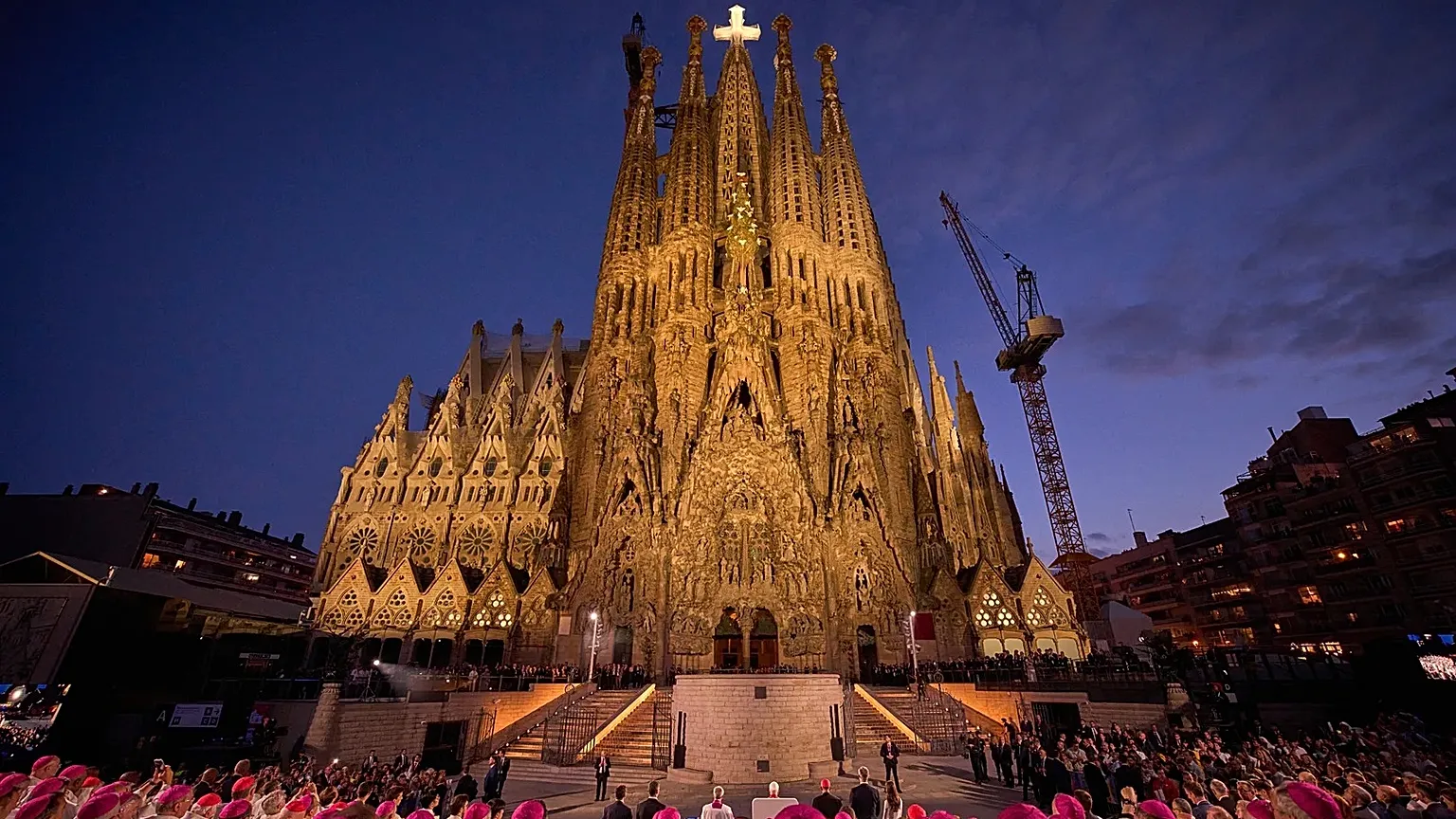
Stone, steel and chemistry complete Gaudí’s unfinished vision.
BARCELONA, Spain | June 2026
After more than 140 years of construction, the Sagrada Familia is approaching a decisive milestone through a combination of modular engineering and advanced structural chemistry. The basilica’s central towers have been assembled using thousands of stone components, reinforced steel and approximately 24 tonnes of specialized adhesive. The system has allowed builders to accelerate work that would have required several additional decades under traditional methods. Antoni Gaudí’s nineteenth-century geometry is now being completed through twenty-first-century materials.
The achievement coincides with the centenary of Gaudí’s death in 1926 and the completion of the central Tower of Jesus Christ. Rising to 172.5 meters, the tower has made the basilica the tallest religious building in the world, surpassing the spire of Ulm Minster in Germany. Pope Leo XIV visited Barcelona in June to bless the tower. The moment connected the building’s spiritual purpose with one of the most complex construction programs in modern architecture.
Gaudí understood that he would not live to see the temple completed. He left models, geometric studies and detailed instructions so that future generations could continue the project. The architect devoted 43 years to the basilica and spent the final 12 years of his life focused almost exclusively on its development. Because the project relied on private donations rather than public funding, progress depended on available resources, technical capacity and changing historical circumstances.
The central structural challenge involved six hyperbolic towers designed to withstand wind, seismic activity and the weight of a monumental cross. The Tower of Jesus Christ alone supports a cross measuring approximately 17 meters. Traditional construction would have required workers to place individual stones at extreme height with slower assembly and greater logistical risk. Engineers instead transformed the towers into a modular system.
The structure was divided into 826 prefabricated panels containing more than 2,100 stone pieces. These sections were assembled at the quarry before being transported to the basilica. Each panel combines carved stone with an internal steel framework, allowing the two materials to work as a unified structural element. The modular method reduced the amount of complex work performed hundreds of meters above the ground.
The key material connecting the stone and steel is Loctite EA 9497, an advanced two-component epoxy adhesive developed by Henkel after approximately a decade of research and testing. Around 30 kilograms of resin were applied to each modular panel. The adhesive was introduced in liquid form so it could fill microscopic spaces between the different materials. Once cured, it created a permanent bond capable of distributing structural loads across the entire panel.
After application, every module underwent a controlled thermal curing process lasting 24 hours. Stable temperatures allowed the resin to harden evenly and penetrate small cavities that mechanical fasteners alone could not reach. The completed sections were then transported to the construction site and lifted into position. Workers assembled them level by level with the precision of a monumental three-dimensional puzzle.
Project managers estimate that this system allowed construction to advance up to ten times faster than conventional techniques. Work completed in approximately eight years could otherwise have required between 50 and 60 years. The acceleration made it possible to finish the main towers around the centenary of Gaudí’s death. It also demonstrated how industrial prefabrication can be adapted to a building defined by unique sculptural forms.
The adhesive performs more than a joining function. Barcelona’s coastal environment subjects the basilica to salt-laden air capable of accelerating steel corrosion. Relative humidity commonly ranges between 65 and 75 percent, while seasonal temperatures can move from around 5 degrees Celsius in winter to more than 30 degrees in summer. Those cycles cause stone and metal to expand and contract at different rates.
Urban vibration presents another challenge because two metro lines pass beneath the foundations each day. The adhesive must absorb small movements between steel and stone without cracking or losing strength. Its flexibility allows the materials to respond to temperature, humidity and vibration while remaining structurally integrated. This invisible capacity is especially important in tall towers exposed to wind and constant environmental stress.
Engineers calculate that the bonded structure can resist loads equivalent to approximately 100,000 people per square meter. That strength helps stabilize the enormous cross crowning the Tower of Jesus Christ. The final appearance emphasizes stone, light and religious symbolism, but its safety depends on chemistry hidden inside the panels. The most technologically advanced part of the structure is therefore almost completely invisible to visitors.
The tower’s interior also combines engineering with spiritual art. A crystal lamb created by Italian artist Andrea Mastrovito filters Mediterranean light through the space. Beginning in 2027, the tower is expected to open to visitors as a walkable observation point. It will provide the highest panoramic viewpoint in the city while preserving the symbolic function of the basilica’s central axis.
Gaudí conceived the Sagrada Familia as a stone catechism rather than a conventional church. Its 12 apostolic towers, organic columns and sculptural façades translate Christian narratives into architecture. The Nativity and Passion façades present different moments in the life of Christ, while the interior resembles a forest illuminated by colored glass. Every structural solution must therefore support both engineering requirements and a dense symbolic program.
That dual responsibility explains why the project could not simply replace Gaudí’s ideas with ordinary modern construction. Architects and engineers needed to preserve the original geometric logic while using technologies unavailable during his lifetime. Digital modeling, modular fabrication and structural adhesives made it possible to interpret the designs without imitating nineteenth-century methods. Innovation became a means of continuity rather than a rejection of tradition.
The final phase of the basilica shows how heritage projects can evolve through collaboration between architecture, chemistry and industrial production. Stone maintains the visual and symbolic language, steel provides internal strength and epoxy creates a continuous bond between them. None of the materials alone could accomplish the task efficiently. Their integration transformed a seemingly endless project into a structure approaching completion.
The Sagrada Familia’s modern engineering does not diminish Gaudí’s legacy. It confirms his expectation that later generations would complete the work using the knowledge available to them. The basilica has survived war, accidents, financial limitations and a global pandemic because its construction remained adaptable. Its completion is becoming possible not through a return to the past, but through a careful alliance between inherited vision and contemporary science.
Great works endure when innovation serves their original meaning. / Las grandes obras perduran cuando la innovación sirve a su significado original.