

 Phoenix 24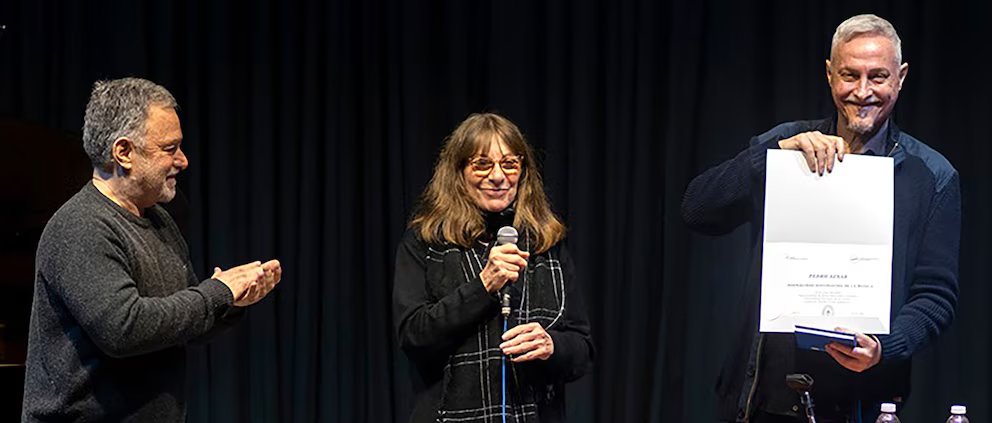
Creation requires exposure, time and emotional availability.
BUENOS AIRES, Argentina | June 2026
Pedro Aznar reflected on artistic creation, professional identity and the pressures of contemporary life during a meeting with students at the National University of the Arts. The Argentine musician and composer described art as an act of profound personal exposure, one that reveals the creator without the protections normally used in everyday life. He called that experience a beautiful nakedness of the soul and argued that, under this definition, artistic work may be the most honest form of labor. His remarks turned a university lecture into a wider meditation on why creating has become increasingly difficult.
The event took place at the Julio García Cánepa Auditorium within the university’s Department of Musical and Sound Arts. The conversation lasted approximately 90 minutes and was organized through the composition course led by Gabriel Senanes. The meeting was titled An Almost Honest Job, a phrase Aznar used to question conventional ideas about work and the social expectation that a profession must justify a person’s existence. Students listened as he connected musical technique with the emotional and political conditions required for creativity.
Aznar began with a question familiar to many young artists: what kind of work can someone expect to find after choosing music? He recalled the common reaction directed at children and adolescents who express an interest in the arts, when adults praise the passion before immediately asking how it will become a job. That response, he suggested, reduces creative identity to economic usefulness. Art may become a profession, but its meaning cannot be exhausted by employment categories or productivity measurements.
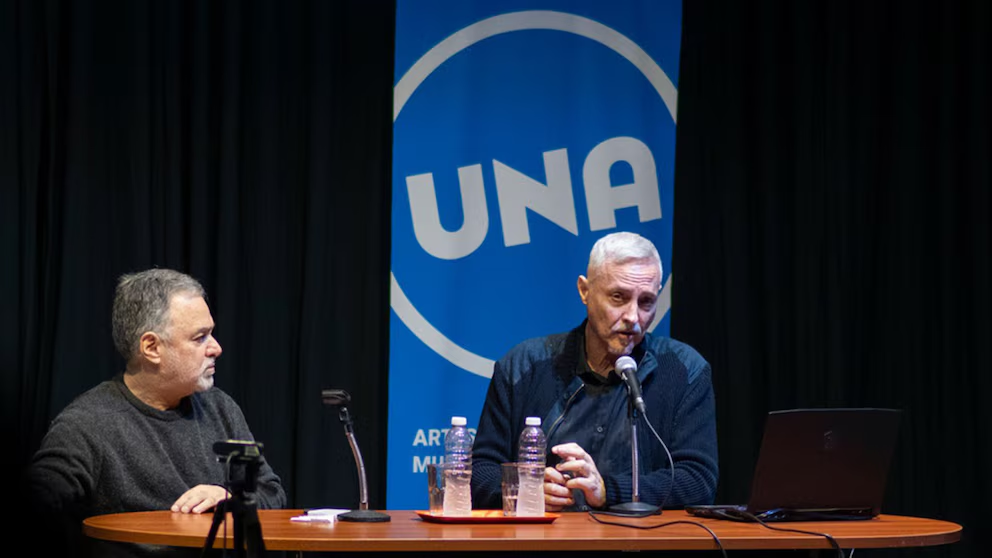
He also challenged the idea that a person’s profession should define an entire life. Contemporary society often treats work as the principal source of identity and as proof that an individual deserves social recognition. Creative practice, however, reaches beyond the completion of assigned functions because it involves interpretation, memory and personal risk. The artist does not merely produce an object, but exposes a way of seeing the world.
The title of the meeting allowed Aznar to develop this argument through humor. He explained that describing art as an almost honest job was a joke because everyone involved in creative work understands the vulnerability it demands. If honesty is understood as the removal of emotional defenses, then art becomes an exceptionally honest activity. The creator places something intimate before an audience without knowing how it will be received.
This exposure does not mean that artistic work depends only on spontaneous emotion. The discussion also addressed methods, discipline and the decisions required after an initial idea appears. Students asked Aznar about his rituals when composing, his development as a fretless bass player and the process of continuing a piece beyond its first impulse. His responses connected inspiration with sustained technical work rather than treating them as opposing forces.
The musician dedicated around an hour to answering questions from students. Their concerns moved between practical craft and the difficulties of circulating music in a culture dominated by speed. The conversation included how to develop a composition, how to make decisions during the creative process and how to present a completed work in the current media environment. These questions revealed that emerging artists are not only worried about making art, but also about whether anyone will stop long enough to encounter it.
Aznar argued that depth remains available to everyone, but the conditions required to reach it have become harder to preserve. Constant scrolling, accelerated consumption and the influence of dominant media systems encourage rapid reaction rather than sustained attention. Artists must find ways to interrupt that rhythm if they want to observe, interpret and create. Depth is not an exclusive privilege, but it demands time and a deliberate resistance to distraction.
He described artists as chroniclers of their era, communicators and critical observers. Their responsibility is not limited to producing entertainment because creative work can register emotions, conflicts and transformations that ordinary public language fails to capture. To perform that role, artists need moments of calm that allow them to step outside the permanent movement of daily life. Without that distance, observation becomes superficial and expression loses complexity.
The most direct warning in the lecture concerned what Aznar called survival mode. He argued that contemporary life often keeps people in a continuous state of urgency, economic anxiety and defensive attention. Living under those conditions makes artistic creation more difficult because survival mode narrows perception toward immediate threats. Music requires another kind of availability, one capable of receiving sensations, questions and ideas without demanding an instant practical result.
His statement did not romanticize creativity as something separate from material reality. Instead, it identified the contradiction facing artists who need emotional openness while living under conditions that produce exhaustion and insecurity. The ability to create cannot be separated from the social environment in which people work, study and attempt to sustain themselves. When all energy is directed toward endurance, imagination becomes harder to access.
Gabriel Senanes placed the event within the mission of public education. He emphasized the value of direct exchanges between established artists and students, particularly inside a public university. Such meetings allow knowledge to move in both directions rather than remaining confined to formal instruction. His remarks also acknowledged that education, public institutions and artistic culture are all facing increasing pressure.
Near the conclusion, Aznar read a text of his own and reflected on the kinds of works that remain emotionally powerful. He argued that people are not always moved by the greatest technical achievements, monumental projects or most admired displays of virtuosity. Smaller gestures can reach the heart when they recover directness and sincerity. He invoked the idea that artistic maturity may require rediscovering the freedom associated with childhood rather than accumulating complexity indefinitely.
The meeting presented artistic creation as both discipline and exposure. Technique provides the means to construct a work, but honesty gives that work emotional consequence. Aznar’s central message was that art requires enough inner space to move beyond fear, professional calculation and constant urgency. In an age organized around speed and survival, recovering that availability may itself be an act of courage.
Creating is also a way of remaining human. / Crear también es una forma de seguir siendo humanos.