

 Phoenix 24
Software transforms complex engineering designs into printable structures within minutes.
Cambridge, Massachusetts | July 2026
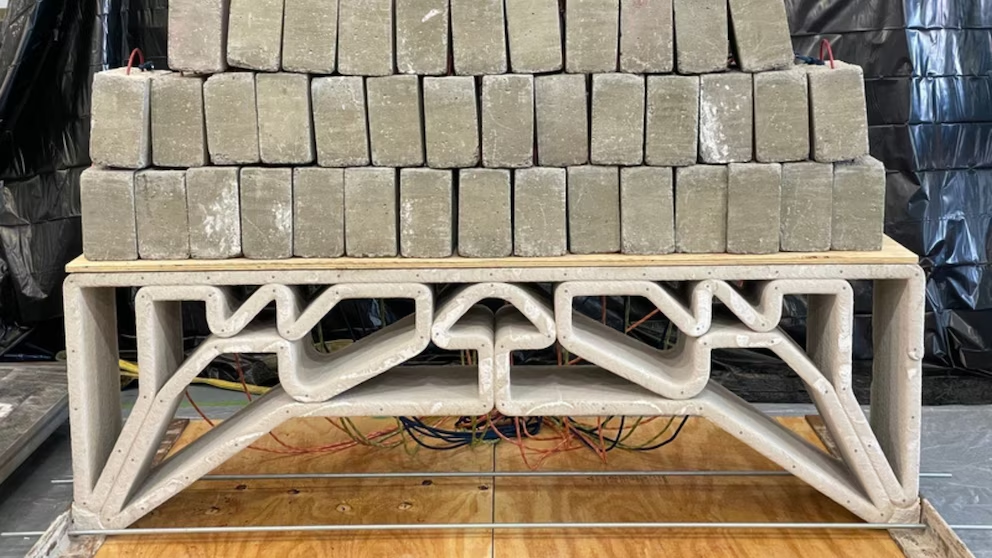
Researchers at the Massachusetts Institute of Technology have developed a 3D-printed concrete bridge capable of supporting more than twice its own weight, marking a significant advance in automated construction and structurally optimized infrastructure.
The experimental bridge measured approximately 2.3 metres and carried loads exceeding 900 kilograms with minimal deformation during laboratory testing. It was manufactured in only 30 minutes using commercially available mortar, demonstrating that digital construction methods can produce strong physical structures without requiring conventional moulds or extensive manual fabrication.
The achievement resulted from a new mathematical framework designed to close a persistent gap between computational engineering and industrial 3D printing. Engineers can use optimization software to create highly efficient structures that place material only where it is structurally necessary. However, many of those theoretical designs cannot be reproduced by existing concrete printers because the machines operate under specific physical restrictions.
Industrial printers must deposit continuous lines of material through a nozzle. Their movement is constrained by the nozzle’s width, minimum turning radius and ability to change direction without interrupting the printing path. A digitally optimized structure may appear ideal on a computer screen but become impossible to manufacture when those limitations are ignored.
The MIT team addressed that problem by incorporating the printer’s physical constraints directly into the design process. Its software uses mixed-integer optimization, a mathematical method capable of evaluating multiple structural and manufacturing conditions simultaneously.
Instead of generating an ideal form that later requires extensive modification, the system produces a design that is both structurally efficient and immediately printable. The software considers the thickness of each concrete line, the angles the nozzle can execute and the need to maintain a continuous deposition route.
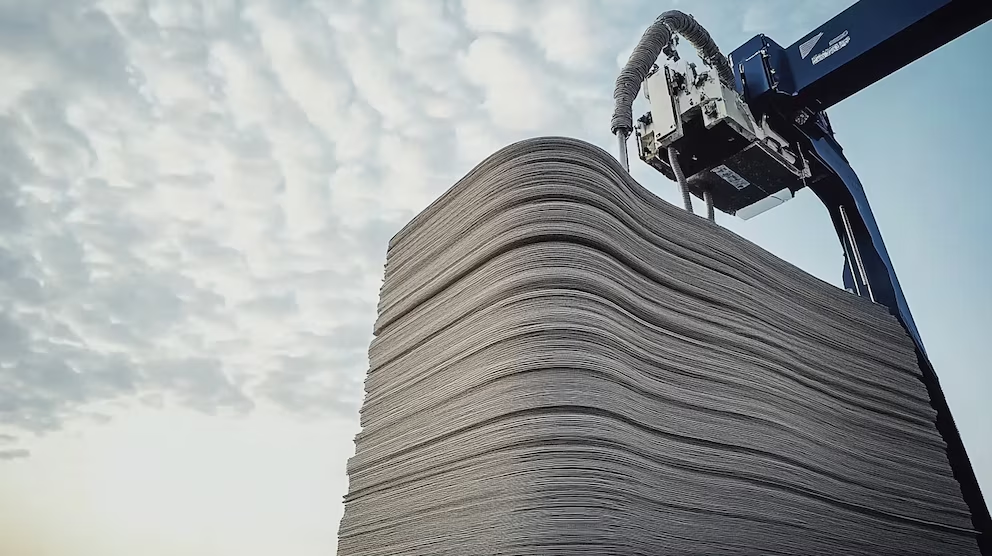
Researchers reported that a complete design can be generated on an ordinary laptop in approximately two minutes. This represents a substantial reduction from conventional processes that may require engineers to spend days manually adjusting an optimized model so that a printer can physically reproduce it.
The system also demonstrated considerable adaptability during the experimental phase. When the researchers needed to reduce the bridge’s dimensions shortly before printing, they reran the optimization and obtained a revised, manufacturable design in less than ten minutes.
That capacity could prove especially valuable in real construction environments, where dimensions, site conditions and available equipment may change unexpectedly. A rapid redesign process would allow engineers to adjust structures without rebuilding the entire digital model manually.
The bridge’s geometry was shaped not only by engineering principles but also by conversations with operators at the Autodesk Technology Center in Boston. Those specialists helped identify three practical restrictions affecting concrete printing: the minimum width of the deposited line, the maximum sharpness of the nozzle’s turns and the requirement for uninterrupted printing.
By translating those operational realities into mathematical parameters, the research team created a direct connection between structural optimization and fabrication.
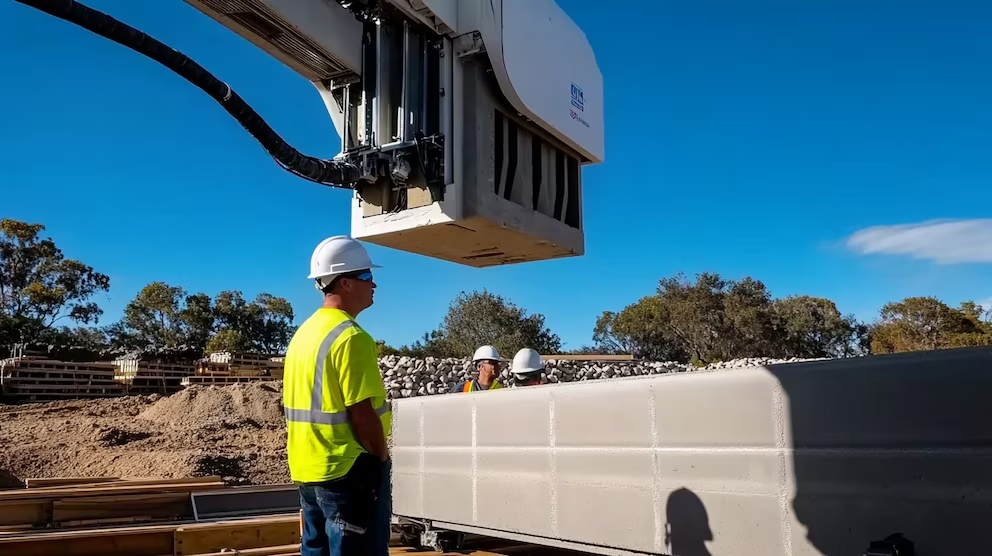
The project also revealed substantial opportunities to reduce material consumption. According to the researchers’ analysis, narrowing the printed concrete line from four centimetres to one centimetre could decrease material use by as much as 76%.
Such savings could produce important environmental and financial benefits. Concrete manufacturing requires large quantities of raw material and energy, while cement production contributes significantly to global carbon emissions. Using less material without compromising structural performance could reduce costs, waste and the environmental footprint of future infrastructure.
The absence of disposable formwork offers another advantage. Traditional concrete construction usually depends on moulds made from timber, metal or plastic to hold the material while it hardens. Designing, transporting, assembling and later removing those moulds adds labour, time and waste to a project.
Three-dimensional printing deposits material directly in the required geometry, potentially eliminating much of that temporary construction. This could make the technology particularly useful for customized structures, temporary bridges and emergency infrastructure in areas affected by natural disasters.
The experiment nevertheless exposed important limitations. The bridge resisted heavy downward loads because concrete performs well under compression. However, it fractured when lifted from one corner, demonstrating the material’s continuing vulnerability to tensile forces.
Traditional reinforced concrete addresses this weakness by combining concrete with steel bars or other reinforcement systems. Concrete carries compressive loads, while steel absorbs tension and helps prevent brittle failure.
Integrating internal reinforcement into an automated printing process remains one of the field’s most difficult technical challenges. The MIT team plans to investigate methods for incorporating steel bars or comparable materials during fabrication, an essential step before printed structures can be used more broadly in permanent public infrastructure.
The prototype should therefore not be interpreted as evidence that bridges can now be printed and installed without conventional engineering controls. Full-scale deployment would require additional testing involving fatigue, weather exposure, repeated loading, vibration, durability and compliance with construction regulations.
Engineers would also need to assess how printed layers bond over time. Because concrete is deposited sequentially, the interfaces between layers may behave differently from material poured continuously into a mould.
Despite those unresolved questions, the project demonstrates that automated construction is advancing beyond the production of walls, decorative components and small architectural prototypes. The combination of mathematical optimization and industrial printing can now produce load-bearing forms capable of responding to genuine structural demands.
The breakthrough lies as much in the software as in the concrete bridge itself. The new framework does not simply instruct a machine to copy a predetermined object. It designs the structure around the capabilities of the machine, treating fabrication constraints as part of the engineering problem from the beginning.
This integrated approach could influence the construction of pedestrian bridges, shelters, modular infrastructure and rapidly deployable structures in locations where conventional materials, skilled labour or heavy equipment are difficult to obtain.
The bridge remains an experimental prototype, but its performance offers a clear indication of where construction technology is moving: toward systems that calculate, redesign and manufacture physical infrastructure through a continuous digital process.
The future of 3D-printed construction will not depend solely on faster machines. It will depend on software capable of understanding what those machines can realistically build.
Phoenix24 | Technology that builds the future. Tecnología que construye el futuro.