

 Phoenix 24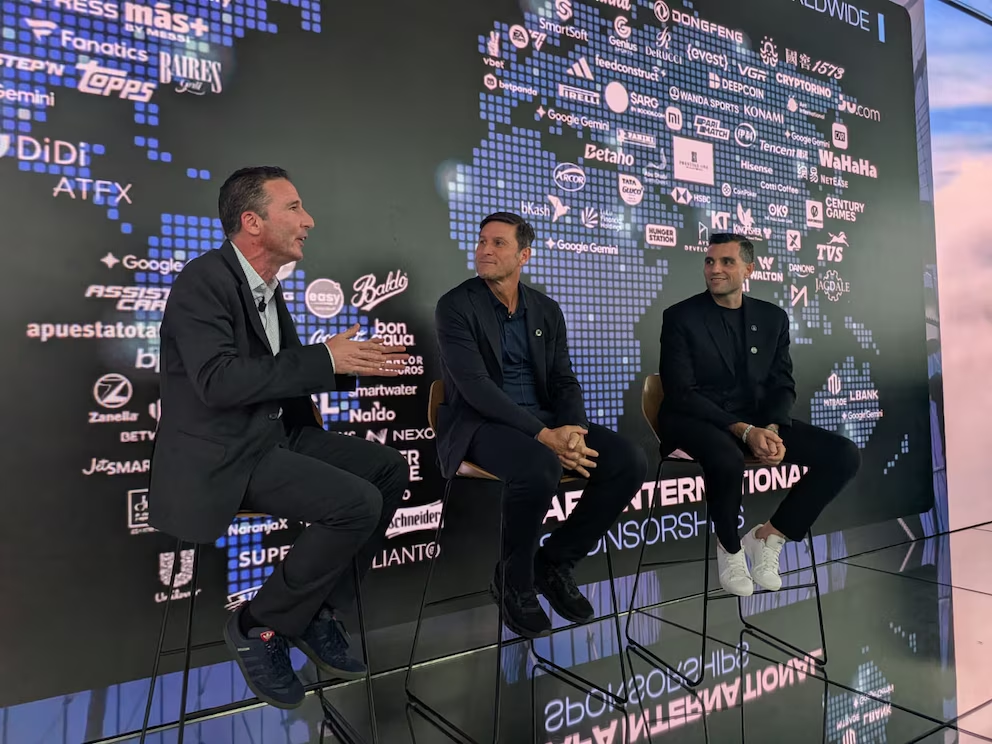
Data, performance and fandom entered a new era.
New York | July 2026
Google has drawn its first major conclusions from the 2026 World Cup, a tournament the company describes as the first in which artificial intelligence became deeply integrated into both sporting performance and the global experience of supporters.
During a presentation in Manhattan, Ramiro Sánchez, Google’s marketing director for Latin America, explained that the company’s partnership with the Argentine Football Association was shaped less by trophies than by the extraordinary digital influence surrounding the national team.
The agreement began taking form toward the end of 2025, when Google was evaluating which national team could provide the strongest strategic connection with audiences during the World Cup. Argentina’s sporting history was important, but the decisive factor was its position within the global conversation.
Before the tournament began, the Argentine national team already generated more than 20% of the social-media discussion associated with participating teams. That level of attention demonstrated that Argentina operated not only as a football institution, but also as an international cultural platform capable of mobilizing millions of people across borders.
The partnership was established for two years and extends beyond the senior men’s team. It also includes the women’s national side and Argentina’s youth categories, giving the agreement a broader institutional dimension than a conventional tournament sponsorship.
For Google, the arrangement offered an opportunity to place Gemini and other artificial-intelligence tools inside one of the world’s most emotionally powerful sporting environments. For the Argentine Football Association, it provided access to technological capabilities connected with performance analysis, audience engagement and global brand expansion.

One of the clearest lessons emerged from online search activity. According to Sánchez, Argentina’s match against Egypt produced the highest search volume ever recorded by Google for a football match.
That level of interest exceeded the previous record generated by the World Cup final between Argentina and France. The comparison illustrates how the digital importance of a match no longer depends exclusively on whether it decides a championship.
Supporters now experience football through several simultaneous channels. They watch the action, search for statistics, investigate players, follow tactical discussions, publish reactions and create visual content while the match is still unfolding.
The result is a sporting event that continues far beyond the television broadcast. Every goal, controversy and individual performance can trigger millions of searches and creative interactions within minutes.
Google identified two principal areas in which artificial intelligence influenced the tournament. The first operated inside the sporting structure.
The company has worked with Argentina’s technical staff on the analysis of historical plays, performance patterns and player behaviour. The objective is to help coaches make better-informed decisions, improve individual and collective performance and identify indicators associated with potential injuries.
The analysis is based on information collected across several seasons rather than isolated observations from a small number of matches. Large historical datasets can reveal recurring movements, workload patterns and changes in player behaviour that may be difficult to detect through conventional observation alone.

Google has not yet released figures demonstrating how much the technology improved results or prevented injuries. The initiative remains a developing process rather than a finished system with independently measurable outcomes.
Artificial intelligence can detect patterns and organize complex information rapidly, but the interpretation of those findings still depends on coaches, doctors and performance specialists.
A model may identify an unusual workload or physical tendency, for example, but it cannot independently determine the full medical or tactical meaning of that information. Human expertise remains essential when transforming data into decisions.
The second area involves the supporters. Google concluded that football passion remains rooted in stadiums, streets and collective celebrations, but an increasingly large part of it is now expressed through digital platforms.
Instagram, TikTok and YouTube have become central spaces where fans communicate identity, emotion and belonging. Artificial intelligence has expanded that participation by making sophisticated creative tools available to users without professional design experience.
Google and the Argentine Football Association introduced Gemini templates that allowed supporters to generate personalized content related to the national team. According to the company, the response produced a level of participation it had not previously observed in comparable initiatives.
Fans did not merely consume official images or advertising campaigns. They created their own interpretations, transforming national-team symbols into personalized messages, celebrations and digital narratives.

This participatory behaviour represents a major change in sports marketing. A modern audience does not want to remain a passive receiver of institutional content. It expects to modify, reinterpret and redistribute the identity of the team it supports.
For Google, this creates a relationship based on mutual value. The company places its technology inside a massive cultural conversation, while users discover practical ways to express their enthusiasm through artificial intelligence.
Sánchez described AI as an enabler of human potential. The concept applies inside the team, where technology can assist specialists, and outside it, where supporters can expand their creative possibilities.
The experience also showed that digital influence is becoming a strategic asset comparable to sporting success. Brands increasingly evaluate the size, intensity and participation level of an online community before entering major partnerships.
A team with a powerful digital following can offer continuous global visibility even between matches. Its players, supporters and cultural symbols generate activity capable of extending a commercial relationship beyond the tournament calendar.
Google has indicated that it views the alliance with Argentina as a long-term initiative rather than a temporary World Cup campaign. The company has not disclosed the financial value of the agreement or confirmed the conditions under which it could continue after the current two-year period.
The project still raises important questions. The use of athlete data requires strong standards of privacy, medical responsibility and institutional control. Creative AI tools must also address issues involving authenticity, intellectual property and the use of personal images.
Despite those challenges, Google’s first AI-centered World Cup revealed a structural transformation in modern football.
Technology is no longer positioned only behind the scenes as an analytical instrument. It now influences training, injury prevention, sponsorship strategy, audience behaviour and the way supporters construct their own relationship with a team.
The central lesson is that artificial intelligence gains relevance when it strengthens existing human activity rather than attempting to replace it.
Football provides the emotion, identity and collective memory. AI provides new ways to analyse, interpret and express them.
Phoenix24 | Technology that amplifies human potential. Tecnología que amplifica el potencial humano.