

 Phoenix 24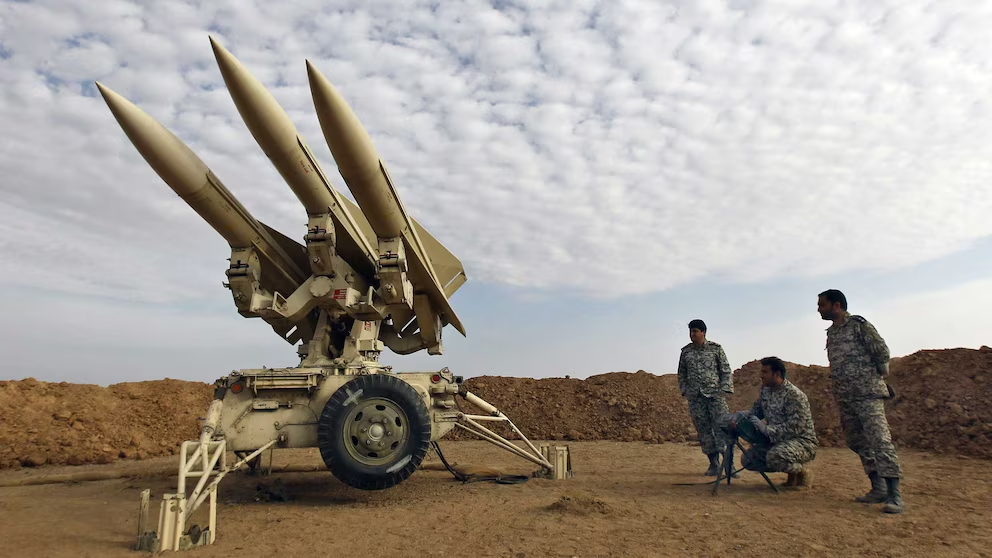
Retaliation and deterrence push the region toward wider conflict.
Tehran | July 2026
Iran’s senior military leadership has threatened the United States with a “decisive and devastating” response following the eighth consecutive American offensive against targets inside the country. The warning emerged as Washington intensified operations intended to weaken Tehran’s missile, drone and maritime capabilities after Iranian forces killed two US service members in Jordan.
General Ali Abdollahi, commander of Iran’s Khatam al-Anbiya Central Headquarters and one of the country’s principal military figures, said the armed forces would respond to any new action interpreted as aggression. His statement reflected the increasingly confrontational language surrounding a conflict now affecting Iran, Jordan, Kuwait and several strategic areas of the Gulf.
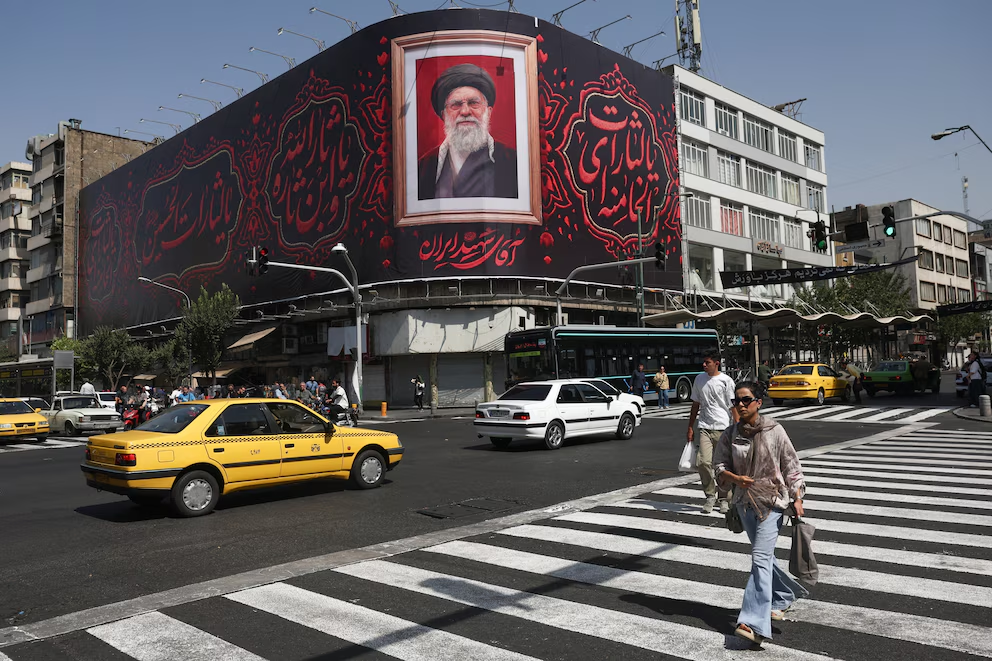
In a message carried by Iranian state media, Abdollahi reaffirmed the military establishment’s loyalty to Supreme Leader Mojtaba Khamenei and said the armed forces would follow his directives to protect the ideals of the Islamic Republic, national unity and the country’s security.
The commander stated that Iran would use its full potential and operational capacity to strengthen coordination among the country’s military organizations, government institutions and population. He presented that cooperation as essential to protecting national interests and preserving Iran’s ability to respond under sustained external pressure.
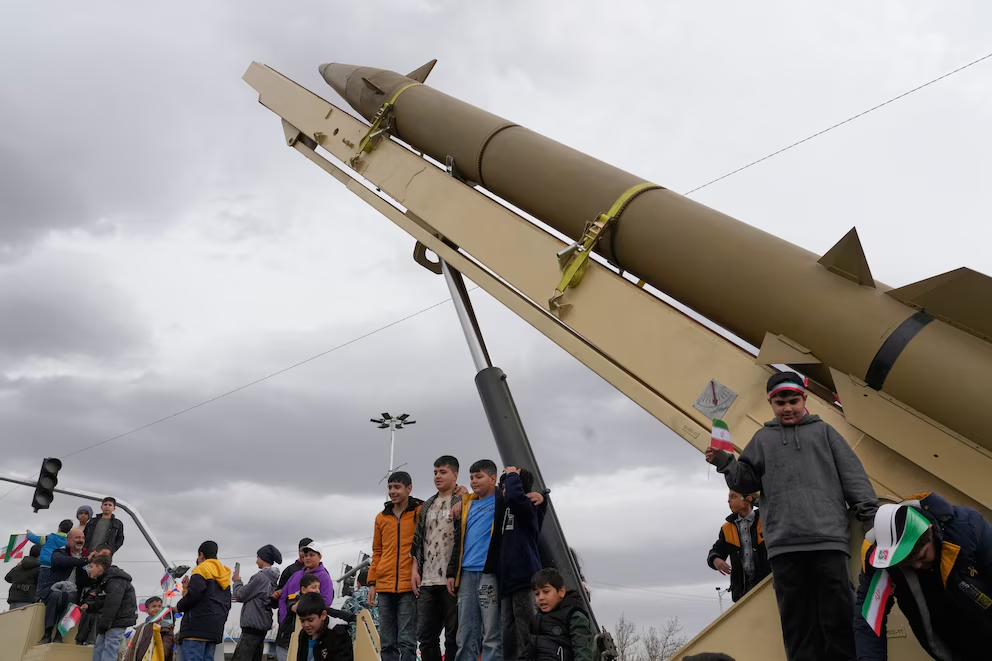
Abdollahi directed particularly severe language toward Washington, accusing the United States of intimidation, domination and aggression. He warned that any further attempt to pressure Iran militarily would impose even greater costs on the opposing side.
Iranian officials frequently describe the country’s military capabilities as defensive instruments designed to deter attacks and preserve sovereignty. The United States and several of its regional partners, however, view Tehran’s missile forces, drones and maritime operations as direct threats to military personnel, infrastructure and international shipping.
The general also accused Washington of attempting to encourage internal divisions after failing to achieve its objectives through military action. He called for national cohesion and portrayed political unity as part of Iran’s broader defensive strategy.
The warning followed another round of Iranian drone attacks against American targets in Kuwait. Iran’s military said the operation struck an ammunition depot at Camp Al-Adairi and facilities housing personnel and equipment at Ali Al Salem Air Base.
Tehran identified those strikes as part of the seventeenth phase of Operation Saegheh, the campaign through which it has targeted US and allied positions in response to continuing American military operations.
The United States completed its eighth consecutive night of strikes against Iran during the same period. President Donald Trump ordered the offensive as part of Washington’s effort to reduce Tehran’s ability to threaten commercial navigation in the Strait of Hormuz and to punish the forces responsible for the deadly attack in Jordan.
Two American service members were killed in that Iranian operation, while another remained missing. The casualties gave the latest US offensive an immediate retaliatory dimension and increased pressure on Washington to demonstrate that attacks against its personnel would carry significant consequences.
The United States Central Command said the eighth round of airstrikes began on Saturday evening and ended several hours later. More than 50,000 American troops remained deployed throughout the region at the time of the announcement.
Central Command described those forces as being on maximum alert and prepared for further action. The statement signaled that Washington expected the confrontation to continue rather than conclude with the latest exchange.
US military officials said the strikes targeted Iranian coastal surveillance facilities, air-defense systems, maritime capabilities and storage sites used for missiles and drones. American forces also attacked units of the Islamic Revolutionary Guard Corps identified as responsible for the July 17 assault against US personnel in Jordan.
The targeting strategy suggests that Washington is attempting to weaken both Iran’s ability to conduct attacks and its capacity to monitor commercial and military movements around the Strait of Hormuz. Surveillance installations and coastal defenses are particularly important in a maritime confrontation because they help identify ships, coordinate missile launches and support drone operations.
The Strait of Hormuz remains one of the most strategically sensitive waterways in the global economy. A major share of internationally traded oil and liquefied natural gas passes through the narrow corridor connecting the Persian Gulf with the Arabian Sea.
Any prolonged disruption can affect shipping insurance, freight costs, energy prices and supply chains far beyond the Middle East. The confrontation therefore carries economic consequences even for countries not directly participating in the military operations.
Iran has repeatedly used its geographic position and maritime capabilities to pressure opponents. The United States, meanwhile, maintains that commercial vessels must be able to navigate international waters without coercion or attack.
The latest exchanges demonstrate how rapidly retaliation can expand geographically. American operations have focused on Iranian territory and military assets, while Tehran has targeted US forces and facilities hosted by neighboring countries.
Jordan and Kuwait are now confronting the risks created by their security partnerships with Washington. Their territories provide important logistical, operational and defensive support for American forces, but that presence also places them within the range of Iranian missiles and drones.
Regional air-defense systems have intercepted numerous projectiles, yet the deaths in Jordan confirmed that no protective network can eliminate every threat. Repeated attacks also force countries to expend costly interceptor missiles while maintaining continuous readiness across military and civilian infrastructure.
Iran’s threat of a devastating response does not specify the form or timing of future operations. Tehran possesses several options, including missiles, drones, maritime pressure, cyber operations and coordinated actions through aligned forces.
Washington also retains significant capacity to expand its campaign. Its regional deployment includes combat aircraft, naval forces, intelligence platforms, missile defenses and personnel positioned across multiple countries.
This balance creates a dangerous cycle. Each side presents its action as a necessary response to the previous attack, while every new operation becomes the justification for further retaliation.
Diplomatic space narrows when military credibility becomes tied to answering every strike. Leaders may fear that restraint will be interpreted as weakness, even when continued escalation increases the risk of a conflict neither side can easily contain.
The eighth American offensive and Iran’s latest warning show that the confrontation has moved beyond symbolic exchanges. Military personnel have been killed, bases have been targeted and strategic infrastructure is increasingly exposed.
The next decision by either side may determine whether the conflict remains a sequence of limited retaliatory operations or develops into a broader regional war.
Phoenix24 | When retaliation becomes strategy, restraint becomes the final defense. Cuando la represalia se convierte en estrategia, la contención se vuelve la última defensa.