

 Phoenix 24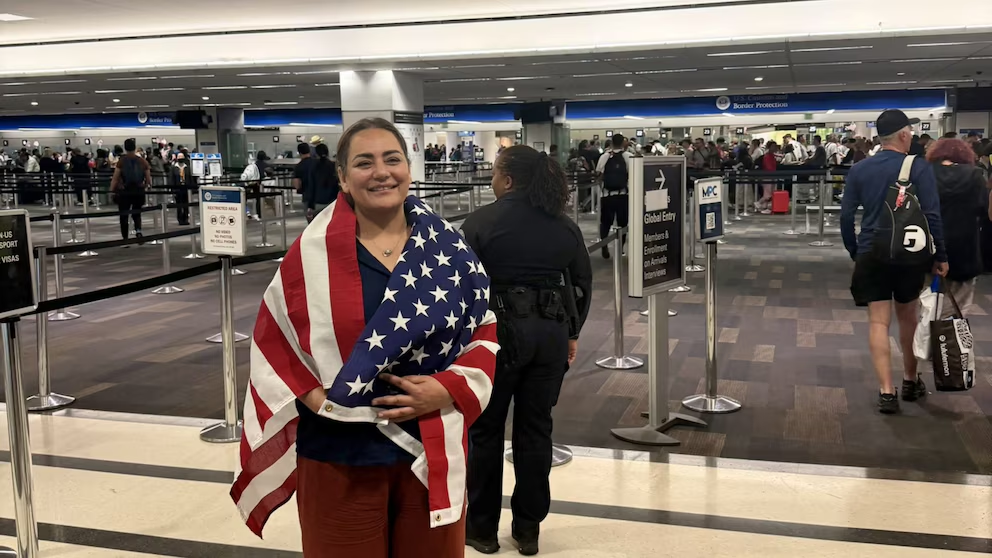
Freedom ends a prolonged ordeal shaped by suspicion and fear.
San Francisco | July 2026
Dena Karari, a 53-year-old Iranian American from California, has returned to the United States after spending 566 days unable to leave Iran, where authorities confiscated her passports, repeatedly interrogated her and investigated her over allegations of espionage and collaboration with a hostile government.
Her attorney, international human rights lawyer Jared Genser, confirmed her arrival and welcomed her back after an ordeal that began in December 2024. Karari appeared wrapped in an American flag upon reaching the United States, marking the end of more than a year and a half of legal uncertainty and restrictions on her movement.
Although early accounts described her situation as detention, Karari was not held continuously inside a prison. Iranian authorities instead imposed an exit ban that prevented her from leaving the country while she remained under investigation.
The distinction does not diminish the seriousness of the case. A person deprived of travel documents and subjected to repeated intelligence interrogations can remain effectively trapped, without control over when or whether they will be permitted to return home.
Karari had travelled to Shiraz to visit relatives when authorities seized her American and Iranian passports. She was later questioned by officials from Iran’s Ministry of Intelligence and accused of activities that her lawyer characterized as unfounded.
The allegations reportedly included espionage and cooperation with a state considered hostile by Tehran. Such charges can carry lengthy prison sentences and, in the most serious circumstances under Iranian law, potentially harsher penalties.
Karari worked for an American technology company and was also associated with the Children of Mehr Foundation, a nonprofit initiative supporting disadvantaged children through education and creative opportunities. Her defense maintained that her professional and charitable activities had been misrepresented.
Genser said the prolonged restrictions caused substantial physical and psychological hardship. Even without permanent incarceration, the possibility of prosecution, continuing surveillance and repeated interrogation created an environment of fear that lasted for nearly 19 months.
President Donald Trump announced that Iran had allowed Karari to leave and described the decision as a gesture of goodwill. He said she was safely outside the country and in good condition, while thanking those involved in securing her release.
Her attorney credited the Trump administration with persistent efforts to obtain her freedom. The exact diplomatic process behind Iran’s decision has not been publicly disclosed.
It remains uncertain whether Karari’s departure resulted from a direct bilateral understanding, private negotiations through intermediaries or a unilateral decision by Tehran. Officials have also not confirmed whether her case formed part of broader discussions between the United States and Iran before the latest escalation in the Middle East.
Iranian authorities disputed the American characterization of the episode. The country’s judiciary said no United States prisoner matching Trump’s description had been released or exchanged from an Iranian prison.
That response may reflect the fact that Karari was living under an exit ban rather than serving a conventional prison sentence. It also illustrates how opposing governments use different legal and political language to describe the same case.
Washington considered Karari wrongfully detained because Iranian authorities prevented her from leaving while pursuing accusations her representatives regarded as politically motivated. Tehran, by contrast, treated the matter as a domestic security investigation involving a dual national.
Iran generally does not recognize dual nationality in the same way the United States does. Iranian Americans entering the country with Iranian documentation may therefore be treated exclusively as Iranian citizens, limiting the ability of American diplomats to provide direct consular assistance.
The case highlights the vulnerabilities faced by dual nationals travelling to countries where diplomatic relations with the United States are severely strained. Family connections, charitable activity or professional employment abroad can be interpreted through a national-security framework during periods of geopolitical tension.
Karari’s return offers relief to her relatives and supporters, but several Americans remain detained in Iran. Human rights organizations and families continue urging Washington to include their cases in any future negotiations with Tehran.
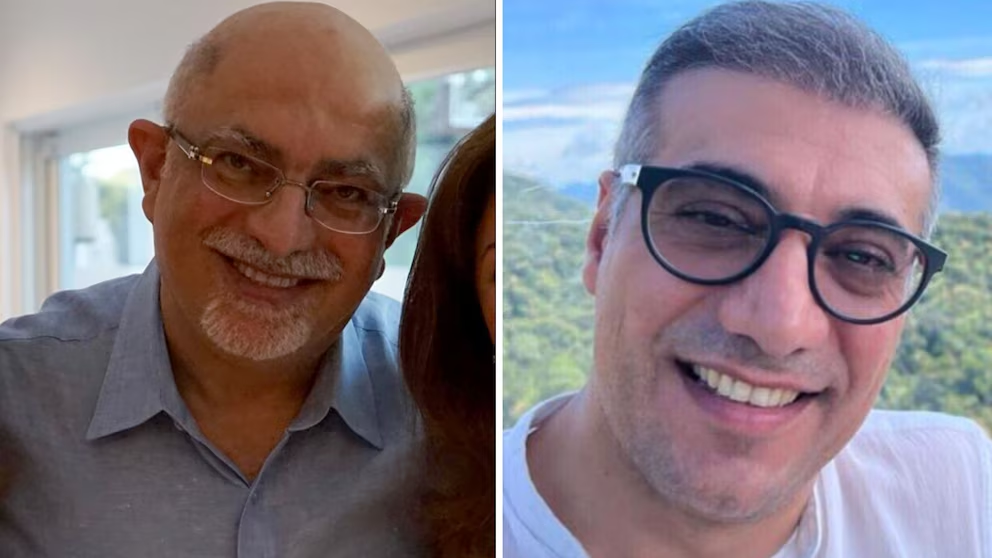
Among them is Kamran Hekmati, a 70-year-old jeweller reportedly serving a two-year sentence after travelling to Iran in 2025. His case was linked to an earlier visit to Israel for a family religious ceremony.
Journalist Reza Valizadeh is also imprisoned after receiving a 10-year sentence connected to allegations of cooperation with a hostile state. He previously worked for a Persian-language broadcaster associated with an organization funded by the United States government.
Another American woman whose identity has not been publicly released is also believed to remain in Iranian custody. The existence of unresolved cases complicates attempts to interpret Karari’s departure as evidence of a wider diplomatic opening.
The United States and Iran have previously negotiated prisoner releases through arrangements involving exchanges, intermediaries and access to restricted Iranian funds. Such agreements are often controversial because critics fear they may encourage governments to use foreign detainees as political leverage.
Supporters argue that direct negotiation remains necessary when citizens face imprisonment, exit bans or prosecution in legal systems where diplomatic access is limited. For families, securing the return of a detained relative frequently outweighs the political symbolism surrounding the process.
Karari’s case unfolded during a period of renewed hostility between Washington and Tehran. Military confrontation, sanctions and disputes over regional security have sharply reduced the space for traditional diplomacy.
Her release therefore carries both humanitarian and political significance. It demonstrates that narrowly focused cooperation can remain possible even while the broader relationship is defined by confrontation.
The event should not be interpreted as proof that relations are improving. Iran has not publicly acknowledged a negotiated concession, and the United States continues applying pressure over Tehran’s military activities, regional alliances and treatment of detained citizens.
For Karari, however, the geopolitical interpretation is secondary to the restoration of personal freedom. After 566 days of uncertainty, she has recovered the ability to live outside the reach of the investigation that prevented her departure.
Her arrival also renews attention on those who have not yet returned. One person’s freedom can create hope, but it can also expose the continuing absence of others whose families remain caught between law, diplomacy and international conflict.
Phoenix24 | Freedom becomes visible when the journey home finally ends. La libertad se vuelve visible cuando finalmente termina el camino a casa.