

 Phoenix 24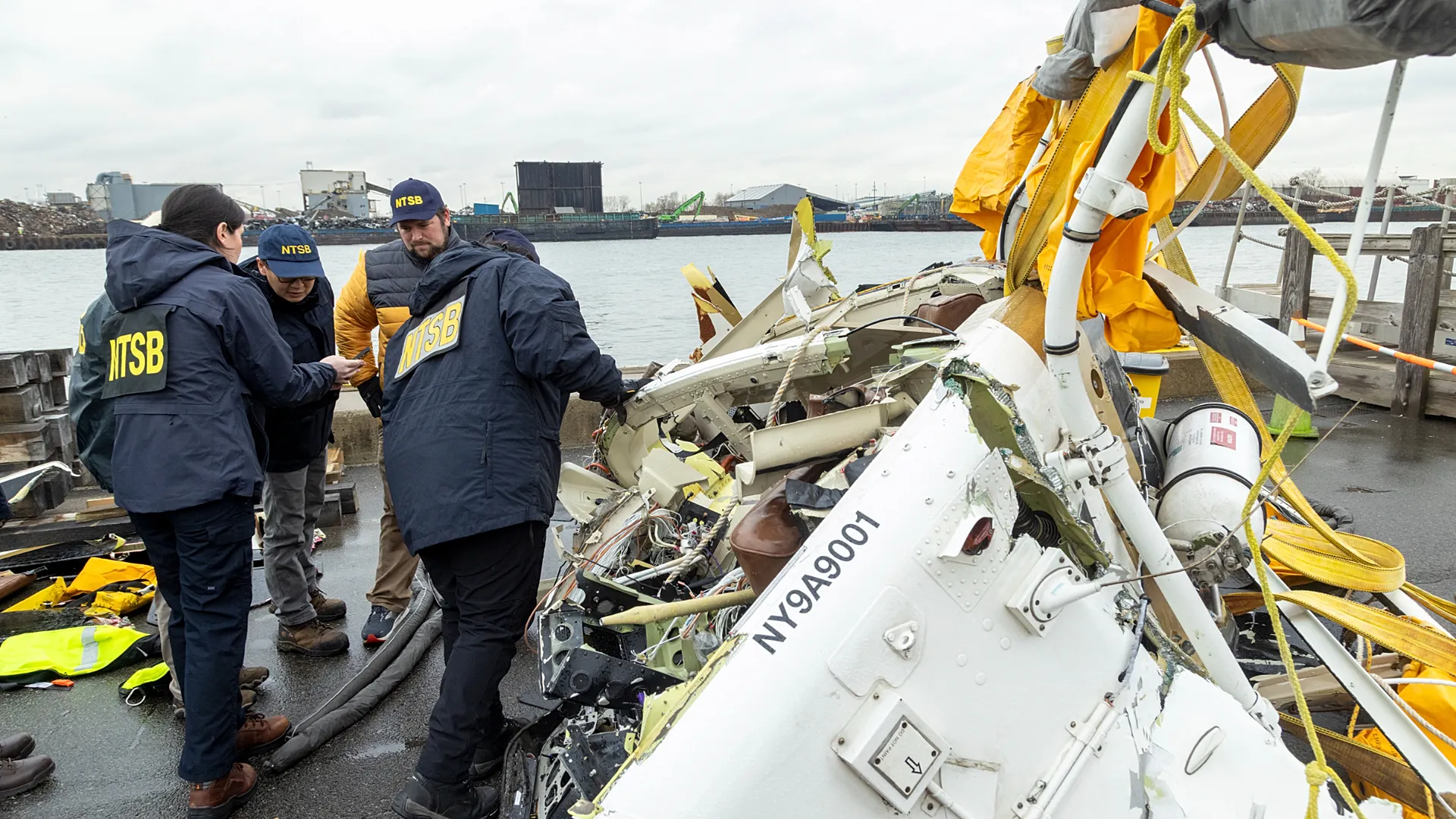
New findings clarify the tragedy without closing the case.
New York | July 2026
New evidence has provided investigators with an important clue about the helicopter crash that killed a Spanish family and the aircraft’s pilot in the Hudson River. Biological remains from several geese were reportedly identified on components of the Bell 206L-4 involved in the April 10, 2025, accident. The discovery strengthens the possibility that a bird strike occurred during the final moments of the flight, although the investigation has not yet established a definitive probable cause.
The helicopter was carrying Siemens executive Agustín Escobar, his wife and their three children, aged 11, seven and four. The pilot was also killed, leaving no survivors who could describe what occurred inside the aircraft. What was intended to be a panoramic family flight over New York ended when the helicopter entered a rapid descent and crashed into the Hudson near Jersey City.
According to Euronews, investigators found remains associated with several geese on the helicopter’s rotor blades. The finding was included among the materials released as part of the United States National Transportation Safety Board’s investigation. The presence of biological evidence has shifted attention toward the possibility that one or more birds struck essential flight components shortly before the aircraft lost control.
The information must nevertheless be interpreted cautiously. The NTSB continues to classify the investigation as ongoing and has not issued a final report establishing the sequence of failures that led to the crash. A bird strike may have initiated the emergency, but investigators must still determine whether it damaged the rotor system, contributed to structural separation or interacted with another mechanical or operational factor.
The aircraft departed from the Downtown Manhattan heliport shortly before 3 p.m. and followed a sightseeing route around some of New York’s most recognizable landmarks. It traveled near the Statue of Liberty, continued north beside Manhattan and passed the George Washington Bridge before turning south along the New Jersey side of the river. Flight-tracking information later showed a brief increase in altitude followed by a sudden and extremely rapid descent.
The helicopter broke apart before or during its fall toward the water. Major components, including parts of the main rotor, transmission and tail system, were recovered separately during the investigation. Their distribution became essential for specialists attempting to determine the order in which the aircraft’s systems failed.
Bird strikes are relatively common across global aviation, but catastrophic accidents involving large birds and helicopters remain unusual. Geese present a particular risk because of their weight, speed and tendency to travel in groups. A collision involving several birds can generate substantial impact forces and may affect multiple areas of an aircraft almost simultaneously.
Helicopters can be especially vulnerable because their rotor systems are directly responsible for producing lift and maintaining control. Damage to a blade or another rotating component can create severe vibration, imbalance and structural stress within seconds. At low altitude, the pilot may have little time or space to stabilize the aircraft or attempt an emergency landing.
The Hudson River environment also presents complex operational conditions. Helicopters conducting sightseeing flights travel at relatively low altitudes over a heavily populated metropolitan area, active waterways and routes used by migratory birds. These overlapping factors require constant situational awareness and careful assessment of environmental risks.
The accident drew international attention because of the victims’ Spanish nationality and Escobar’s senior position within Siemens. He had developed an extensive career in the company’s transport and infrastructure operations. The family was visiting New York when they boarded the helicopter for what was expected to be a brief tourist experience.
The tragedy also renewed scrutiny of commercial helicopter tours operating around Manhattan. These flights provide panoramic access to the city but involve repeated operations over constrained corridors and densely developed areas. Questions have subsequently emerged about aircraft oversight, operator practices, wildlife monitoring and the safety controls applied to high-frequency tourism flights.
The absence of conventional cockpit voice and flight data recorders has made the reconstruction more difficult. Such equipment was not necessarily required for the type of aircraft and operation involved. Investigators have therefore relied on physical wreckage, radar and tracking information, witness accounts, photographs, videos and laboratory examinations.
The newly released evidence may eventually influence broader discussions about bird detection and prevention. Authorities could examine whether operators require stronger wildlife alerts, modified routes or additional precautions during periods of high migratory activity. Any regulatory recommendation, however, will depend on the NTSB’s final technical findings.
For the victims’ relatives, the discovery offers a possible explanation but not yet a complete answer. The central investigative question is no longer only whether the helicopter encountered birds, but precisely how that encounter affected the aircraft and whether any additional condition contributed to the fatal sequence.
The evidence has brought the investigation closer to understanding the tragedy, but the final cause must still be established through the complete technical process.
Phoenix24 | Facts beyond the headline. Hechos más allá del titular.