

 Phoenix 24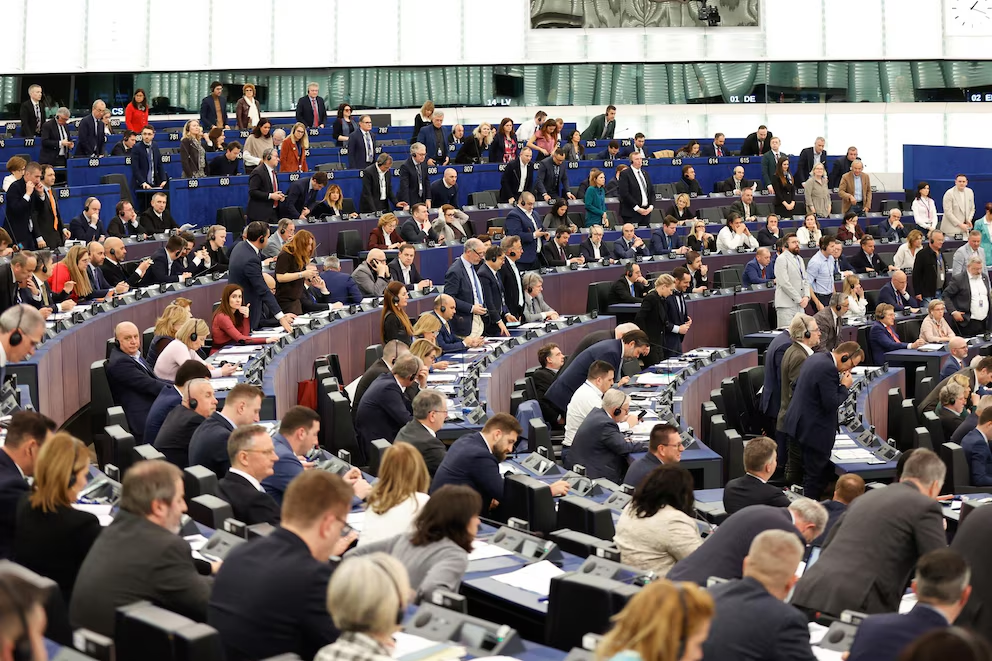
Political support remains firm, but urgency meets resistance.
BRUSSELS, Belgium | June 2026
The European Union has reaffirmed Ukraine’s future inside the bloc while cooling expectations of an accelerated accession timetable, exposing growing differences among member states over how quickly the process should advance. European leaders continue to describe Ukrainian membership as a strategic objective, particularly as the war with Russia reshapes the continent’s security architecture. However, several governments are resisting proposals that could shorten the normal procedure or allow Kyiv to enter before completing the required reforms. The result is a more cautious political message at a moment when Ukraine is demanding speed, certainty and a visible path toward full integration.
Ukraine formally opened negotiations on the first cluster of accession chapters this week, marking its most substantive advance since membership talks began in 2024. The initial phase covers the fundamentals of the European project, including the rule of law, democratic institutions, public administration, economic criteria and fundamental rights. These areas are considered decisive because progress in other chapters depends on sustained compliance with them. Although the opening was celebrated as a historic milestone, it also confirmed that the process will remain highly technical, politically sensitive and potentially lengthy.
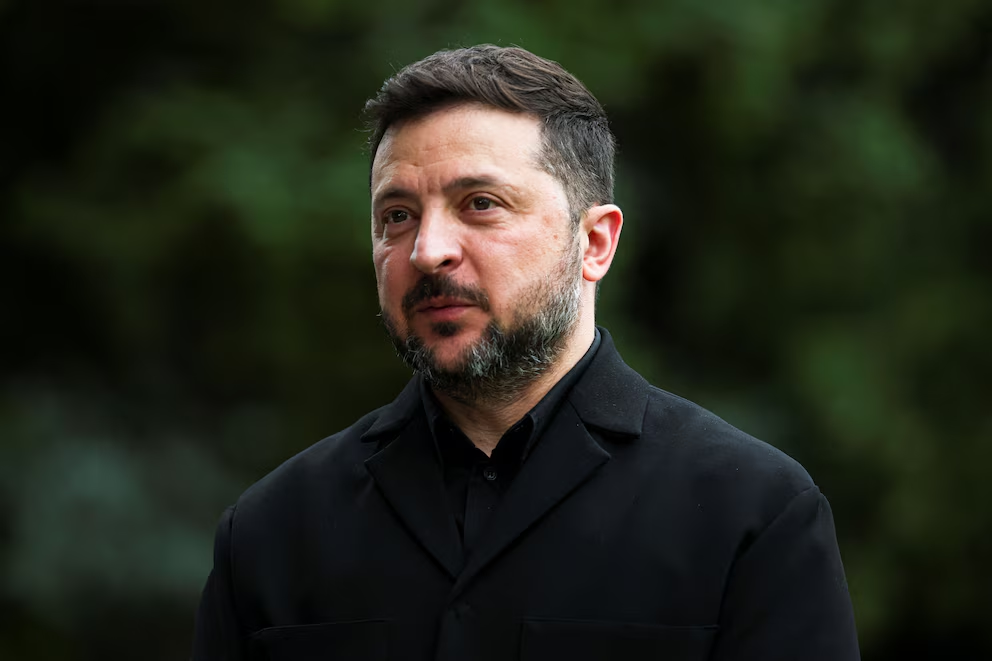
President Volodymyr Zelensky has urged European leaders to open the remaining negotiation clusters rapidly and provide a clearer timeline for membership. Kyiv views accession not only as an economic and institutional objective but also as a long-term security guarantee against Russian influence. Ukrainian officials have argued that the country’s wartime reforms and strategic importance justify an exceptional pace. They fear that an indefinite process could weaken public confidence and create space for Moscow to exploit frustration inside Ukraine.
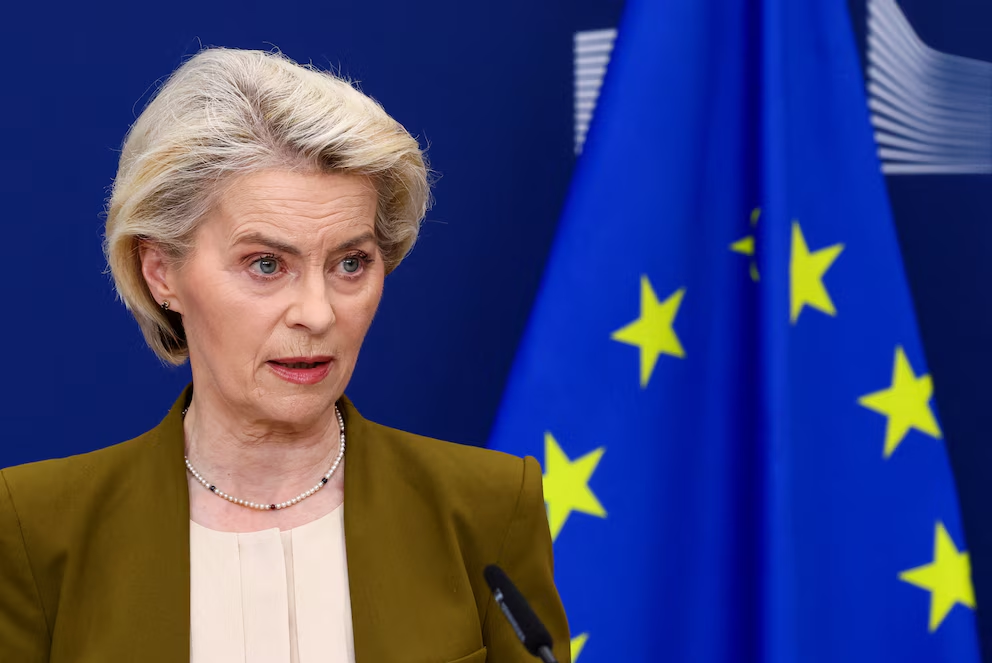
Several European governments support maintaining momentum but oppose creating a special route that would weaken the bloc’s established membership standards. Their position is that Ukraine must be assessed through the same merit-based framework applied to other candidate countries. Governments concerned about democratic backsliding, institutional instability and future budget pressures want stronger safeguards before any enlargement. They argue that admitting a country before it is fully prepared could import unresolved governance problems into the Union.
The hesitation does not amount to a rejection of Ukraine’s candidacy. All member states recently agreed to open the first negotiating cluster after the removal of the political blockade that had stalled progress. The decision demonstrated that the Union can act collectively when diplomatic obstacles are resolved. Yet consensus on beginning negotiations is different from agreement on how quickly they should conclude.
Some countries are particularly concerned about the economic consequences of admitting a large agricultural producer with significant reconstruction needs. Ukraine’s entry would affect the distribution of European funds, agricultural subsidies and regional development resources. Current beneficiaries could receive less support if the budget is not expanded substantially. Governments facing domestic pressure from farmers and taxpayers are therefore reluctant to endorse a timetable before the financial implications are clearly defined.
Agriculture represents one of the most sensitive areas because Ukraine possesses vast productive capacity and can compete aggressively in European markets. Temporary trade measures introduced during the war have already generated disputes with neighboring countries over grain and other agricultural products. Full membership would require a durable framework capable of integrating Ukrainian producers without destabilizing existing sectors. This challenge makes the accession debate inseparable from broader reform of the European Union’s agricultural and budgetary policies.
Institutional concerns are equally significant. A larger Union would make unanimous decision-making more difficult in areas such as foreign policy, taxation and enlargement. Recent disputes with individual member states have strengthened demands for mechanisms capable of responding to democratic regression or obstruction from within the bloc. France, Germany, the Netherlands, Belgium and Luxembourg have proposed additional safeguards for future members, including stronger monitoring and possible restrictions on certain voting rights when fundamental principles are violated.
These proposals reflect the lessons European leaders believe they have learned from previous enlargements. Once a country becomes a full member, the Union has limited tools to address governments that weaken judicial independence, restrict media freedom or use veto power to extract political concessions. Some capitals therefore want accession treaties to include enforceable protections from the beginning. Ukraine’s candidacy is accelerating this wider debate over whether the Union itself must change before admitting new members.
The war further complicates the process because Ukraine is attempting to reform its institutions while defending its territory from Russia. Kyiv has made progress in areas including financial regulation, public administration and alignment with European law. However, corruption, judicial independence and institutional transparency remain central concerns for Brussels. European officials insist that wartime circumstances cannot eliminate the need for credible and measurable reforms.
Ukraine rejects the idea of a secondary or incomplete form of membership. Proposals involving gradual integration, reduced voting rights or temporary exclusion from certain benefits have raised concerns that Kyiv could be placed permanently in a lower category. Ukrainian officials maintain that progressive access to European programs may be useful during negotiations, but it cannot replace full membership. For them, anything less would weaken the political promise made after Russia’s full-scale invasion.
The current slowdown therefore reflects a conflict between geopolitical urgency and institutional caution. Ukraine wants Europe to treat accession as part of the continent’s defense strategy, while several governments continue to view it as a legal and economic transformation that cannot be rushed. Both positions recognize the importance of Ukraine, but they differ over the risks of speed. That tension will shape every stage of the negotiations.
The European Union must also balance Ukraine’s aspirations with those of other candidate countries, particularly in the Western Balkans and Moldova. Governments that have waited years for progress could challenge a process perceived as granting Kyiv preferential treatment. Brussels must demonstrate that political urgency does not erase the credibility of its enlargement framework. Otherwise, acceleration for one candidate could deepen frustration among others.
Ukraine’s path toward membership remains open, but the political atmosphere has become more restrained. The first cluster offers Kyiv a concrete opportunity to prove that reforms can continue despite the war. Success could strengthen support for opening the remaining areas of negotiation, while setbacks would reinforce the arguments of more cautious member states. The decisive factor will be whether Ukraine can convert political solidarity into sustained institutional compliance.
Europe has not withdrawn its promise, but it has made clear that the promise does not yet include a guaranteed date. Ukraine’s membership remains strategically desirable, legally possible and politically contested. The process will advance, but not necessarily at the pace demanded by Kyiv. Between wartime urgency and the Union’s fear of importing future instability, accession has become a test of both Ukraine’s resilience and Europe’s capacity to reform itself.
Phoenix24: periodismo sin fronteras. / Phoenix24: journalism without borders.