

 Phoenix 24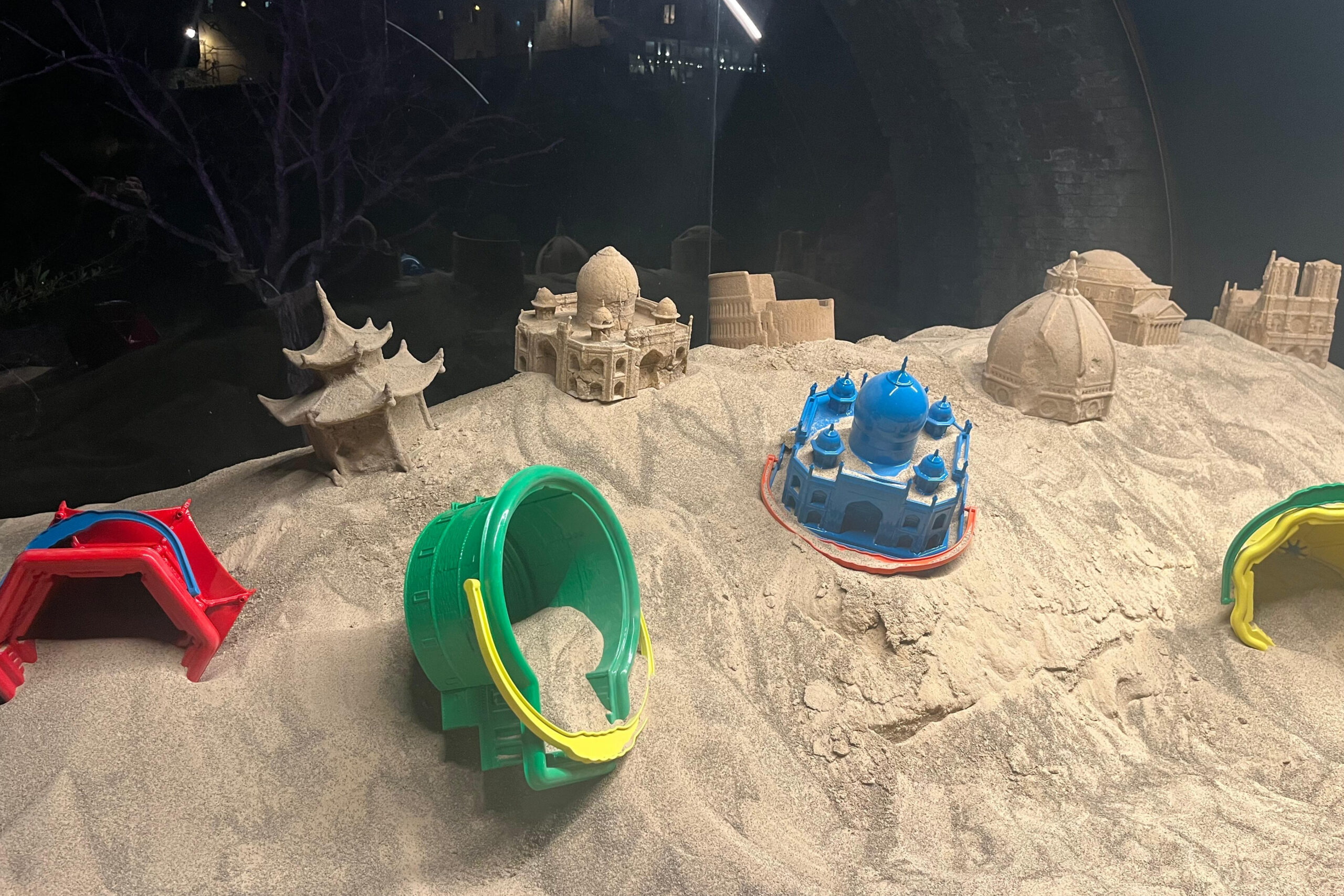
Ephemeral art redefines memory beneath medieval stone
Colle di Val d’Elsa, April 2026. Argentine artist Leandro Erlich has unveiled a striking ephemeral installation in the Tuscan town of Colle di Val d’Elsa, where sand becomes both medium and message beneath the arches of a medieval bridge. The work, titled Sotto gli Archi del Tempo, unfolds as a quiet but powerful reflection on fragility, memory, and the illusion of permanence in human civilization.

Installed under the historic Ponte di San Francesco, the piece deliberately contrasts two temporalities. Above, the enduring solidity of medieval stone. Below, a landscape sculpted in sand, inherently unstable and destined to disappear. This tension is not accidental. It is the conceptual core of the work, forcing viewers to confront the paradox between what societies attempt to preserve and what inevitably erodes over time.
The installation is structured as a sequence of symbolic scenes. One of them features a monumental hourglass resting on a dune, evoking the irreversible flow of time. Another recreates the town itself in miniature, gradually shaped and eroded by an imagined wind. A third section presents what the artist describes as an impossible atlas, where global architectural icons coexist in fragile sand based replicas.
Unlike Erlich’s earlier works, often defined by optical illusions and perceptual dislocation, this project shifts toward material austerity. The emphasis is no longer on deceiving the eye, but on confronting the viewer with the vulnerability of matter itself. Sand, as a medium, becomes a philosophical statement that embodies the idea that even the most ambitious human constructions share the same fate as a structure built on a shoreline.

The setting amplifies the message. Tuscany, a region deeply associated with historical continuity and artistic heritage, provides a backdrop where the weight of the past is tangible. Medieval architecture across the region stands as a testament to human attempts at permanence. Against that backdrop, Erlich introduces a counter narrative in which preservation is always provisional and memory itself is subject to erosion.
The work will remain on display for a limited period, but its temporality is intrinsic to its meaning. It is not designed to endure. It is designed to disappear, leaving behind only the experience and the reflection it generates. In that sense, the installation functions less as an object and more as an event, one that exists in the intersection between presence and loss.

What emerges from this intervention is a broader cultural insight. In a world marked by instability and accelerating change, the idea of permanence becomes increasingly fragile. By choosing sand as his medium, Erlich does not merely represent that fragility. He materializes it, placing viewers inside a space where time is not abstract, but visible, tangible, and already in motion.
Behind every data point, there is an intention. Behind every silence, a structure.