

 Phoenix 24
When peripheral cinema rewrites the map.
Cannes, April 2026. The presence of filmmakers from Argentina, Venezuela, and Chile in the Directors’ Fortnight at Cannes is more than a cultural footnote or a celebratory headline about regional representation. It signals something more consequential about the current geography of cinema: Latin American auteurs continue to enter the global festival circuit not through industrial dominance, but through aesthetic force, thematic risk, and the persistence of filmmaking under structurally unequal conditions. In an era of algorithmic entertainment and franchise saturation, that presence acquires political meaning.
The selection itself carries weight because the Directors’ Fortnight has long functioned as a space where formal experimentation and authorial identity matter more than commercial predictability. This year’s program includes Argentine director Lisandro Alonso with La libertad doble, Venezuelan filmmaker Jorge Thielen Armand with La muerte no tiene dueño, and Chilean director Dominga Sotomayor with La perra. Their inclusion places Latin America inside a section defined by stylistic independence and cinematic singularity rather than by market logic alone.
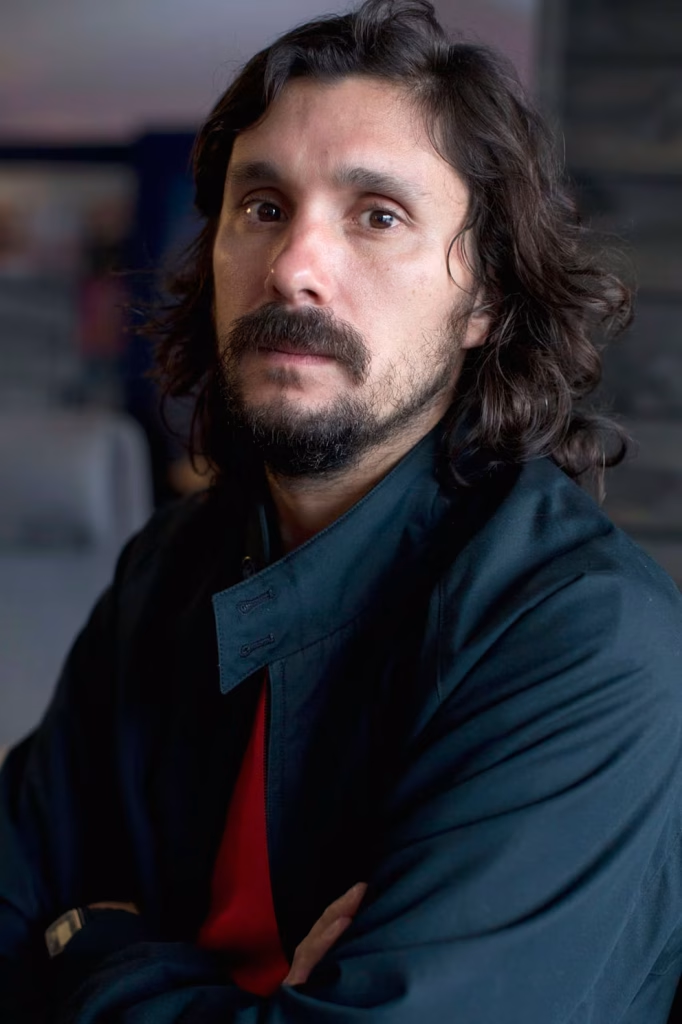
What unites these filmmakers is not a single ideology or visual grammar, but a shared resistance to simplification. Alonso returns with a work presented as an echo of his 2001 debut without being a remake, suggesting a self-reflexive reinvention rather than nostalgic repetition. Thielen Armand arrives with a thriller situated between fantasy and western, while still anchored in the texture of contemporary Venezuela. Sotomayor contributes a story of solitude, rescue, and unrealized motherhood, a quieter emotional register that expands the region’s presence beyond overt political spectacle. Together, these projects suggest that Latin American cinema continues to travel internationally through complexity, not cliché.
That matters because global cultural circulation still tends to demand legible identities from the South. Latin American film is often expected to arrive carrying violence, poverty, dictatorship, or magical realism in forms easily consumable by northern audiences. What the Cannes selection appears to recognize instead is a wider range of sensibilities: existential reinvention, hybrid genre, emotional interiority, and narrative forms that do not reduce the region to trauma alone. Representation becomes more meaningful when it is not trapped inside stereotype.
The broader programming context reinforces that reading. The section reportedly received around 1,800 films and ultimately selected works from five continents and nineteen countries, with notable visibility for less frequently circulated cinemas such as those of Nigeria, Sudan, Guatemala, Venezuela, and Cyprus. That framework matters because it places the Latin American selections within a larger rebalancing of cultural prestige, one in which the margins of global cinema are not merely invited for diversity optics, but increasingly positioned as sites of formal vitality.
There is also an institutional lesson here. Latin American cinema often survives through fragile funding structures, transnational co-production, and uneven domestic support, yet it continues to generate filmmakers capable of competing in the most symbolically charged spaces of world cinema. That persistence is not accidental. It reflects a regional tradition in which artistic legitimacy is often built under scarcity rather than abundance. Cannes, in this sense, is not simply rewarding finished films. It is acknowledging systems of endurance.
The inclusion of Sebastián Lojo from Guatemala in the short film lineup adds another layer to the story. It suggests that the regional presence is not confined to the established names alone, but extends into emerging voices and smaller-format experimentation. This matters strategically because festival ecosystems do not only validate individual works. They shape future circulation, financing pathways, critical attention, and the symbolic map through which world cinema gets narrated. To appear there is to enter a broader contest over visibility and permanence.
What emerges from this year’s selection is a reminder that cultural power is never distributed evenly, but it is constantly being contested. Latin American cinema may not control the global platforms, the dominant streaming logic, or the largest production infrastructures. Yet it continues to occupy spaces of legitimacy where artistic risk still counts. In a fragmented world culture increasingly governed by metrics, that remains one of the last meaningful forms of resistance.
Detrás de cada dato, hay una intención. Detrás de cada silencio, una estructura.
Behind every datum, there is an intention. Behind every silence, a structure.