

 Phoenix 24
Art, music, and debate converge in a new cycle
Buenos Aires, April 2026. The Museo de Arte Moderno de Buenos Aires marks its 70th anniversary not as a retrospective celebration, but as a forward looking cultural activation. The institution has launched a broad program that integrates exhibitions, live music, public debates, and educational initiatives, positioning itself less as a repository of art and more as a dynamic platform for contemporary thought and experimentation.
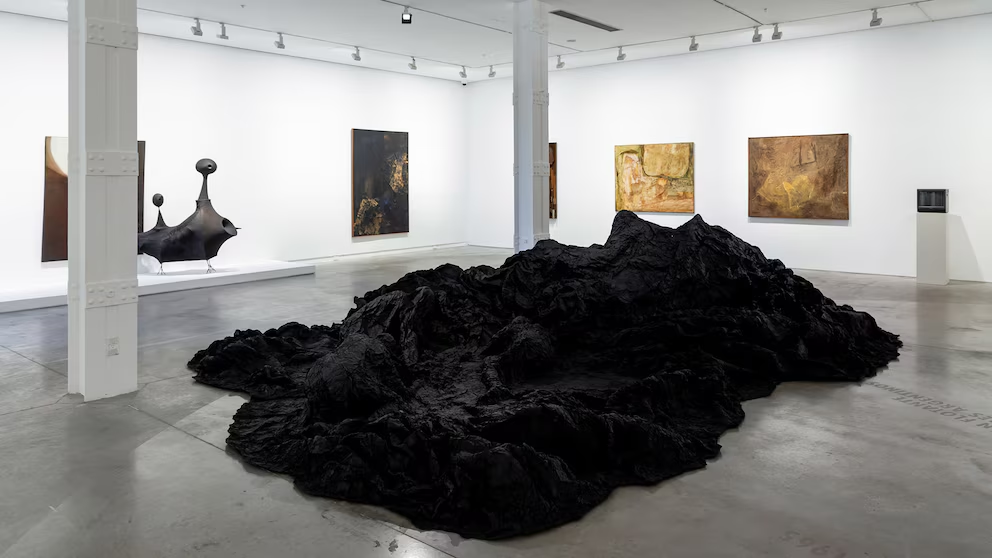
At the core of the anniversary is a curatorial concept that reframes the museum’s role. Under the program “Habitando el futuro,” the Moderno brings together multiple exhibitions alongside a dense calendar of public activities designed to engage diverse audiences. This approach reflects a structural shift in cultural institutions, where the objective is no longer limited to preservation, but extends to participation, dialogue, and social relevance.
The anniversary week functions as both symbolic and operational launch. New exhibitions open alongside guided tours, artist encounters, and access to the museum’s internal collections. These elements are complemented by live music events and community oriented gatherings, reinforcing the idea that cultural spaces must operate as hybrid ecosystems where artistic production, public interaction, and critical discourse coexist.

What distinguishes this celebration is its scale and intentionality. The program extends throughout the year, involving a wide range of artists and formats, from editorial projects to educational platforms. This long horizon strategy suggests that the anniversary is not an endpoint, but a pivot toward a more expansive institutional identity aligned with global cultural trends.
The broader implication goes beyond Buenos Aires. Museums worldwide are undergoing a similar transformation, shifting from static exhibition models toward participatory and multidisciplinary frameworks. In that context, the Moderno’s 70th anniversary becomes a case study in how cultural institutions adapt to new expectations around accessibility, relevance, and intellectual engagement.

Ultimately, the celebration reveals a deeper principle. Culture is no longer confined to objects displayed on walls. It is produced through interaction, interpretation, and collective experience. By integrating art, music, and debate into a single platform, the Moderno is not just commemorating its past. It is redefining its function in the present.
Behind every data point, there is an intention. Behind every silence, a structure.