

 Phoenix 24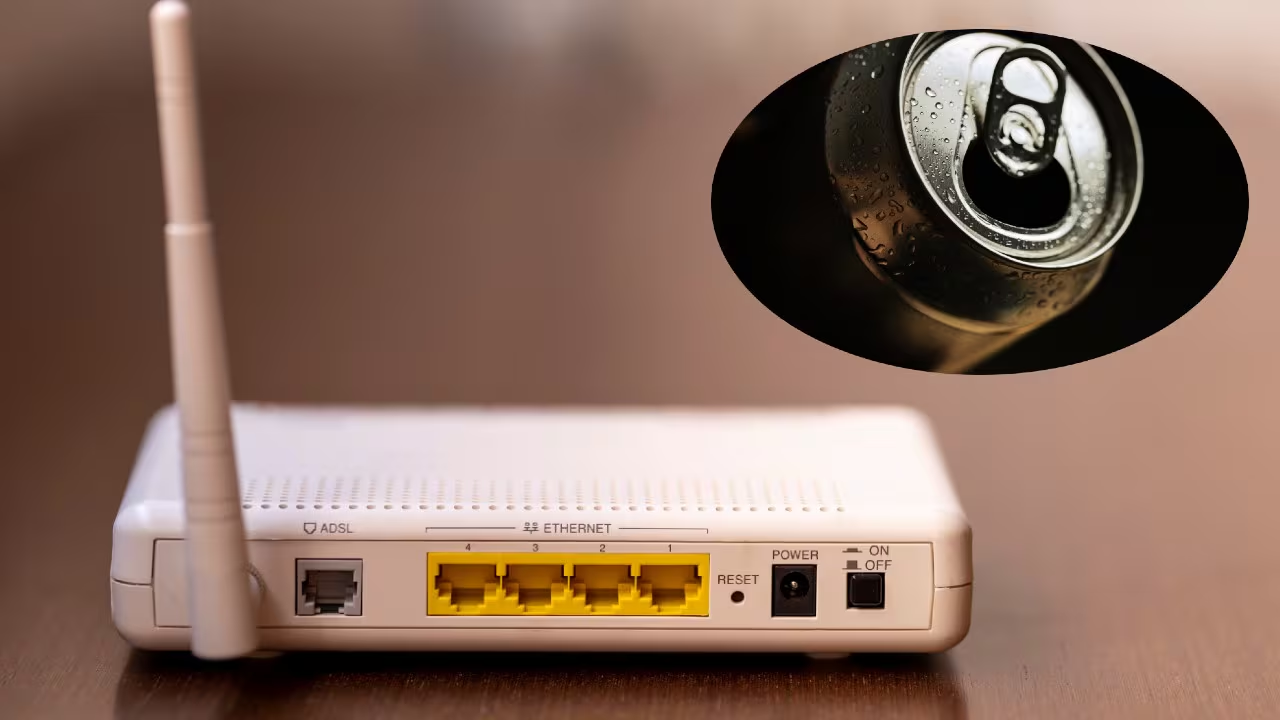
The metallic trick can redirect radio waves, but it does not increase internet speed or create additional transmission power.
Mexico City, June 2026
A popular home experiment claims that an empty beer can placed around a router antenna can improve Wi-Fi coverage, and although the idea may appear improvised, it is based on a genuine principle of radio-frequency engineering. Metal can reflect electromagnetic waves and redirect part of a wireless signal toward a particular area instead of allowing the energy to spread evenly in every direction. The result can sometimes produce a stronger connection in one room or corner of a home, especially when the router is positioned close to an exterior wall. However, the can does not create new power, increase the speed purchased from an internet provider or transform an outdated router into modern networking equipment.
Most domestic routers are designed to distribute their signal across a broad area, which means part of the radio energy may travel toward walls, outdoor spaces or rooms where coverage is unnecessary. A curved section of aluminum positioned behind an antenna can operate as a basic reflector by redirecting some of that energy toward the open side of the metallic surface. This can strengthen reception in one selected direction while simultaneously weakening the signal behind the reflector. The technique therefore redistributes existing coverage rather than amplifying the total amount of energy transmitted by the router.
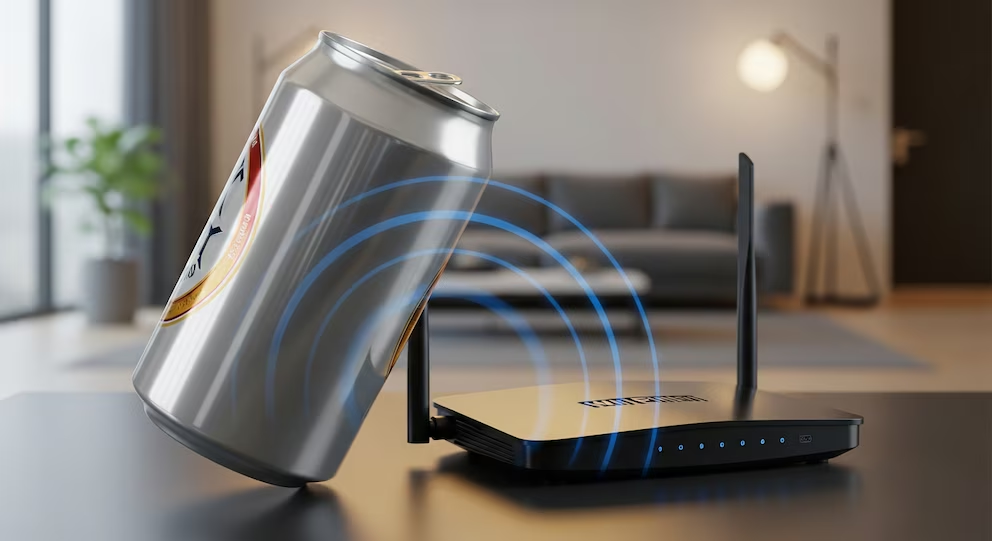
The same physical principle appears in professionally designed directional antennas, satellite dishes and other telecommunications systems that concentrate radio-frequency energy within a defined area. Unlike a household can, however, professional equipment is manufactured according to precise dimensions, frequencies, angles and polarization requirements. A beverage can has not been engineered specifically for Wi-Fi wavelengths, so its performance is inconsistent and highly dependent on placement. The experiment may produce a modest improvement, no measurable difference or even a reduction in network quality.
The trick is most likely to help when the router stands near one side of a house and nearly all connected devices are located in the opposite direction. In that situation, a reflector may reduce the amount of signal being wasted outside the property and redirect part of it toward interior rooms. The open side of the curved metal must face the desired coverage area, while the reflective section remains behind the antenna. Even then, small changes in distance, curvature and orientation can significantly alter the result.
Wi-Fi signals interact constantly with walls, furniture, mirrors, appliances and other metallic surfaces, creating reflections and interference patterns that vary from one building to another. A setup that improves connectivity in one apartment may fail completely in another because construction materials and room layouts affect radio propagation. Thick concrete, reinforced walls and large household appliances can weaken or redirect the signal before it reaches the intended device. For this reason, online demonstrations should not be interpreted as evidence that the method will work universally.
Modern routers create an additional complication because many use several internal or external antennas through multiple-input and multiple-output technology. These systems combine different signal paths to increase speed, stability and coverage, rather than depending on a single antenna pointed in one direction. Placing an improvised reflector around one antenna may disturb the balance the router was designed to maintain. The method is therefore more plausible with basic devices whose external antennas and transmission patterns are easier to identify.
Frequency also affects the outcome because current Wi-Fi networks commonly operate in the 2.4-gigahertz, 5-gigahertz and 6-gigahertz bands. Each band has a different wavelength, range and ability to pass through walls, meaning a reflector that behaves acceptably at one frequency may perform poorly at another. The dimensions of a standard beer can are not optimized for all those bands, and the curvature may redirect some frequencies more effectively than others. This helps explain why the same modification can produce inconsistent results across different devices and network configurations.
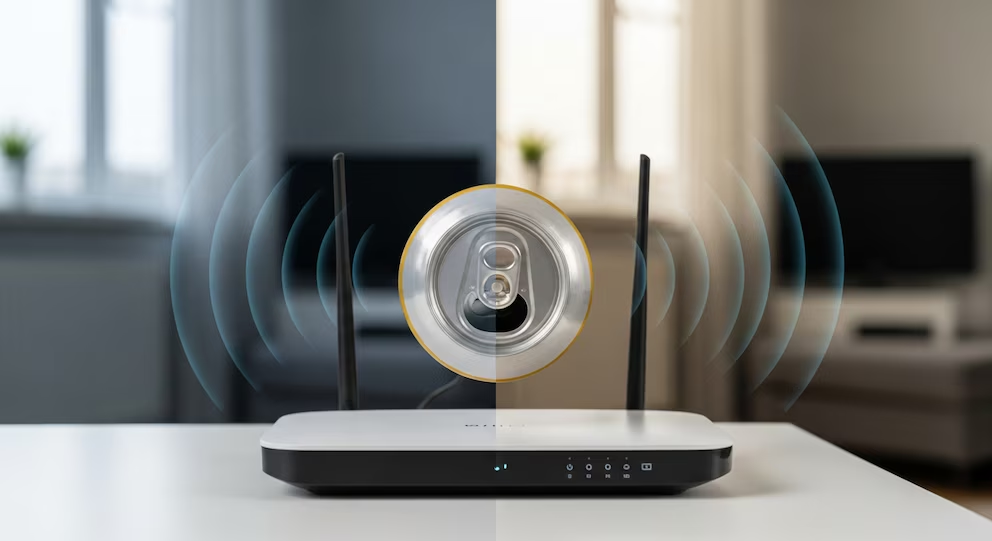
The beer-can method should not be confused with a true cantenna, even though both concepts are frequently presented as if they were identical. A cantenna is a directional antenna built from a metal cylinder using carefully calculated dimensions and an internal radiating element connected to the wireless system. It functions as a waveguide and is intentionally designed to focus radio energy in a particular direction. A cut beverage can placed behind a router antenna generally acts only as a passive reflector and lacks the engineering required to operate as a professional directional antenna.
Another source of confusion is the difference between signal strength and actual internet performance. A phone or computer may display additional Wi-Fi bars after the reflector is installed, but that visual change does not necessarily produce faster downloads, lower latency or a more reliable connection. Network congestion, neighboring routers, the number of connected devices, broadband limits and the capabilities of the receiving equipment also affect performance. A stronger local signal cannot compensate for a slow internet plan or an overloaded network.
The only reliable way to determine whether the experiment works is to compare performance before and after making the modification under similar conditions. Tests should be conducted from the same location, with the same device and while the network is carrying a comparable level of traffic. Users should measure download speed, upload speed, latency and signal strength across several attempts rather than relying on a single favorable result. Normal fluctuations can otherwise be mistaken for an improvement caused by the metal reflector.
Safety must also be considered because cutting an aluminum can creates sharp edges capable of causing serious cuts. The metal should never touch electrical contacts, exposed wiring, ventilation openings or internal router components. It must not cover the device or restrict airflow, since routers generate heat and require adequate ventilation to operate properly. A poorly positioned reflector may therefore create physical risks while delivering little or no networking benefit.
There are usually more effective ways to improve Wi-Fi coverage before attempting improvised modifications. Moving the router to a central, elevated and unobstructed position can produce a greater improvement without altering the antenna system. Keeping it away from microwave ovens, large metal objects, enclosed cabinets and thick structural walls may also reduce interference. Updating the firmware and selecting a less congested wireless channel can further improve performance at no additional cost.
Homes with persistent dead zones may require equipment designed specifically for broader coverage. A mesh Wi-Fi system, a properly positioned access point or a wired Ethernet connection offers more predictable results than a homemade reflector. These alternatives involve additional expense or installation work, but they are built to manage multiple rooms, devices and signal paths efficiently. They also avoid the uncertainty associated with reshaping the router’s transmission pattern through trial and error.
The beer-can experiment therefore occupies an unusual space between technological myth and legitimate physics. Its central principle is real because metal can reflect and redirect radio waves, but its practical value depends heavily on the router, frequency, room layout and exact positioning. In some circumstances, the modification may slightly improve reception in one direction while reducing it elsewhere. It cannot increase transmission power, repair a poor broadband connection or replace professionally designed networking equipment.
Una lata puede redirigir la señal, pero no crear la velocidad que la red nunca tuvo. / A can may redirect the signal, but it cannot create speed the network never had.