

 Phoenix 24
The federal government is deploying biometric technology to accelerate identification and strengthen customs controls, while the expansion raises questions about privacy and the treatment of sensitive personal data.
Brasília, Brazil, August 14, 2026.— Brazil is expanding the use of facial-recognition systems at airports, maritime terminals and land-border crossings as part of a broader modernization of passenger identification and customs enforcement.
The Federal Revenue Service awarded NEC Latin America a contract worth approximately 13.49 million reais to provide a customized facial-recognition platform, equipment, software licenses, installation, technical support and staff training.

The agreement began in April 2026 and is scheduled to remain in force until April 2031. The system will be integrated with government platforms selected by the agency and installed at strategic points of entry and departure.
Facial images can be compared with official databases to verify a traveler’s identity, detect possible document fraud and support the identification of people sought by authorities. The technology may also reduce the time required for manual inspections.
The project coincides with Brazil’s National Biometric Policy, which seeks to standardize identity verification across airports, ports and inland waterways. Under that program, passengers may undergo facial validation when entering secure departure areas and again before boarding.
Government officials argue that the system will reduce queues, improve operational efficiency and allow personnel to concentrate on higher-risk cases. Biometric databases are expected to be managed through federal digital infrastructure with access controls, traceability and cybersecurity protections.
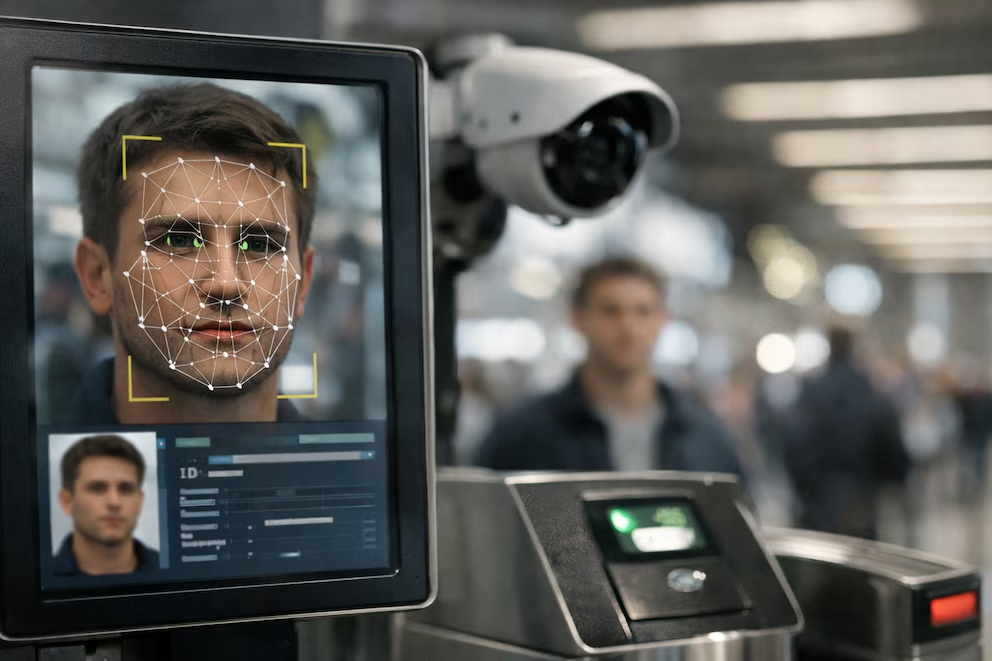
Facial information is classified as sensitive personal data under Brazil’s General Data Protection Law. Authorities maintain that individual consent may not be required when biometric processing is performed for an authorized public-security or critical-infrastructure purpose.
That exemption does not eliminate the government’s obligations. The system still requires clear limits on how information is collected, retained, shared and deleted, as well as mechanisms allowing people to challenge an incorrect identification.

Independent audits will be essential because facial-recognition systems can produce false matches and may perform differently across demographic groups. An automated alert should therefore support an investigation rather than function as sufficient evidence for detention or punishment.
Brazil’s expansion illustrates the tension surrounding biometric borders: the same technology capable of simplifying travel can also create a permanent identification infrastructure if safeguards, transparency and human oversight fail to develop at the same pace.
Technology advances, but responsibility remains human.