

 Phoenix 24
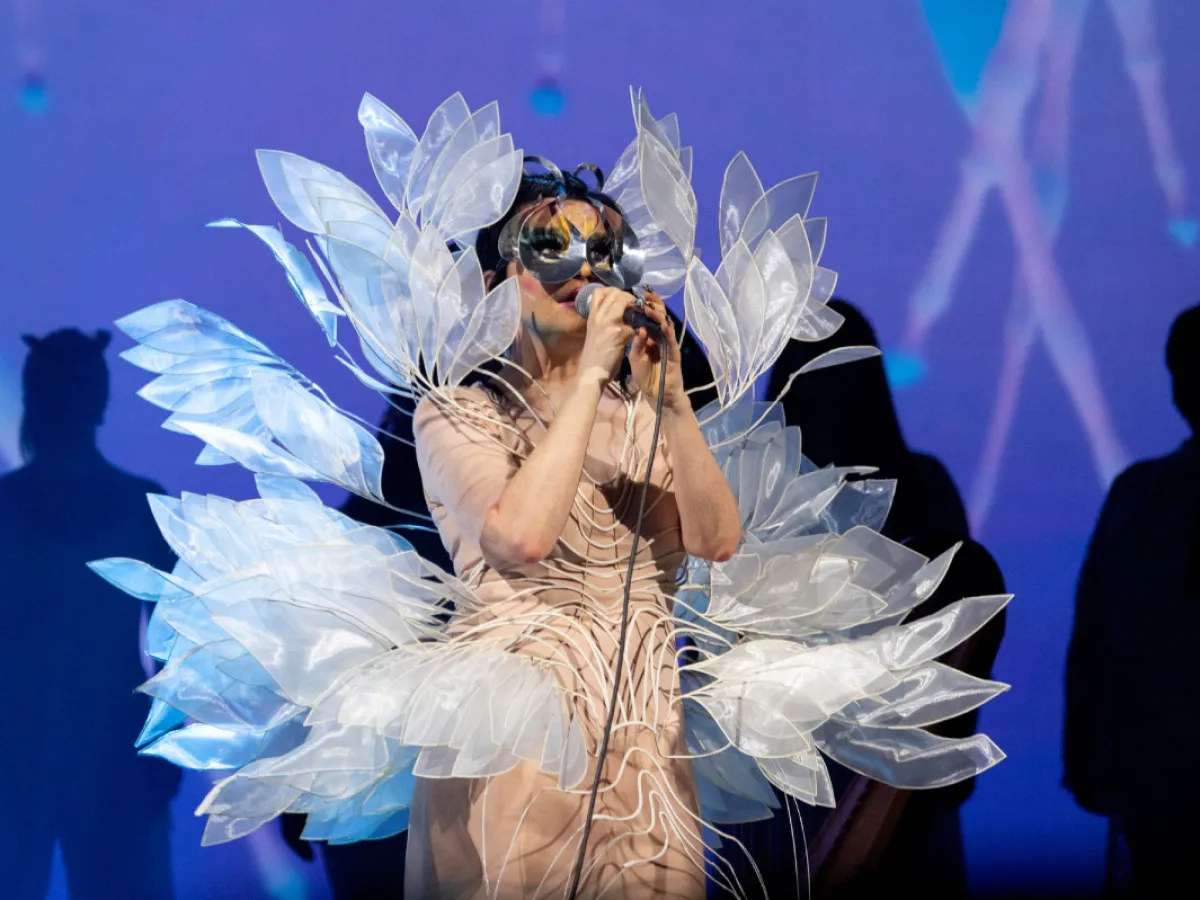
A rave turns astronomy into artistic myth.
Reykjavík, April 2026
Björk is preparing to celebrate this year’s total solar eclipse with an event that feels entirely consistent with the logic of her career: part concert, part ritual, part aesthetic provocation. Rather than marking the celestial event through a conventional performance, the Icelandic artist is set to anchor a rave in the path of totality, transforming an astronomical phenomenon into a cultural experience shaped by sound, atmosphere and symbolism. The gesture is striking not simply because it is unusual, but because it reflects how certain artists no longer merely participate in culture. They stage worlds.
The event has been presented as the Echolalia Festival, a one-day gathering scheduled for August 12 in Hafnarfjörður, Iceland, at the Víðistaðatún sculpture park. Its geographic position matters because the site lies within the band of totality, which means attendees are expected to witness the full eclipse while the moon completely obscures the sun for just over a minute. That brief duration is part of the power of the concept. Total eclipses are rare, compressed and emotionally charged experiences. Björk appears to be building a live event around that exact structure of intensity: fleeting darkness, heightened perception and collective immersion.
What makes this more than a curiosity is the way it aligns with Björk’s long-standing artistic grammar. Her career has been built on treating music not as an isolated product but as an ecosystem of image, nature, body, technology and myth. In that framework, an eclipse is not just a scientific event. It is a stage condition. It offers a ready-made atmosphere of rupture and wonder, precisely the kind of threshold moment that her public persona has always known how to inhabit. A rave under totality therefore does not feel like an eccentric side project. It feels like a continuation of a worldview.
There is also a distinctly Icelandic layer to the event. Iceland has long occupied a privileged place in the global imagination as a landscape of extremes: volcanic, glacial, remote and visually charged with a kind of elemental drama that many artists and tourists alike read as spiritually heightened. By placing the festival in that setting, the event acquires more than geographic context. It acquires narrative density. Björk is not borrowing some abstract cosmic backdrop. She is using her own national terrain as the stage on which nature, art and identity can briefly converge.
The reported presence of Arca as part of the musical programming adds another important dimension. Arca is not simply an electronic collaborator or complementary booking. She represents a contemporary experimental sensibility that matches the event’s ambition to turn listening into atmosphere and performance into altered space. The pairing suggests that the festival will not be constructed as a nostalgic celebration of Björk’s legacy, but as an active, current expression of avant-garde cultural circuitry. In other words, this is not an eclipse-themed gimmick. It is a carefully coded event aimed at audiences who understand music as environment and identity as performance.
The timing also intersects with another major cultural move in Björk’s orbit: her exhibition at the National Gallery of Iceland, scheduled to run from late May to mid-September. That overlap matters because it turns the eclipse rave into part of a broader season of presence rather than a standalone happening. The gallery show reportedly includes new songs, among them material linked to a still-unannounced album, which suggests that the festival may serve not only as spectacle but as narrative bridge. Björk is not merely appearing in public. She is arranging a larger cycle of visibility across museum space, live experience and anticipated recording work.
Politically, the event sits within a period in which Björk has remained publicly outspoken beyond music itself. Recent interventions around Greenland and her visible support for the cultural boycott campaign against Israel show that her public identity continues to extend into questions of sovereignty, colonialism and ethical alignment. That does not mean the eclipse rave should be reduced to politics, but it does mean the event emerges from an artist whose symbolic choices are rarely empty. Björk understands staging, and she understands that where and how one appears can communicate as much as what one sings.
There is a broader lesson here about the current cultural economy. In an age saturated with tours, festival lineups and algorithmic promotion, distinctiveness is no longer secured by visibility alone. It is secured by context. The artists who remain memorable are often the ones capable of embedding their work in a larger narrative field. Björk has mastered that logic for decades. She does not simply release music or announce appearances. She frames moments. A total eclipse, with its built-in sense of rarity and cosmic interruption, offers exactly the kind of stage on which such framing can feel inevitable.
This is why the event resonates beyond music journalism. It reveals how contemporary cultural influence often works at the intersection of spectacle, place and symbolic intelligence. A rave during an eclipse in Iceland is, on one level, an extravagant artistic gesture. On another, it is an efficient reminder that certain figures retain power not because they follow the rhythms of the industry, but because they can still bend public attention around an idea. Björk continues to do that with uncommon precision.
In the end, the most interesting part of this story is not that Björk chose a rave to mark an eclipse. It is that the choice feels so perfectly calibrated to her mythology that it instantly becomes legible as an event larger than entertainment. For a few seconds of midday darkness, music, landscape and celestial timing will collapse into one shared image. That is the kind of cultural moment ordinary pop acts consume. Björk, by contrast, still knows how to create one.
Detrás de cada dato, hay una intención. Detrás de cada silencio, una estructura.
Behind every data point, there is an intention. Behind every silence, a structure.