

 Phoenix 24
Efficiency is turning into a competitive weapon.
Warsaw, February 2026.
In major apple-producing regions, the classic harvest scene is being redesigned. Ladders, long picker lines, and last-minute labor scrambles are giving way to mechanized workflows built around one hard constraint: harvest windows are tightening while labor is scarcer, costlier, and less predictable. The shift is not about building a humanoid with perfect fingers. It is about redesigning the orchard, the machinery, and the logistics chain so fruit moves from tree to bin with fewer human bottlenecks and fewer time losses.
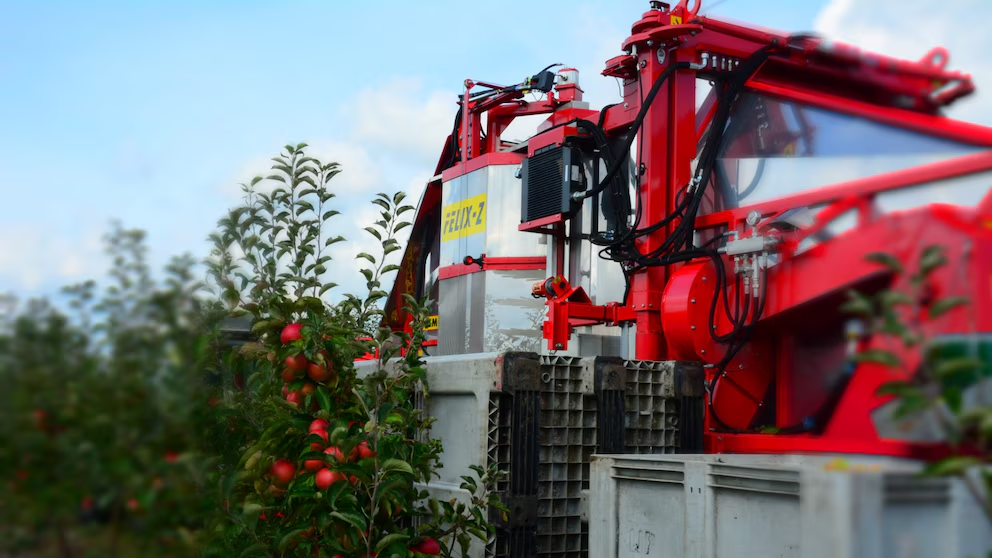
A machine highlighted in recent coverage is a tractor-mounted apple harvester developed by the Polish manufacturer WEREMCZUK, often referenced under the FELIX family. Its approach is blunt but effective for certain harvest realities: it moves through trellised rows and uses vibrating harvesting heads to detach fruit. Instead of letting apples crash to the ground, the system “catches” them on flexible conveyors, then routes them through a controlled flow that can include basic cleaning and handling before the fruit is collected into large bins. The point is not to eliminate human labor entirely, but to compress the number of workers needed across picking, gathering, and staging, while keeping throughput steady.
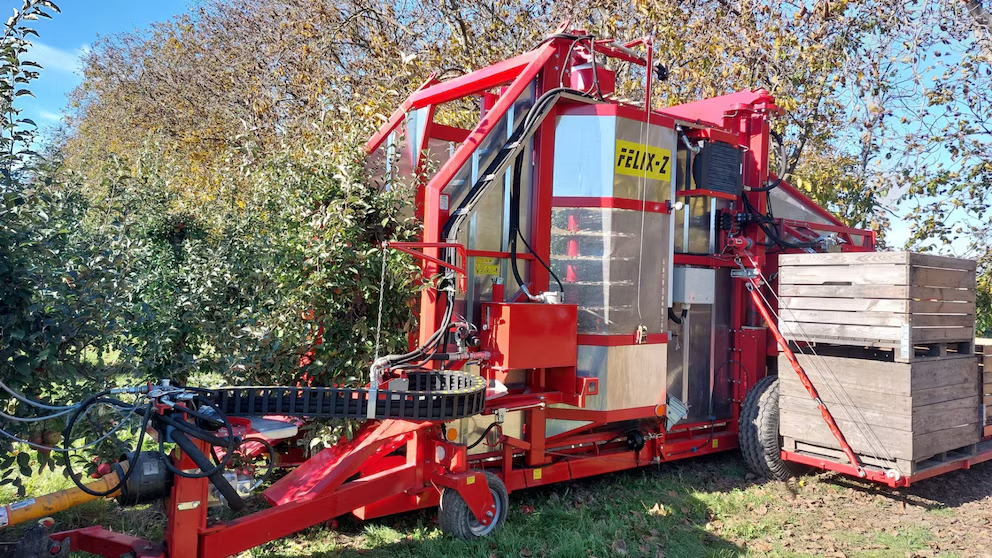
This only works because modern orchard design has been evolving in the same direction. High-density, trellis-based planting creates predictability: consistent row spacing, controlled canopy shape, and a repeatable path for machines. Mechanization feeds on repeatability. When trees are trained into architectures that machines can reach, harvesting becomes less an improvisation and more a scheduled operation. In that model, the orchard behaves like a production line in open air, and the limiting factors shift from “how many pickers showed up” to “how fast can the system move bins, trailers, and storage intake without backing up.”
The economics are what push the transition from interesting to inevitable. In commercial orchards, harvest labor is often one of the largest variable costs. When weather risk rises and price competition stays relentless, delays in picking translate directly into quality loss and margin erosion. Mechanization changes the risk profile: labor exposure goes down, but capital exposure goes up. Maintenance becomes strategic. A breakdown is no longer an inconvenience; it is a system failure that can ripple into missed deliveries, storage congestion, and contract penalties. The farm starts managing uptime the way an industrial operation does.
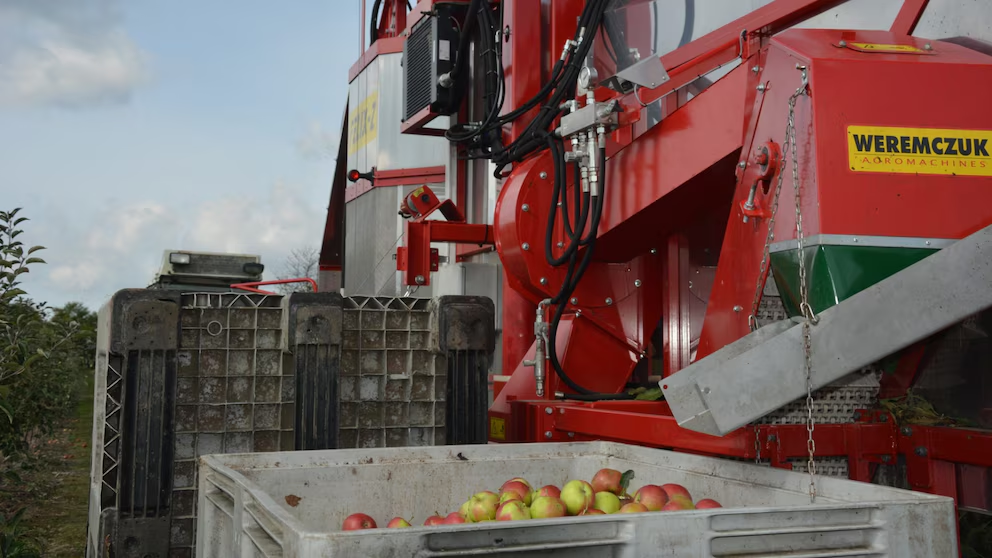
Not all apples benefit equally from this kind of mechanization, and that nuance is crucial. The most immediate fit is fruit destined for processing, where minor bruising is acceptable because the output is juice, purée, or cider. In that segment, shake-and-catch systems can scale faster because the market does not punish cosmetic imperfections as harshly. For premium fresh-market apples, appearance is part of the product, and damage tolerance is much lower. That is why many orchards still rely heavily on people for top-grade fresh fruit, even as they adopt platforms and assisted systems to reduce strain and speed movement. The result is a two-track harvest economy: automation concentrates on high-volume throughput, while humans remain where quality thresholds are unforgiving.
This is not a purely European story, even if Europe’s orchard structure makes it especially visible. North America is pursuing heavier robotics and sensor-driven picking in some regions, while other systems favor mechanization that increases speed without requiring delicate end-effectors. In parallel, Israel and Australia have showcased different approaches, including autonomous robotic systems aimed at selective harvesting. These strategies differ in mechanics, but they converge on the same structural reality: harvesting is becoming a platform race defined by uptime, workflow integration, and the ability to operate reliably in messy, real orchards.

The deeper consequence is political and economic, not just technical. Mechanized harvesting tends to favor growers who can finance equipment, redesign orchards, and absorb downtime risk. That can accelerate consolidation, shift rural employment patterns, and change bargaining power between growers, processors, and retailers. Over time, the orchard becomes less a field and more a factory without walls, where the scarce inputs are capital, maintenance talent, logistics capacity, and dependable energy. Automation does not simply replace people. It rewrites who can compete, and on what terms.
Detrás de cada dato, la intención. / Behind every data point, the intention.