

 Phoenix 24
When a scorecard becomes a geopolitical problem.
Milan, February 2026.
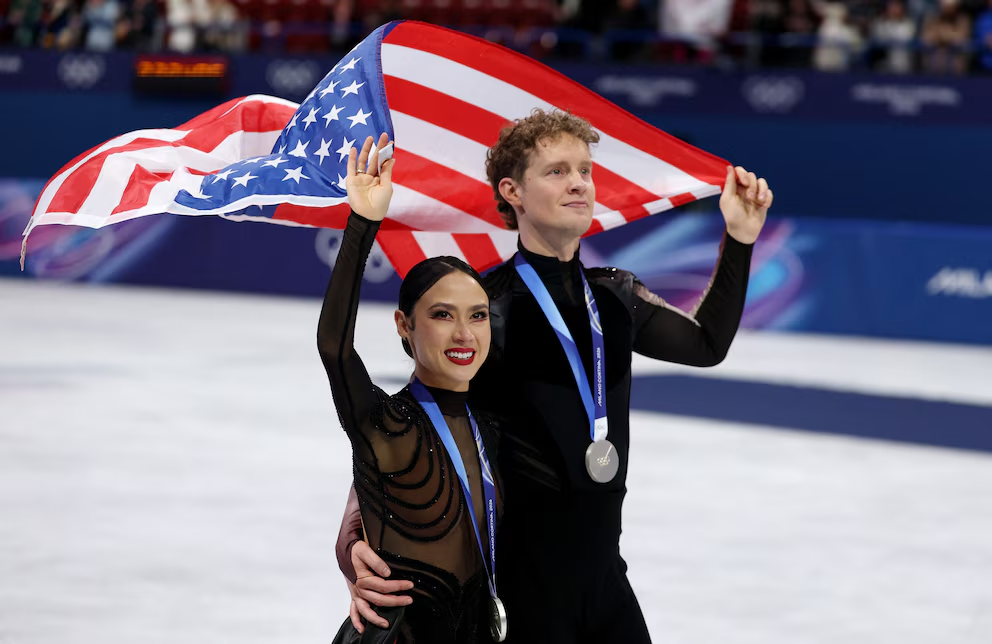
A judging sheet, not a fall on the ice, has become the most disputed artifact of the Winter Games. The allegation centers on Jézabel Dabois, the French judge on a nine member panel for Olympic ice dance, after France’s Laurence Fournier Beaudry and Guillaume Cizeron edged the American team of Madison Chock and Evan Bates for gold by 1.43 points. The controversy is not about whether ice dance is subjective, everyone in the sport accepts that premise. It is about whether one judge’s outlier scoring can still tilt an outcome in a system that claims it is engineered to prevent exactly that.
The raw numbers are what turned suspicion into a headline. In the free dance, Dabois awarded 137.45 points to the French pair and 129.74 to the Americans, a gap of 7.71 points that stood far outside the spread among the other judges. In the rhythm dance, the pattern repeated, with 93.34 for France and 87.60 for the United States, a separation close to six points. When the margin for gold is smaller than the distance created by one judge’s divergence, the public does not read it as nuance. It reads it as leverage.
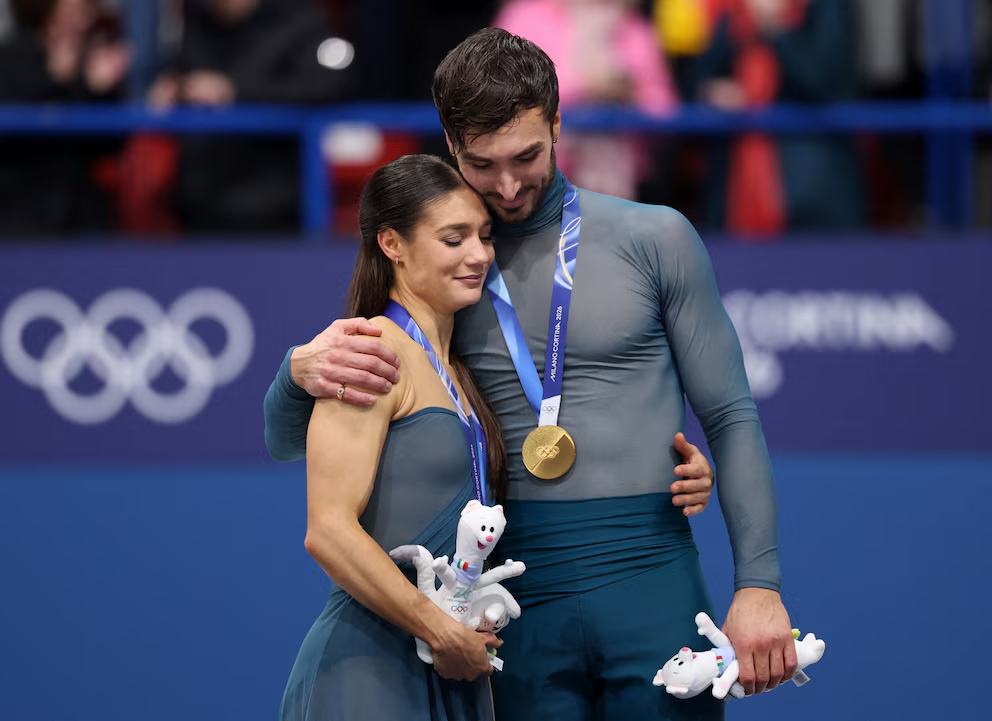
The International Skating Union has defended the integrity of its scoring, arguing that variation across a judging panel is normal and that safeguards are built into the mathematics of the result. Under the current system, the highest and lowest marks for elements and program components are discarded before averaging, a trimmed mean designed to blunt the power of extremes. Officials have leaned on that mechanism to say that outlier marks do not automatically decide medals. Yet that reassurance often fails at the exact point where trust breaks, because spectators are not only reacting to arithmetic. They are reacting to the perception that a human gatekeeper can still push the sport toward an outcome that feels pre selected.
This is why a petition for an inquiry gathered momentum quickly and why the issue is larger than one competition. Chock and Bates have largely avoided attacking the officials, focusing instead on pride in delivering what they describe as their best performance. Still, even restrained comments from athletes can carry a warning label: when audiences cannot understand why one skate wins over another, the sport’s legitimacy erodes in real time. In judged events, legitimacy is the product, and medals are the proof of purchase. Once the proof looks inconsistent, the institution is forced into reputational defense rather than celebration.
The deeper problem is structural, not personal. Modern figure skating scoring was rebuilt after the early century scandals that stained the sport, moving away from the simpler 6.0 framework toward a technical and component based system that promised transparency and reduced backroom bargaining. The new architecture is more granular, but it is also more opaque to non specialists, because program components and levels of difficulty are hard to translate into intuitive “who skated better” narratives. Complexity was meant to reduce corruption risk, yet complexity can also camouflage discretion. In a world trained by analytics, fans do not accept “trust us” as a sufficient explanation.
Context also matters, because audiences interpret scoring through the stories they already believe. The French champions arrived under unusual scrutiny beyond the rink, partly because the partnership is relatively new at the highest level of international competition. Reports note that Fournier Beaudry switched national representation to France and debuted internationally with Cizeron only months before the Games, then surged quickly into gold contention. Separate reporting has described allegations and disputes involving former partners, including a memoir by Cizeron’s former teammate Gabriella Papadakis that portrayed him as controlling, alongside public controversy tied to Fournier Beaudry’s previous partnership. None of that proves bias, but it creates a primed environment where any anomalous score feels like confirmation of an insider system protecting its own.
That is the pattern the Olympic brand keeps confronting: sport is sold as a clean contest, but governance is always political because it decides whose excellence becomes official history. When the International Olympic Committee declines to comment, or when a federation signals that review mechanisms are limited unless it chooses to open them, the vacuum invites speculation. In today’s attention economy, speculation scales faster than adjudication, and the institution pays the price even if no wrongdoing is ultimately found. The irony is that the more the federation defends its system as sophisticated, the more it implicitly asks the public to accept outcomes it cannot easily verify.
What happens next is less about overturning a podium and more about whether the sport can re secure trust without surrendering the subjectivity that defines it. Under current rules, teams have limited avenues to challenge results unless the federation elects to review judging conduct, which makes institutional willingness the real bottleneck. If leaders want to calm the legitimacy bleed, the most effective moves are procedural rather than rhetorical: clearer publication of how component marks were justified, tighter oversight of extreme deviations, stronger vetting and performance review of judges, and a communications model that treats confused fans as stakeholders rather than outsiders. The Olympics do not only reward winners; they also train the public in what fairness looks like, and the training is failing when the scoreboard feels like a closed language.
Hechos que no se doblan. / Facts that do not bend.