

 Phoenix 24
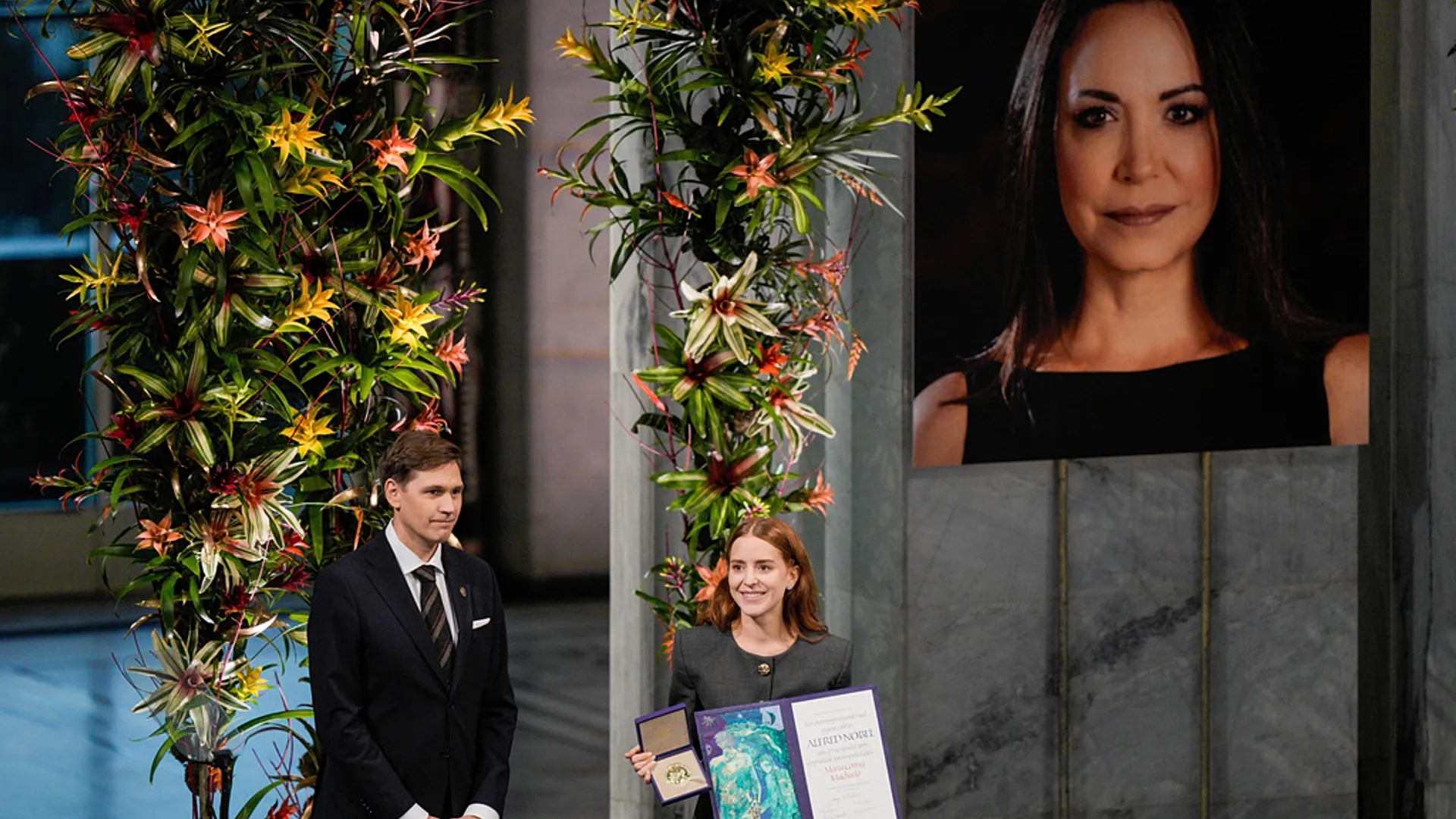
The absence of a recipient can sometimes define a ceremony more powerfully than any speech delivered on stage.
Oslo, December 2025.
The Nobel Peace Prize ceremony opened today in the Norwegian capital with an unexpected void at its center, as Venezuelan political figure María Corina Machado did not appear to receive the world’s most emblematic peace distinction. Her absence, confirmed only hours before the event, reflected a convergence of legal obstacles, travel restrictions and growing pressure from Venezuelan authorities who have pursued investigations against her on charges ranging from alleged conspiracy to public incitement. While the Norwegian Nobel Committee maintained until the last moment that she intended to travel, the political environment surrounding her made departure nearly impossible.
The medal and diploma were instead collected by her daughter, who represented the family before an audience of diplomats, researchers and human rights observers. Her presence in Oslo underscored the symbolic weight of the award, but also highlighted the risks faced by dissidents who challenge entrenched power. Analysts referenced by the Center for Strategic and International Studies noted that international recognition often magnifies the vulnerability of political opponents in authoritarian contexts, especially when criminal charges are used to restrict movement and silence criticism. European commentary cited by Le Monde situated the case within a broader pattern in which exiled or persecuted figures are honored abroad while confronting punitive constraints at home.
Security experts referenced in reporting by the Associated Press added that the pressure on Machado intensified shortly after her nomination, with inquiries expanding inside Venezuelan institutions and increasing surveillance around her political network. The Reuters network, drawing on diplomatic sources across Europe, underscored that the prospect of her international travel had become uncertain for weeks, despite her stated intention to attend the ceremony. Her inability to leave the country now positions her among a small group of laureates prevented from claiming the prize in person due to political or judicial restrictions.
Observers from the Lowy Institute noted that the symbolism of an empty chair in Oslo reverberates far beyond Venezuela’s borders, framing the award as a message about democratic resilience and state control in Latin America. The Norwegian Committee had highlighted Machado’s decades long activism in defense of civil liberties, and her recognition was interpreted by analysts as a broader indictment of democratic regression in the region. Her absence, therefore, served not merely as a procedural footnote but as evidence of the environment she has long denounced.
Inside the ceremony hall, the reaction blended solemnity with a sense of geopolitical clarity. Western diplomats viewed the moment as a reminder of the tension between international advocacy and domestic repression. Analysts from SIPRI observed that peace prizes granted under authoritarian pressure tend to acquire a dual function, honoring an individual while signaling global concern about the civic space of an entire nation. This duality shaped audience reception as her daughter delivered a restrained message centered on perseverance, democratic conviction and the hope that Venezuela might one day restore full political rights for its citizens.
Across Oslo’s institutional corridors, discussions also touched on the precedent of laureates absent due to state pressure. Scholars referenced by the Jacques Delors Institute emphasized that the power of such absences often lies in their ability to reveal the contradictions between a regime’s external diplomacy and its internal punitive mechanisms. Machado’s case aligns with this pattern, reinforcing the idea that the honor bestowed upon her is inseparable from the constraints preventing her travel.
The ceremony concluded without the customary images of the laureate holding the medal, yet the missing figure became the defining symbol of the event. The empty chair stood as a representation of silenced dissent, transforming what might have been a celebration into a political statement about visibility, risk and democratic erosion. In the aftermath, Oslo’s narrative shifted from the glamour of a global award to the sobering reality of a struggle that continues far from the stage.
Phoenix24: clarity in the grey zone. / Phoenix24: claridad en la zona gris.