

 Phoenix 24
Milestones do not erase contradictions, and ninety years are enough to show how a life can be luminous and troubling at once.
New York, November 2025
Woody Allen reaches ninety this week, a milestone that places him in a rare category of filmmakers whose influence spans multiple generations yet remains inseparable from a public debate that refuses to fade. His name continues to evoke the same duality that has followed him for decades. On uncountable screens around the world, he is a reference point for modern cinematic language. Outside those screens, he remains a figure entangled in unresolved tensions. This combination of artistic recognition and moral controversy frames a birthday that is anything but symbolic.
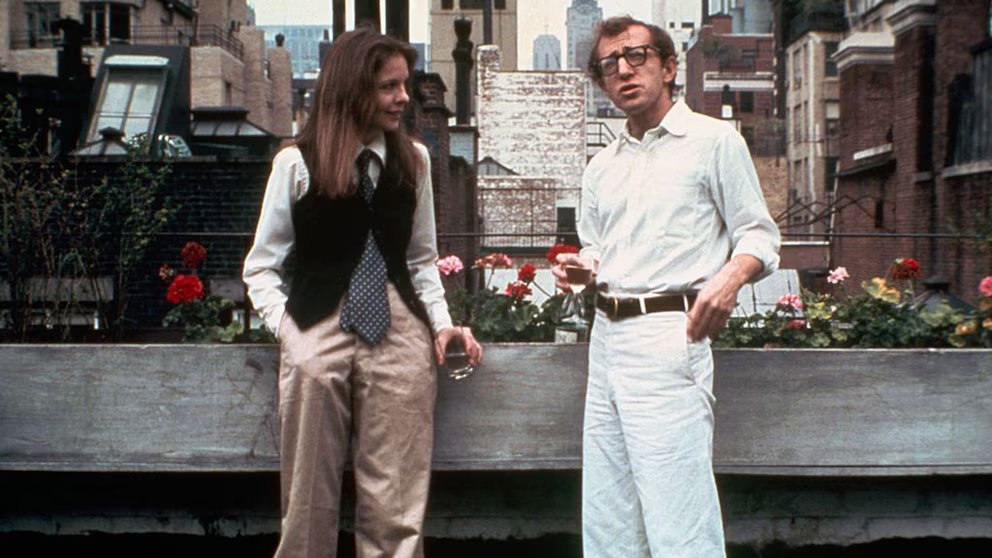
From his early years in New York comedy clubs to his breakthrough in American cinema, Allen shaped a style that critics across North America describe as deeply urban, cerebral and rhythmically unique. His films fused literary irony with emotional fragility, producing a body of work that reshaped the expectations of romantic comedy and psychological drama. European film scholars have long pointed out that his influence runs parallel to broader currents in continental cinema, echoing existential traditions while adding a distinctly American sensibility. It is an unusual synthesis that helped define his legacy long before the controversies emerged.
Yet any account of his career must confront the magnitude of those controversies. Allegations that resurfaced repeatedly since the nineties continue to divide audiences, institutions and critics. Some cultural commentators in Europe note that while the artistic community once insulated him from public scrutiny, today the cultural climate demands accountability that was absent in previous decades. In Asia and North America, debates on ethics, memory and power in the entertainment industry often return to his case as a point of reference. The contradiction between the acclaim he accumulated and the accusations he faced has created a fracture that no anniversary can resolve.
Despite this, Allen’s artistic activity has not disappeared. His most recent films, shot mostly in European cities, still attract attention from festival programmers and cinephiles. Observers in cultural circles across Asia argue that his persistence is part of what keeps the debate alive. They point out that he is neither retired nor marginalized. Instead, he continues to work, publish and direct, adding new pieces to a filmography that already exceeds fifty titles. His recent experiments in fiction writing reveal yet another layer of introspection woven into his creative identity.

The complexity of his legacy becomes even more visible when examining the global reception of his work. In the United States, major publications still revisit his early films as cultural landmarks even as they acknowledge the moral discomfort surrounding his personal life. In European cinematic institutions, retrospectives often provoke public disagreements, with some viewers demanding contextualization and others insisting that artistic merit stands apart from biography. In Asian markets, younger audiences encounter his work mostly through streaming platforms, which creates a detachment from the political and cultural battles that shaped his earlier reception. That generational gap has added new ambiguity to his standing, as admiration and unease intersect in different ways depending on the context.
Such divergences underline the enduring tension between the artist and the allegations. Supporters claim his work should be judged independently from his personal life. Critics argue that the industry’s past silence contributed to broader injustices. For both sides the debate is emblematic of a larger struggle within global culture, one that questions how society should handle legacies marked by both creative achievement and ethical controversy.

Reaching ninety does not settle the matter. It intensifies it. It forces a reconsideration of how cultural figures are remembered and how their influence persists even when their reputations are contested. Allen himself has often played with themes of guilt, doubt and identity in his films, but the irony of seeing these themes mirrored in his real-world reception is not lost on scholars. Some academics in North America describe his life as a narrative that continues to unfold, one that mirrors the contradictions of modern public memory.
His anniversary, therefore, functions not as a celebration but as a lens through which a complex legacy becomes more visible. The longevity of his career, the breadth of his influence, the depth of the controversies and the conflicting feelings he provokes all converge in a moment that resists easy reading. To some he remains an auteur whose films changed the texture of modern cinema. To others he remains a symbol of an industry that failed to confront uncomfortable truths.
Ninety years after his birth, Woody Allen stands at the intersection of admiration and repudiation, legacy and dispute, art and accountability. The tension between those realms is likely to shape the way future generations interpret his work. His films will continue to circulate, his controversies will continue to be debated, and his name will continue to evoke the paradox of an artist whose influence is neither erasable nor uncontroversial. In that unresolved tension lies the real meaning of this milestone.
Phoenix24: every silence speaks
Phoenix24: cada silencio habla