

 Phoenix 24
When the sky ceases to be a digital dead zone, flying will also mean being connected.
San Francisco, October 2025.
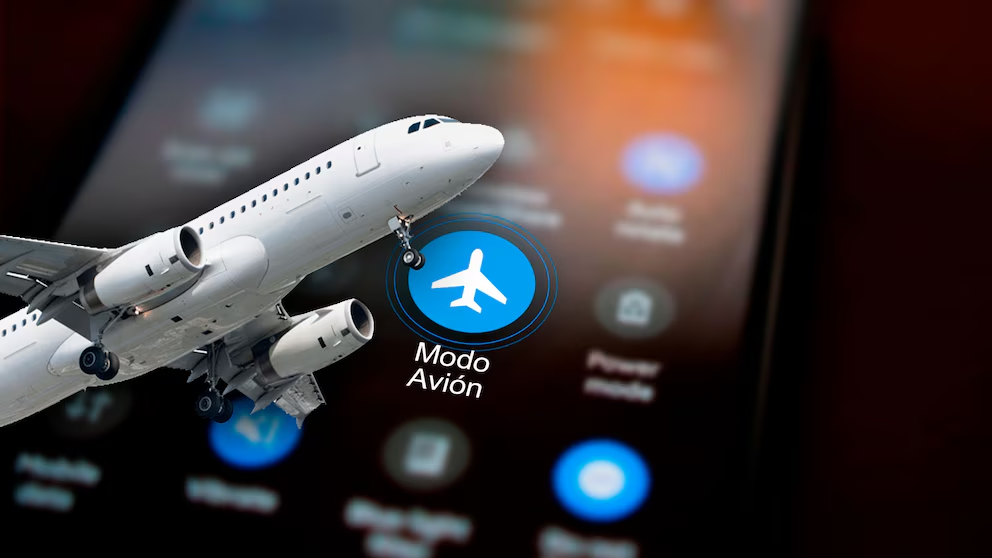
Elon Musk shook the global technology sector with a promise that could redefine the flight experience: to eliminate airplane mode in commercial aviation through a new satellite network integrated with Starlink Aviation. The announcement, delivered at a global connectivity forum, marks a potential structural shift in how passengers communicate thousands of meters above the ground.
According to Musk, the upcoming version of Starlink will enable stable, high-speed internet on airplanes without interfering with navigation systems. The project, developed jointly by SpaceX and multiple airlines in the United States, Europe, and Asia, aims to transform airspace into an extension of terrestrial internet. Technically, the new low-profile satellite terminals will be embedded into aircraft fuselages and synchronized with ground-based 6G networks to reduce latency and cost.
The proposal arrives at a moment when the aviation industry is reimagining the passenger experience in the post-pandemic era. Until now, in-flight internet has depended on slow or expensive systems that rely on geosynchronous satellites or limited terrestrial relays. Starlink promises speeds above 200 megabits per second per user and latency below 25 milliseconds, a performance level previously unimaginable for air travel.
The Federal Aviation Administration faces the challenge of certifying electromagnetic compatibility between these terminals and aircraft flight instruments. However, early tests conducted on Delta and Qatar Airways aircraft have shown full stability during takeoff and landing phases.
In Brussels, the European Union Aviation Safety Agency confirmed that it is evaluating a unified regulatory framework that would allow flights to operate with full connectivity without activating the traditional airplane mode. If approved, the system could begin rolling out in 2026, initially on transatlantic and Asia-Pacific routes.
Economists at the Peterson Institute note that the initiative will also reshape the commercial aviation business model. Airlines could introduce premium connectivity tiers or personalized real-time advertising as new revenue streams. Yet cybersecurity specialists warn that continuous network access in-flight increases the potential attack surface for hackers and state surveillance operations.
Beyond the economics, Musk’s initiative embodies a symbolic ambition: to erase the final physical boundary of the digital world. For him, connectivity represents both infrastructure and ideology. “No one should disconnect just because they’re flying,” he stated during his presentation. The phrase condenses a worldview in which Earth and sky merge into a single, seamless data field sustained by satellites.
Experts argue that the success of this transformation will depend on balancing technological enthusiasm with safety and privacy safeguards. The end of airplane mode could become both a natural and disruptive milestone, ushering in an age where even at ten thousand meters, the world remains permanently online.
Information that anticipates futures. / Información que anticipa futuros.