

 Phoenix 24
Software creation is becoming conversational.
New York, June 2026
IBM has introduced Bob, an artificial intelligence platform designed to create websites, mobile applications, video games, and digital products from natural-language instructions. The tool promises to let users build software without writing code, placing another layer of pressure on one of the most important assumptions in the digital economy: that technical creation still belongs primarily to engineers.
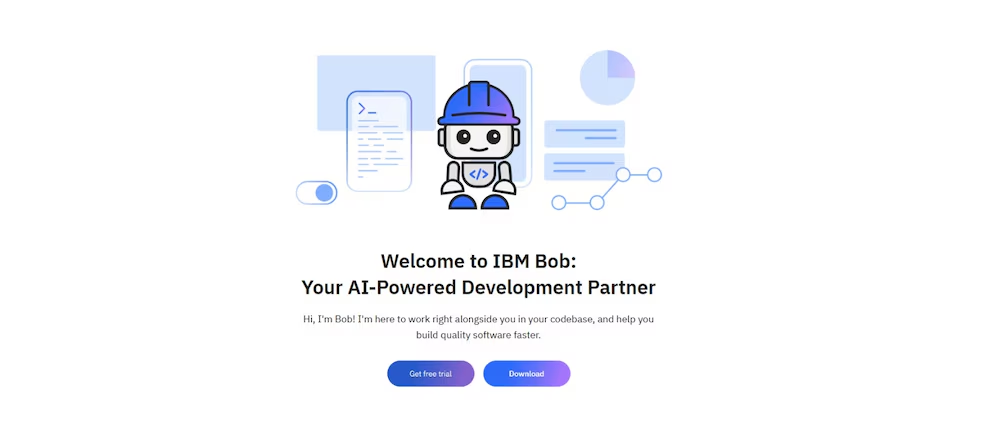
Bob is not presented as a simple code assistant. It works as an integrated development companion capable of reading repositories, interpreting user intent, applying organizational standards, and assigning tasks to different AI models depending on quality, cost, and performance. That model-agnostic structure makes it more than a productivity tool. It is an attempt to turn software development into an automated workflow where human direction replaces much of the manual construction process.
The implications are immediate for non-technical users, startups, educators, entrepreneurs, and small businesses. A person who once needed a developer, a designer, and a prototype budget may now be able to describe an idea and receive a functional draft in minutes. That does not eliminate engineering, but it changes the entry barrier. The first version of a product is no longer necessarily a technical act; it becomes a conceptual one.
For developers, the challenge is more complex. Junior roles may face the greatest disruption because many early-career tasks involve scaffolding, repetitive coding, debugging, documentation, and prototype construction. Senior engineers, however, may become more valuable if they can supervise AI output, audit architecture, manage security, evaluate performance, and translate business needs into reliable systems. The profession does not disappear, but its center of gravity shifts.

The risk is that speed can create false confidence. Software generated in seconds still requires testing, governance, cybersecurity review, accessibility checks, data protection, and long-term maintenance. A website or app may look finished before it is structurally sound. That gap between appearance and reliability is where the next generation of digital failures could emerge.
Bob’s arrival confirms that artificial intelligence is moving from assisting knowledge work to restructuring production itself. The question is not whether AI can create code. It already can. The real question is whether society can distinguish between software that is quickly generated and software that is professionally engineered. In that distinction, the future of digital labor will be decided.
Behind every data point, the intention. / Detrás de cada dato, la intención.