

 Phoenix 24
American stone will receive an Italian neoclassical transformation.
WASHINGTON, D.C.
Indiana limestone has been transported to Italy to be carved into monumental columns for President Donald Trump’s controversial White House ballroom project. Details disclosed in court documents indicate that the stone was selected for its high quality and entrusted to specialist Italian artisans before returning to Washington for installation. The columns are expected to feature an ornate classical design consistent with the president’s preference for monumental architecture. Delivery of the completed pieces is scheduled to begin shortly.
The unusual journey combines one of the United States’ best-known building materials with Italy’s centuries-old stone-carving tradition. Indiana limestone has been used in prominent American structures because of its durability, uniform texture and suitability for detailed architectural work. Sending it abroad does not necessarily indicate a lack of qualified American craftspeople, but reflects the project’s search for a specific European finish and a visually elaborate interpretation of classical architecture. The decision nevertheless creates an awkward political contrast for an administration that frequently promotes domestic production and an “America First” economic agenda.
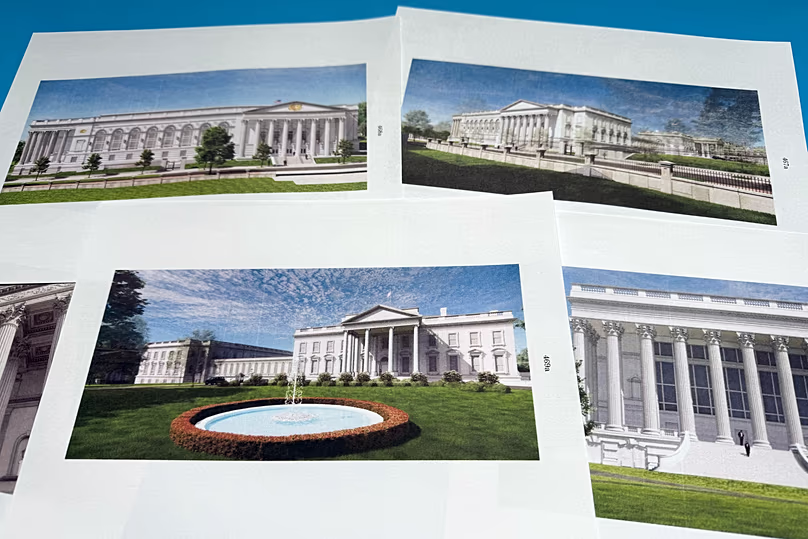
The columns form part of a much larger development planned for the site of the former East Wing, which was demolished to accommodate a new ballroom and associated facilities. The project has been described as a 90,000-square-foot complex with extensive security infrastructure, reinforced foundations and underground areas. Its publicly discussed cost has reached approximately $400 million, although questions remain about its final price and the precise balance between private donations and public funding. Trump has defended the construction as both a ceremonial venue and a national-security asset capable of supporting protected government operations.
The project has also generated a major legal dispute over presidential authority and the protection of historic federal property. Preservation groups argue that an alteration of this scale required congressional authorization and a more transparent review process before demolition and construction began. A federal appeals court ordered work to stop, but the Supreme Court subsequently allowed construction to continue temporarily while it considers the administration’s request. That decision did not settle the underlying legality of the project.
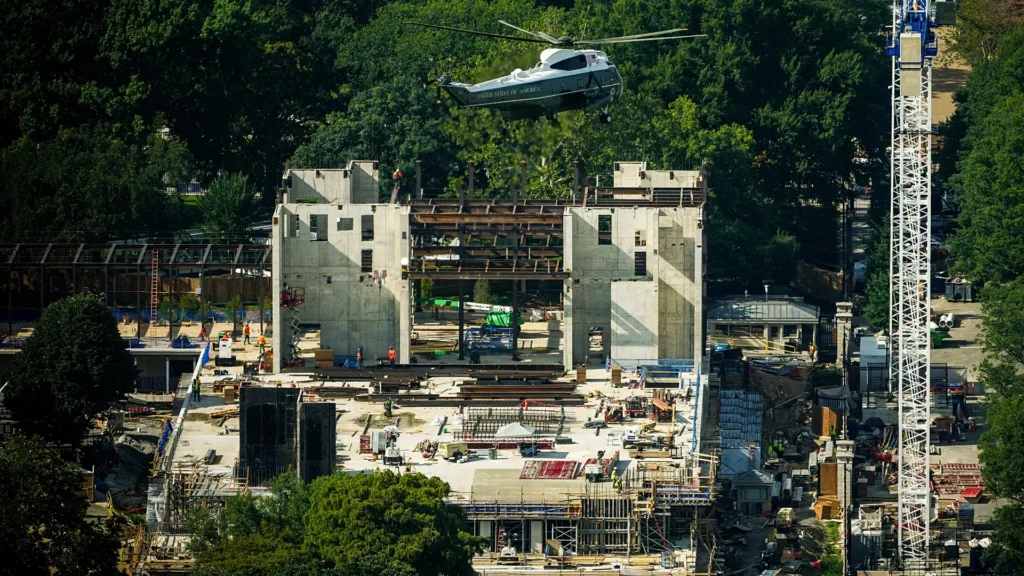
Beyond the courtroom, the Italian-carved columns have become symbols of Trump’s broader effort to reshape the visual identity of the American presidency. Supporters see ambition, permanence and renewed grandeur, while critics view the ballroom as an ostentatious intervention in one of the country’s most historically sensitive buildings. The stone may originate in Indiana, but its political meaning will ultimately be carved in Washington.
Architecture preserves power long after speeches are forgotten. / La arquitectura conserva el poder mucho después de que los discursos son olvidados.