

 Phoenix 24

The future rarely announces itself with noise; it arrives through the quiet reshaping of what we call work.
San Francisco, diciembre de 2025
The acceleration of artificial intelligence has sparked global debates about the disappearance of human labor, yet Jensen Huang insists the narrative is being misunderstood. For the founder and CEO of NVIDIA, the rise of advanced computational systems will not erase society’s need for workers. It will change who they are, what they do and how economies measure value. His recent remarks, delivered during a technology forum in California, outline a vision in which new professions are born from the physical and digital infrastructures powering the world’s computational expansion.
According to Huang, the global race to develop intelligent technologies requires far more than engineers and programmers. He argues that the most essential workers of the next decade may come from fields traditionally overlooked in discussions about the future. Electricians, metal technicians, carpenters, HVAC specialists and digital mechanics will become indispensable as nations expand their data centers, cooling systems, power grids and large scale robotics facilities. Analysts at the European Council note that this shift aligns with infrastructure deficits already documented in Europe, where energy capacity and physical networks lag behind the demands of large scale computing.

Across Asia, specialists in industrial development point out that the emerging wave of intelligent infrastructure will compel governments to invest in technical education as aggressively as they have invested in semiconductor capacity. Reports from research groups in South Korea and Japan have emphasized that without a skilled technical workforce, even the most advanced AI models cannot operate at scale. This link between physical expertise and digital capability forms the backbone of Huang’s thesis. He maintains that the future belongs not merely to those who write algorithms, but also to those who build and maintain the machines that make those algorithms possible.
In North America, economists studying labor transformation argue that the next decade will produce a hybrid professional landscape populated by both human and digital workers. Huang supports this perspective and frequently describes a future in which individuals collaborate with autonomous systems that act as colleagues rather than tools. These digital agents, powered by large language models and generative engines, will handle repetitive tasks, freeing human workers to focus on complex reasoning and high consequence decisions. Yet Huang cautions that this shift will not reduce the workload. Instead, he predicts that the intensity of human labor will increase, as workers become responsible for supervising intelligent systems and responding to their outputs in real time.
Organizations monitoring global employment trends observe that this hybrid model may generate an unexpected outcome. Instead of contracting, the workforce could diversify, splitting into highly specialized roles that combine manual, cognitive and digital skills. The International Labour Organization has suggested that such diversification might stabilize employment during technological transitions, provided governments adapt training programs to prepare workers for the dual demands of physical dexterity and digital fluency. Huang’s view echoes this assessment. He argues that workers who master both dimensions will be the most valuable assets of the new economy.
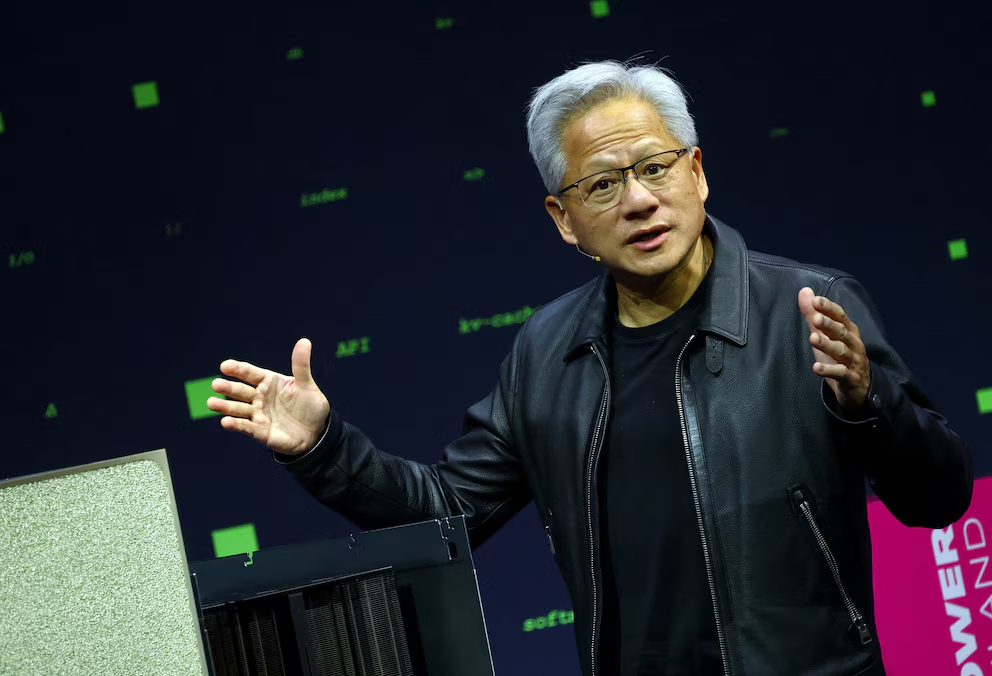
The rising influence of AI also raises questions about education. According to experts at leading American research universities, curricula must evolve to incorporate computational thinking across disciplines, while still preserving the foundation of hands on skills essential for infrastructure construction. In discussions with industry leaders, Huang has repeatedly emphasized that the most resilient professionals of the future will be those who can understand the logic of machines yet remain capable of solving practical physical problems that machines cannot. This dual literacy represents what he calls an augmented workforce, a population whose abilities are expanded rather than replaced by intelligent technologies.
Meanwhile, markets across Africa and the Middle East are exploring how this vision might translate into opportunities for developing economies. Governments evaluating national digital strategies recognize that AI adoption cannot advance without supporting trades capable of building electrical networks, sensor grids and cooling systems for large scale computing environments. International development organizations argue that these technical fields could become gateways to new forms of economic mobility, especially for younger populations entering the labor market. Huang’s forecast provides a framework for such transitions, reinforcing the idea that nations able to cultivate technical talent will benefit first and fastest from AI based growth.
Beyond the technicalities, Huang’s perspective carries a social implication. It challenges the long standing cultural assumption that digital professions alone define the future. Instead, it positions trades and skilled labor as the structural foundation of the next technological revolution. This reframing matters for governments designing long term employment policies, for companies preparing training pipelines and for workers attempting to chart their own future in a rapidly shifting world. If he is correct, the jobs that dominate tomorrow may be the ones society has been slowest to value.
For Huang, the message is clear. The future of work is not a battlefield between humans and machines. It is an ecosystem in which both must evolve together, supported by infrastructures built not by algorithms, but by the hands of skilled workers who enable intelligent systems to exist at all. In that sense, the next great workforce may already be here. It simply awaits recognition.
Phoenix24: resistance in every narrative.