

 Phoenix 24
A meal turned margins into history.
London, February 2026.
Tottenham did not lose a Champions League place because they forgot how to play football. They lost it because, on one of the most consequential days of their season, too many bodies refused to cooperate. The story has survived for years precisely because it sounds absurd in a sport obsessed with control, preparation, and elite performance. One plate of lasagna, a cluster of sick players, and a final league table that still reads like a lesson in how fragile “merit” can be when the margin is a single match.
The stakes were brutally simple. Tottenham entered the final day of the Premier League season with a direct path into the top four. They did not need favors, only competence. Arsenal, their North London rival, were close enough to punish any wobble, and the difference between finishing fourth and finishing fifth was not cosmetic. Fourth meant Champions League access, money, recruitment gravity, and a different type of institutional confidence. Fifth meant the long way around, and in that era it also meant living under the shadow of what might have been.
Then the stomachs started to turn. Players reported acute illness in the hours before the match, the kind that drains hydration, coordination, and energy in ways that no motivational talk can repair. By kickoff, Tottenham were not simply “off.” They were compromised. This is where the tale becomes more than a punchline. Elite football is built on repeatable routines, but biological disruption does not negotiate. Once a squad’s baseline is damaged, the game becomes a test of survival rather than strategy, and survival is rarely sufficient when you are playing for a season’s worth of leverage.
The match itself, away at West Ham, unfolded with the logic of a team trying to function inside a body that is not fully present. Tottenham fell behind, responded, and then slipped again. They lost 2 to 1, and that scoreline became the door that slammed. Arsenal, meanwhile, did what rivals do in these moments. They won their own match, turned Tottenham’s weakness into their advantage, and took the fourth place finish. On paper, it was just football arithmetic. In memory, it became something else: the day a club’s trajectory was shaped by something as mundane, and as uncontrollable, as food.
What makes the episode endure is the way it exposes modern sport’s hidden dependence on logistics and micro decisions. Clubs invest in tactics, analytics, and psychology, yet the chain of performance is still anchored in sleep, nutrition, hygiene, and recovery. It is unglamorous infrastructure, but it is infrastructure all the same. When it fails, the consequences can be disproportionate because the calendar does not care. The league table does not offer compassion for circumstances. It only records outcomes.
The “lasagna” label is shorthand, but the deeper issue is accountability under uncertainty. Foodborne illness in elite environments triggers uncomfortable questions: where was the food sourced, how was it handled, what controls existed, what documentation was kept, who was responsible for verification. Even when investigations produce no sensational smoking gun, the reputational damage is immediate because the public sees a pattern it recognizes. Something preventable happened, and a massive price was paid. In competitive systems, preventable is the most expensive adjective.
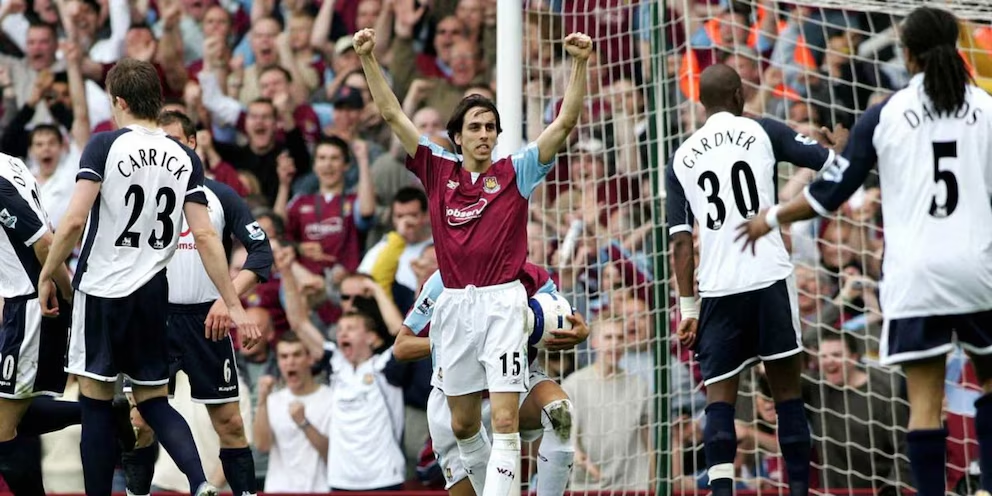
There is also a psychological cruelty in the timing. Illness early in a season can be absorbed. Illness on the final day becomes destiny. The mind processes that difference harshly, because it feels like theft even when no villain is proven. For players, it creates a particular kind of frustration: you did not lose because your opponent outplayed your best. You lost because your best never arrived. For fans, it becomes mythology, the type of story shared with a grim laugh that still carries pain. For clubs, it becomes policy, because organizations learn most quickly from embarrassment.
The larger pattern is that the Premier League era transformed qualification into a form of geopolitical competition, not between states, but between institutions. Champions League access became a gateway to global attention, sponsorship, commercial tours, and long term squad building. Missing it by one match, under such bizarre conditions, had knock on effects that reached beyond that season’s headlines. It influenced recruitment conversations, managerial narratives, and the internal belief about whether Tottenham could consistently sit at the top table. In elite sport, legitimacy is a currency. Champions League nights print that currency.
Rivals, of course, never let such stories rest. Arsenal supporters treated it as comedy, Tottenham supporters treated it as tragedy, and neutral fans treated it as proof that football remains stubbornly human. That last point matters. For all the technology and polish, the sport still lives inside fallible systems. A squad can be perfectly prepared and still be undone by an invisible error. That tension is part of why football holds attention. It offers control fantasies, then breaks them in public.
Years later, the lasagna story persists because it compresses an entire truth into a single image. In high performance environments, the smallest operational failures can decide the largest strategic outcomes. It is a reminder that clubs are not only teams, they are ecosystems. Tactics win games, but systems protect seasons. And when a season turns on a stomach bug, it forces everyone to admit something uncomfortable: greatness is not only built in training grounds and boardrooms. Sometimes it is protected in kitchens.
Hechos que no se doblan. / Facts that do not bend.