

 Phoenix 24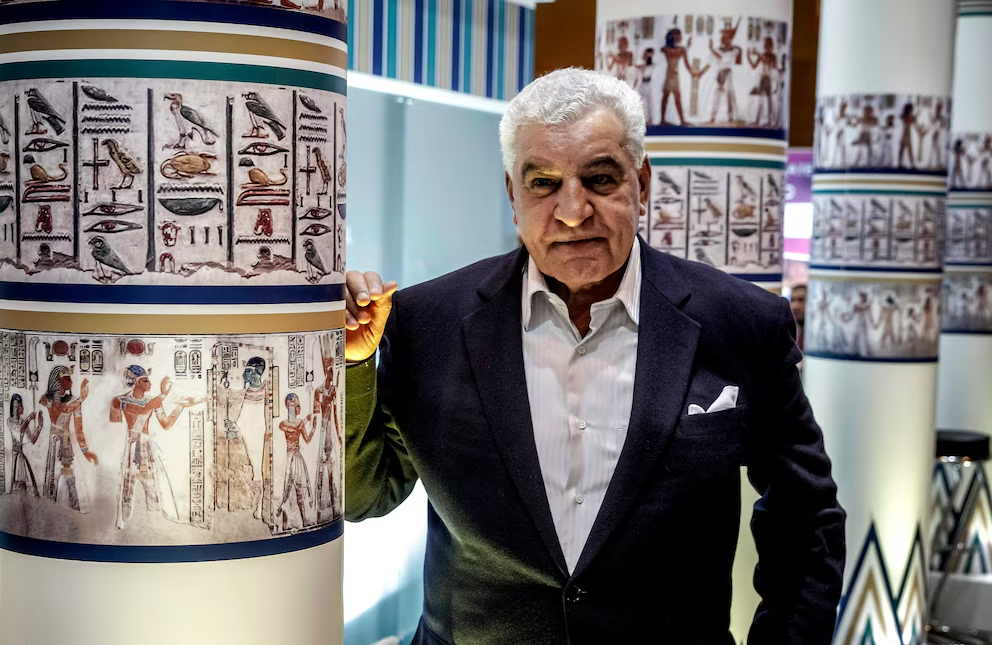
Fame sharpens discovery, and multiplies enemies.
Cairo, February 2026.
Zahi Hawass has spent decades doing something rare in cultural heritage: turning excavation into mass narrative without fully surrendering it to outsiders. Now, at 78, he is also the subject of The Man With the Hat, directed by Jeffrey Roth, a film that frames his career as both national project and personal odyssey. The documentary’s tone is unmistakably autobiographical, emphasizing achievement, charisma, and a sense of siege. Hawass’s defiant line, that “failures will try to stop you,” is not simply a quote built for trailers, it is the organizing logic of his self portrayal. In a media environment that punishes ambiguity, the film chooses a single voice and dares the audience to dispute it.
His rise is presented as inseparable from the modern Egyptian state’s effort to reclaim heritage as a central pillar of identity and sovereignty. That strategy reaches its architectural peak in the Grand Egyptian Museum, a project often described as costing around one billion dollars and marketed as proof that antiquities are not just remnants of the past but an economic and symbolic asset. In Hawass’s worldview, museums, excavations, and repatriation campaigns are not cultural luxuries, they are instruments of national standing. When the camera moves through monumental spaces, it is also moving through a theory of power: whoever curates the past controls a portion of the present. This is why his story resonates beyond archaeology, because it maps heritage onto geopolitics.
The film leans hard into origin myth, not as fiction, but as a method. Hawass recounts childhood in northern Egypt, a late arriving vocation, and the moment a cleaned statue of Aphrodite shifted his trajectory from other ambitions into archaeology. The narrative includes the classic rite of passage of international validation, a scholarship through the Fulbright Program leading to doctoral study at the University of Pennsylvania. This arc matters because it mirrors a broader pattern in postcolonial heritage politics: Western credentials open doors, then returning experts use that legitimacy to renegotiate who gets to speak for the past. Hawass’s persona is built on mastering that loop and then insisting Egypt should no longer be spoken for.

His public brand has always been part showmanship, part gatekeeping, and the documentary treats that as feature rather than flaw. Hawass has described himself as the rare Egyptian official to achieve global fame, and he argues that prominence invites coordinated destruction, especially through social media. This is not paranoia in the simple sense, it is a recognition that cultural authority now travels through platforms that reward conflict and certainty. When he calls critics demons, it reads as an overstatement, but it also reveals how intensely he experiences the struggle for narrative control. The deeper issue is not tone, it is ownership: who owns the story of Egypt’s past, and by what right.
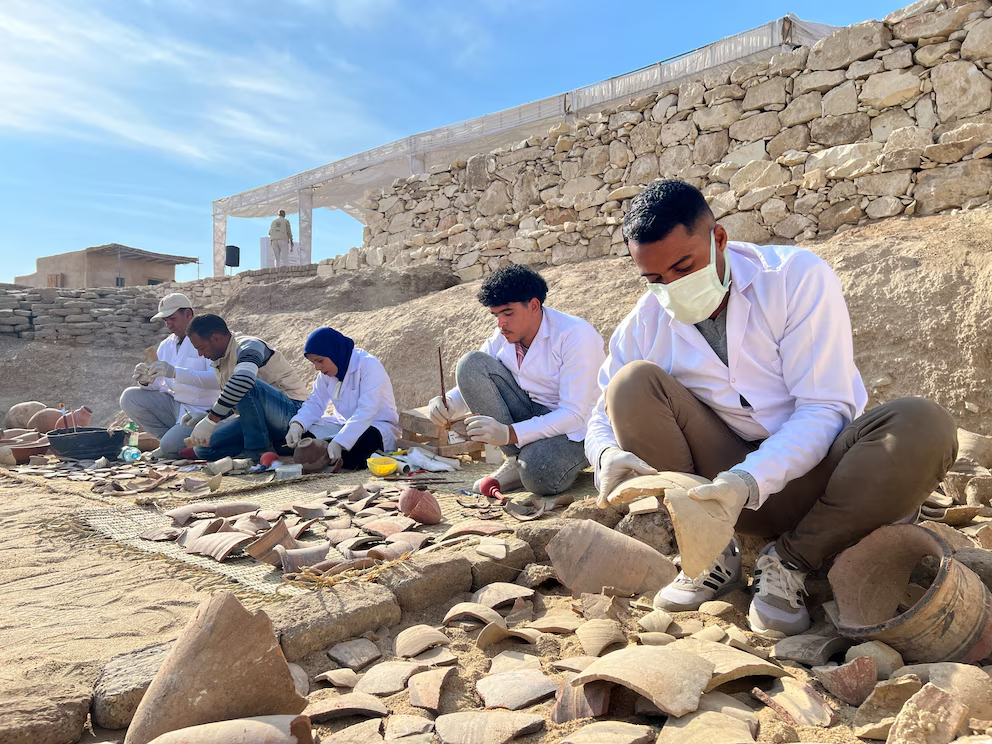
The film’s most crowd pleasing passages return to discovery, particularly the “lost golden city” near Luxor, a three thousand year old settlement with houses, workshops, bakeries, and brick making infrastructure, widely compared to an “Egyptian Pompeii.” Hawass presents it as an accidental find during a search connected to the mortuary landscape around Tutankhamun, and he repeats an expansive claim that only about 30 percent of Egypt’s ancient monuments have been found. Whether one accepts the percentage as literal or rhetorical, the strategic function is clear: it keeps Egyptology framed as an open frontier rather than a closed archive. In that framing, Hawass is not closing a chapter, he is staging an unfinished mission.
That mission is personified in the hunt for Nefertiti, treated as the greatest unresolved mystery still within reach. Hawass argues her tomb may remain intact, positioning the quest as the modern echo of Howard Carter’s 1922 discovery, the moment when global fascination with ancient Egypt became a permanent cultural industry. A claim like this is powerful because it fuses scholarship with suspense, and suspense creates funding, tourism, and attention. It also invites criticism, because high profile predictions can outrun evidence and turn archaeology into a performance of inevitability. The documentary does not resolve that tension, it simply aligns the audience with the hunter.
The politics of repatriation threads through the narrative like a secondary plot that is actually the main one. Hawass points to iconic objects held in Europe, including the bust of Nefertiti in Berlin’s Neues Museum, the British Museum’s Rosetta Stone, and the Dendera Zodiac in the Louvre Museum, framing their return as both moral correction and strategic necessity. This is where cultural heritage becomes a diplomatic instrument, because restitution debates force states to reveal what they consider legitimate ownership. The film implicitly argues that Egypt is no longer petitioning, it is negotiating from a position of increased leverage built on global public sympathy and national infrastructure. That posture plays well internationally, but it also sharpens domestic expectations and raises the stakes of every dispute.
What the documentary downplays, and what makes Hawass polarizing, is the long record of institutional conflict around access, credit, and control. Colleagues have accused him of restricting excavation access, monopolizing media attention, and turning discoveries into personal brand extensions rather than shared scientific assets. He has also taken hard public positions against certain reinterpretations of history, including criticism of African Queens, a Netflixproduction that cast Cleopatra in ways he called misleading, revealing how quickly scholarly disputes become culture war ammunition. The film touches these controversies lightly, then returns to the protagonist’s voice, leaving viewers with a portrait that is vivid but strategically incomplete. Even his fall from official authority during the 2011 upheavals, amid backlash tied to association with Hosni Mubarak, is treated more as interruption than reckoning.
The result is a documentary that operates as cultural power move as much as biography. It reframes Egyptology as a national project, positions its most recognizable face as both builder and target, and invites audiences to interpret criticism as envy rather than governance debate. In the background, the film demonstrates a modern truth: heritage is not only about stones and sand, it is about who gets to define reality in public. Hawass understands that better than most, and this documentary is his attempt to lock in a version of the past that serves a version of the present. Whether audiences accept that version is almost secondary, because the act of presenting it at scale is already an assertion of authority.
Phoenix24: periodismo sin fronteras. / Phoenix24: journalism without borders.