

 Phoenix 24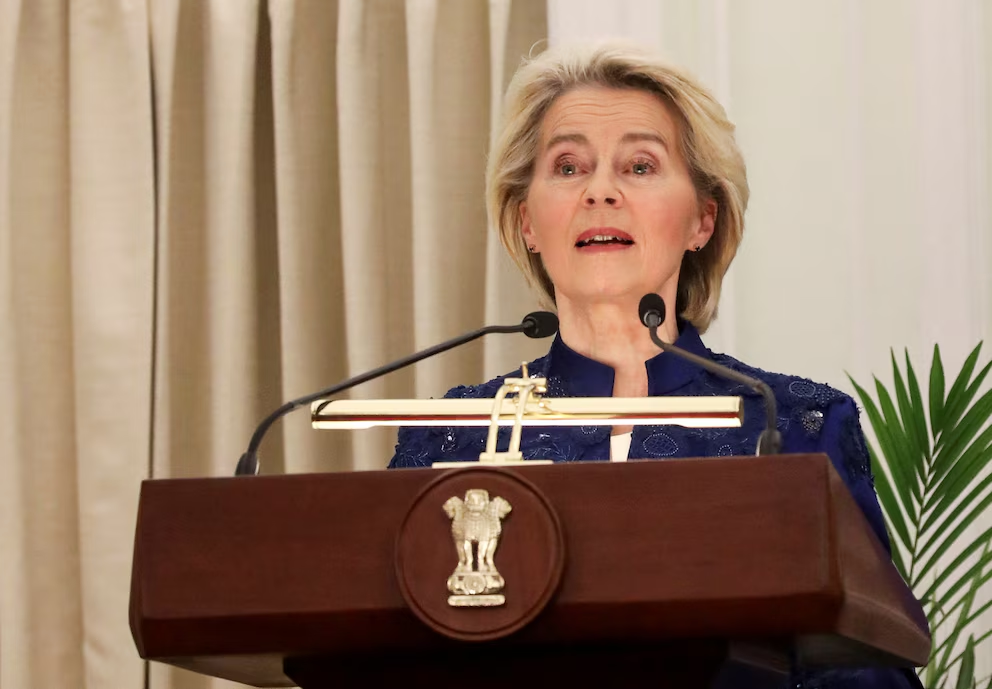
Tariff volatility is a credibility test.
Brussels, February 2026.
The European Union is not arguing about a number, it is arguing about whether commitments still bind when domestic politics heats up. After a sudden swing in U.S. tariff policy, Brussels has demanded that Washington respect the transatlantic trade arrangement reached last year, framing the issue as contract discipline rather than diplomatic mood. The European Commission’s public line is deliberately blunt because ambiguity is expensive in trade. When tariffs change quickly, businesses stop planning and start hedging, and hedging is where investment quietly goes to die.
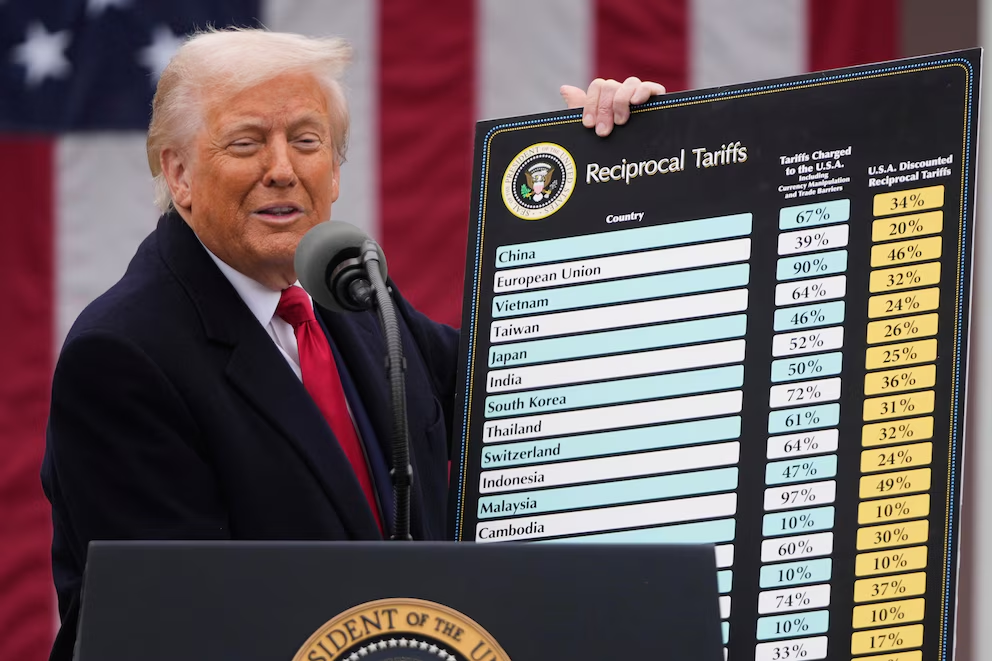
The immediate trigger is a legal shock inside the United States, where the Supreme Court struck down a set of sweeping tariffs tied to emergency powers. That ruling did not restore stability, it created a vacuum, because importers want clarity on what remains valid and what might be refunded. President Donald Trump responded by moving toward a new across the board tariff approach, first signaling 10 percent and then raising it to 15 percent under a different legal pathway. From Brussels, the sequence looks less like adaptation and more like a search for alternative levers to keep tariff pressure alive. In trade diplomacy, the reason matters less than the pattern, because the pattern defines future risk.
The EU’s position rests on the claim that last year’s deal was built precisely to prevent a tariff spiral. In that framework, a 15 percent cap was presented as the ceiling for most European goods entering the U.S. market, a limit meant to replace the threat of higher rates with a predictable corridor. There were sectoral carve outs, and the aviation piece was politically important, because aircraft and related components were treated as a zone where both sides aimed for zero tariffs. The Commission’s concern is that a new U.S. global tariff at the same level can still violate the agreement’s logic if it is imposed in a way that disregards negotiated coverage, exemptions, or sequencing. A ceiling is not reassurance if the ceiling can be redefined without notice.
This is why Brussels keeps repeating the demand for “full clarity.” The phrase is not rhetorical, it is operational, because the EU needs to know whether the U.S. will treat the deal as a binding framework or as a reference point that can be overridden by executive action. Maros Sefcovic, the EU’s trade commissioner, has been described as directly engaging U.S. counterparts to pin down the next steps. The Commission also has to manage internal credibility: if it cannot enforce the deal’s basic terms, it will struggle to sell any future compromise to member states and legislators. Agreements collapse less from one dramatic breach than from repeated small shocks that teach everyone to expect the worst.
Inside the European Parliament, the political cost is already visible. Bernd Lange, the chair of the Parliament’s trade committee, has pushed for delaying the ratification vote, arguing that tariff chaos undermines the premise of the bargain. That matters because EU approval is not automatic, and skepticism spreads quickly when Washington appears unable, or unwilling, to hold a stable line. The Greens and other groups have their own reasons to resist, but instability is the accelerant that turns scattered objections into a blocking coalition. If the vote slips, the delay itself becomes leverage, because Brussels can point to democratic process and say, credibly, that U.S. unpredictability is making approval impossible.
The economic substrate is large enough that neither side can treat this as symbolism. Transatlantic trade spans massive flows of goods and services, and the most exposed categories are the politically sensitive ones: autos, pharmaceuticals, aircraft, industrial machinery, and high value components that depend on predictable customs treatment. When tariffs swing, the damage is not only price level. The deeper damage is time horizon, because firms rewrite sourcing decisions, reprice contracts, and divert investment to jurisdictions where policy is boring. Boring policy does not win elections, but it wins factories.
Brussels is also signaling that it has tools and that it is willing to use them if it concludes it is being coerced. The EU’s Anti Coercion Instrument exists for moments when economic pressure is used as political force, and tariff uncertainty can function as pressure even without explicit threats. The Commission’s strategic aim is deterrence, not escalation: make the cost of unilateralism concrete enough that Washington returns to the agreed corridor. Still, deterrence requires credibility, and credibility requires the EU to show that it can retaliate in a targeted way without injuring itself more than the opponent. That is why European messaging is heavy on legality, process, and proportionality.
From the U.S. side, officials have suggested that the agreement remains intact and that neither party has formally withdrawn. That statement may be technically true, yet it does not resolve the EU’s core worry, which is behavioral rather than procedural. Trade agreements are not enforced by good intentions, they are enforced by predictable administration. If the U.S. keeps moving tariffs through different statutes or executive interpretations, the EU will treat the deal as unstable even if it still exists on paper. Paper commitments do not stabilize markets, operational behavior does.
There is a global layer that makes this dispute more than a bilateral quarrel. In an era of industrial policy and supply chain security, other capitals are watching whether the EU and the U.S. can keep their own rules stable. Japan’s economic planners, who depend on predictable access to both markets, will read this as a signal about whether negotiated caps can withstand domestic turbulence. The World Trade Organization sits in the background as a legitimacy reference point, yet the real enforcement is political, and politics is where uncertainty lives. If transatlantic rules become improvisational, other actors will adapt by hardening their own defensive measures, and global trade governance will drift further from law toward leverage.
Europe’s warning is therefore simple: if a deal can be treated as optional, then deals stop working as stabilizers and become temporary ceasefires. Brussels is not asking Washington for friendship, it is asking for reliability. The immediate question is whether the U.S. will provide a clear operational map that keeps tariffs within the negotiated structure, including how exemptions and sectoral terms are applied. If clarity arrives and holds, the agreement survives as a restraint. If not, the EU’s politics will harden, retaliatory structures will activate, and the transatlantic economy will relearn an old lesson about tariff wars: they begin as tactics and end as habits.
Más allá de la noticia, el patrón. / Beyond the news, the pattern.