

 Phoenix 24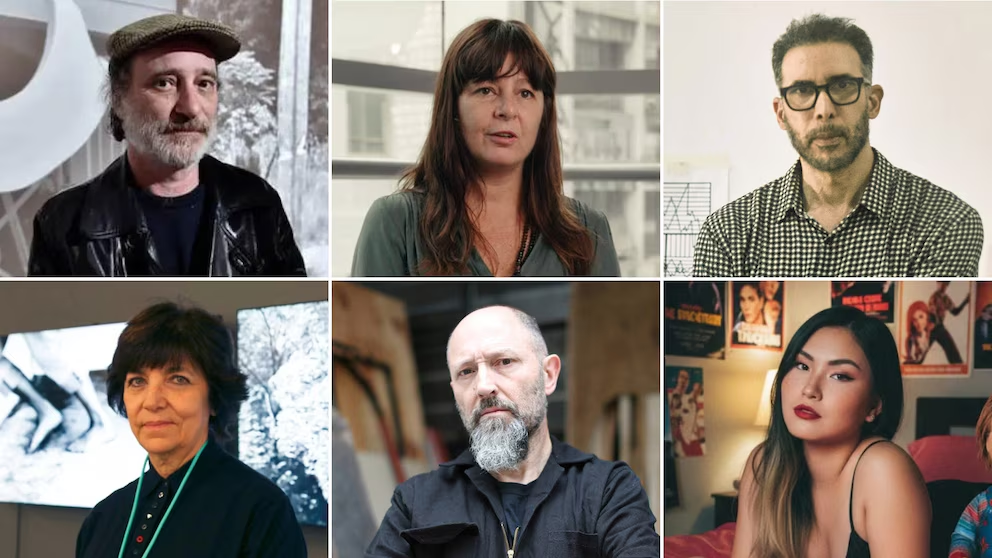
Peripheral cities can host central conversations.
Junín, February 2026.
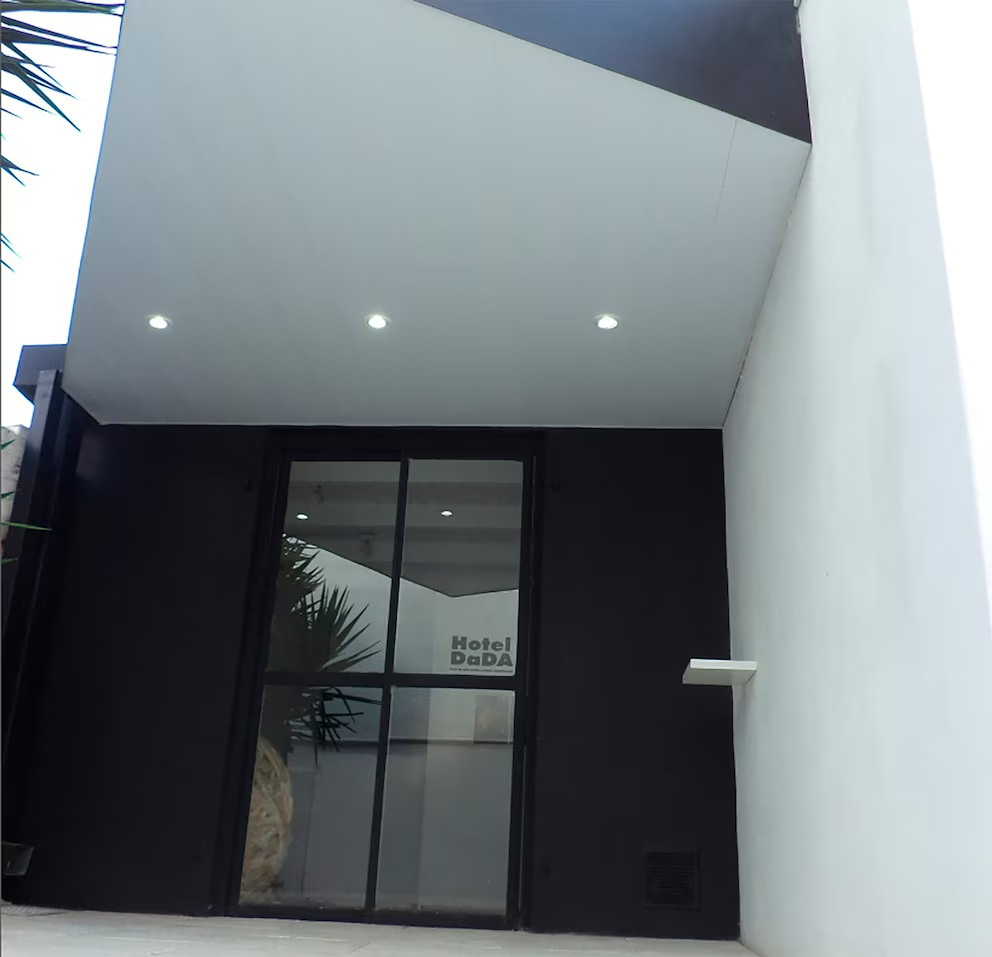
Posverso Bienal has announced the roster for its second edition: 53 artists from 11 countries, gathering in Junín at the Hotel Dada gallery from late August through early October. On paper, it reads like another biennial calendar entry. In practice, it is a strategic move inside the cultural economy, where legitimacy is no longer monopolized by capital cities and where “the circuit” is increasingly built by curatorial intent, not postal codes. The announcement matters because it treats experimental poetics as infrastructure, a platform that can reorganize attention across borders.
The structure of power revealed here is not governmental, but institutional. Cultural authority is typically centralized, funded, and narrated from a small set of metropolitan hubs, then exported as taste. Posverso proposes the inverse: a mid-size city becomes a convening device, and the international names orbit the local venue instead of the other way around. UNESCO has long framed cultural production as both identity and economy, and the tension between those two logics is exactly where biennials operate. When a project like this scales, it competes for a scarce resource that is more decisive than money: global attention.
The 2026 edition is designed to broaden its vocabulary beyond visual art into multiple registers of experimentation. Organizers have indicated an expanded field that includes visual practices, experimental music, contemporary jewelry, electronic art, and performance, with a curatorial layer that explicitly privileges crossover languages and “expanded poetry.” That choice is not aesthetic decoration, it is governance by format. Hybrid disciplines create hybrid publics, and hybrid publics reduce dependence on a single local audience or a single national funding mood. The biennial is effectively building resilience by refusing to be only one thing.
Names on the roster underline the intended scale and the intended frictions. Internationally recognized figures such as Santiago Sierra and Mounir Fatmi sit alongside artists from Latin America, Europe, and North America, creating a lineup that is structurally diverse rather than symbolically diverse. The program also emphasizes regional participation, bringing in creators based in Junín and its surrounding area, which avoids the common biennial failure of parachuting global prestige into a city without leaving local capacity behind. That balance is not sentimental. It is how cultural initiatives defend themselves against the critique of extraction, where the city supplies the stage and outsiders take the meaning.
Posverso’s own narrative frames the thematic axis of the edition as “Del encantamiento y el horror,” a title that signals both seduction and rupture. The curatorial argument, as presented by the biennial, points toward a recovery of non-hegemonic knowledge and a challenge to a contemporary system described as exhausted by productivism and stripped of mystery. Read structurally, this is not a retreat into nostalgia. It is a wager that experimental art can function as a dissident method, a way of thinking against the grain when dominant institutions flatten complexity into efficiency. The theme also works as a shield, because it legitimizes contradiction as part of the project rather than a curatorial inconsistency.
There is a larger pattern the announcement repeats across the global system. Biennials have become soft-power instruments, but they are also logistics machines that move artists, texts, and reputations through networks of institutions and media. UNCTAD’s work on the creative economy consistently treats creative goods and services as trade flows shaped by digitalization and uneven infrastructure, and biennials increasingly behave like the physical manifestation of those flows. A roster spanning multiple regions is, in effect, a map of cultural connectivity. The choice to host that map in Junín is a statement that connectivity can be produced, not merely inherited.
The previous edition is invoked as proof of capacity, with organizers pointing to a wide footprint of participants and venues. That detail is not just retrospective pride, it is reputational collateral. In the cultural field, scale is credibility, and credibility is what convinces artists and partners that travel, time, and risk are worth it. The OECD has argued that cultural and creative sectors can be leveraged for local development when policies and ecosystems align, and events like this attempt to translate that claim into lived reality. The test is whether the biennial’s presence generates durable local competence, not merely a seasonal burst of visitors.
What remains structurally interesting is the silence around the most common biennial anxieties. There is always an implicit question about funding, gatekeeping, and who benefits, yet the announcement foregrounds programming and selection rather than patronage. That can be read as strategic: the project wants to be evaluated as a platform of meaning, not as a budget line. It also reflects a shift in how cultural initiatives defend legitimacy in a polarized media environment, where the wrong sponsor can become the story. In museum and exhibition worlds, professional ethics frameworks like those associated with ICOM exist precisely because credibility can be lost faster than it can be earned.
Posverso’s bet is that experimental poetry, when expanded into sound, performance, electronics, and theory, can operate as a transnational language without becoming generic. If it succeeds, Junín becomes more than a host city; it becomes a node that other nodes must acknowledge, if only temporarily. If it fails, it will still reveal something useful about the current cultural system: how difficult it is to turn attention into institution, and institution into continuity. The announcement of 53 artists from 11 countries is not the climax, it is the opening condition. The real measure will be whether the biennial can convert global names and local energy into an ecosystem that outlasts the calendar.
Phoenix24: periodismo sin fronteras. / Phoenix24: journalism without borders.