

 Phoenix 24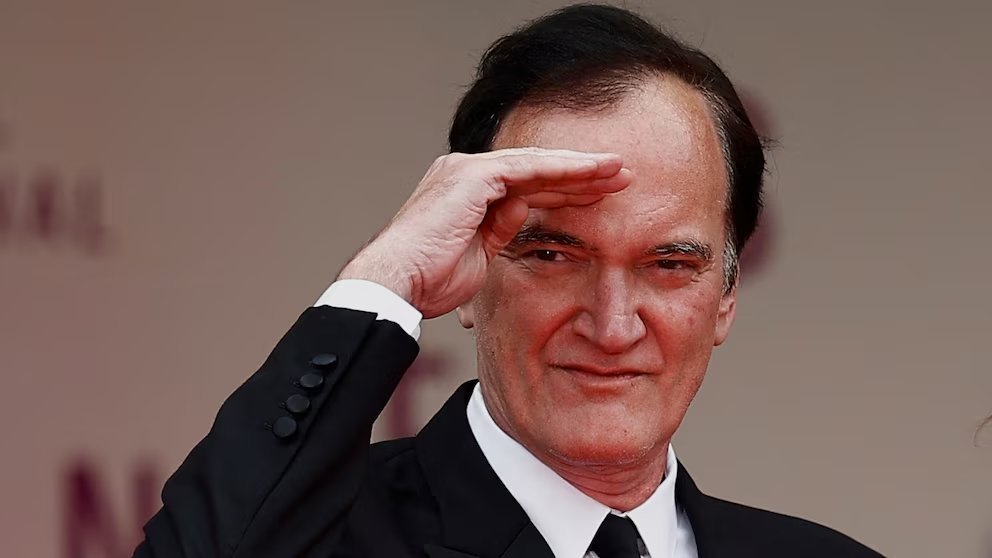
Cinema’s outlaw now tests the discipline of the stage.
London, March 2026
Quentin Tarantino’s next move is not another film, but a theatrical gamble that may reveal as much about his late career instincts as any tenth feature ever could. His newly announced stage project, The Popinjay Cavalier, is set to debut in London’s West End in early 2027 as a comedy of deception and disguise set in 1830s Europe, with Tarantino attached to direct. That matters because this is not a side experiment or a temporary detour. It is being framed as his next major creative undertaking, one substantial enough to pull him and his family to England for an extended period.
The choice of genre is revealing. A swashbuckling work of disguise, romance, and theatrical excess allows Tarantino to move into a tradition that predates cinema while still preserving the qualities that made his film voice unmistakable: stylized tension, verbal performance, tonal play, and a fascination with heightened worlds. Reporting on the production indicated that the play draws inspiration from swashbuckling stage and screen traditions and is being developed with major production backing. That combination of old theatrical form and contemporary prestige support suggests this is not a novelty act. It is an attempt to translate authorship across mediums without abandoning bravado.
There is a deeper artistic logic behind the move. Tarantino has long built scenes that depend less on visual sprawl than on enclosed pressure, performance, and verbal rhythm. Much of his strongest work unfolds through confrontation in confined spaces, where pacing, timing, and character tension do the heavy lifting. In that sense, theatre is not as alien to his sensibility as it may first appear. The stage strips away some of cinema’s protective machinery and forces the writing, blocking, and actorly cadence to stand more nakedly on their own. For a director so associated with control, that can be either liberating or exposing. Most likely, it will be both.
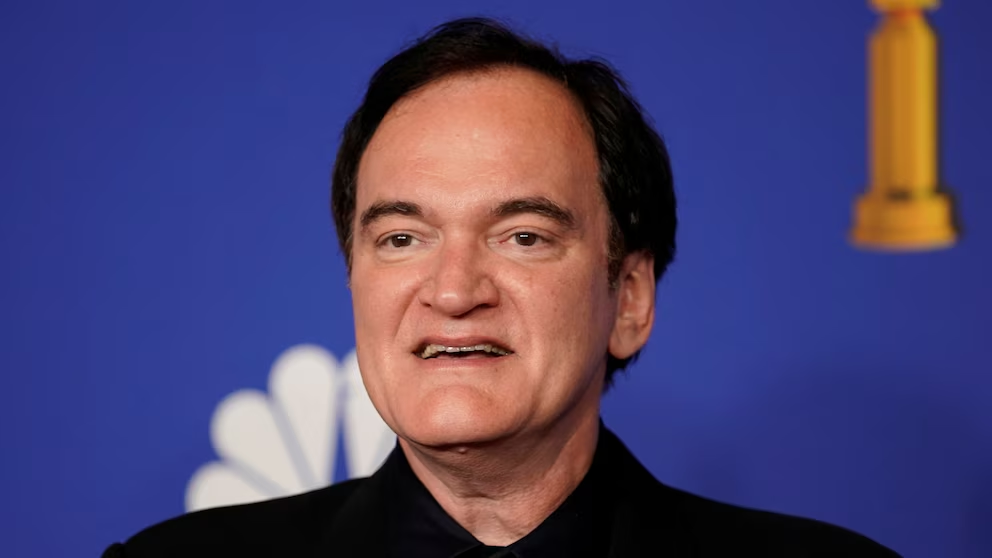
What makes the London decision especially important is that the West End is not being treated as a symbolic launchpad, but as the core testing ground. Tarantino reportedly suggested that if the play succeeds there, it could travel further, while also acknowledging that failure in theatre becomes visible very quickly. That candor matters. It suggests he understands the stage as a harsher ecosystem than celebrity filmmaking, one in which audience response is immediate, repetition is unforgiving, and prestige cannot protect weak material for long. In film, reputation can cushion reception. On stage, the work has to survive night after night in direct contact with a live audience.
The project also fits into a wider pattern in Tarantino’s recent career. His artistic output has become less narrowly tied to directing feature films and more dispersed across adjacent forms, including fiction writing and now theatre. That expansion can be read two ways. On one level, it reflects a director who no longer needs to prove cinematic authority and is instead testing where else his voice can live. On another, it may signal a more strategic repositioning before the still mythologized tenth film that he has long described as the endpoint of his directing career. If so, the play is not a side note. It is part of how Tarantino is renegotiating legacy before closure.
There is also something culturally shrewd about choosing London for this transition. The West End offers a rare mixture of tradition, visibility, and critical seriousness. It is commercial enough to make success meaningful and demanding enough to make failure credible. A Tarantino theatre debut in London will inevitably be judged not only as entertainment, but as a test of whether a filmmaker famous for cinematic authorship can submit to a medium with older rules and different disciplines. That makes the production vulnerable in an interesting way. It cannot simply be Tarantino on stage. It has to become theatre, or the experiment will feel ornamental.
The title itself, The Popinjay Cavalier, reinforces that sense of stylized risk. It evokes theatricality, costume, irony, and flamboyant movement, all of which suggest a work interested in performance as both narrative engine and subject. That is fitting for an artist who has always treated genre as something to inhabit, remix, and exaggerate rather than merely reproduce. The question now is whether his long-practiced command of cinematic pastiche can deepen into stage architecture. Theatre is less forgiving of empty flair. It demands structure beneath style, repetition beneath surprise, and ensemble control beneath authorial wit.
What emerges from this announcement is not merely a celebrity crossover into another art form. It is a serious wager on whether Tarantino’s sensibility can outlive the conditions that first made it famous. The West End will not judge him as a legend of 1990s cinema or as the keeper of cult auteur mythology. It will judge the play in front of it. That is exactly what makes the project compelling. After decades of mastering the mechanics of screen violence, tension, and cinematic cool, Tarantino is walking into a medium where presence is immediate, failure is public, and style must breathe without the camera’s protection. That is not retreat. It is exposure.
Narrative is power too. / Narrative is power too.