

 Phoenix 24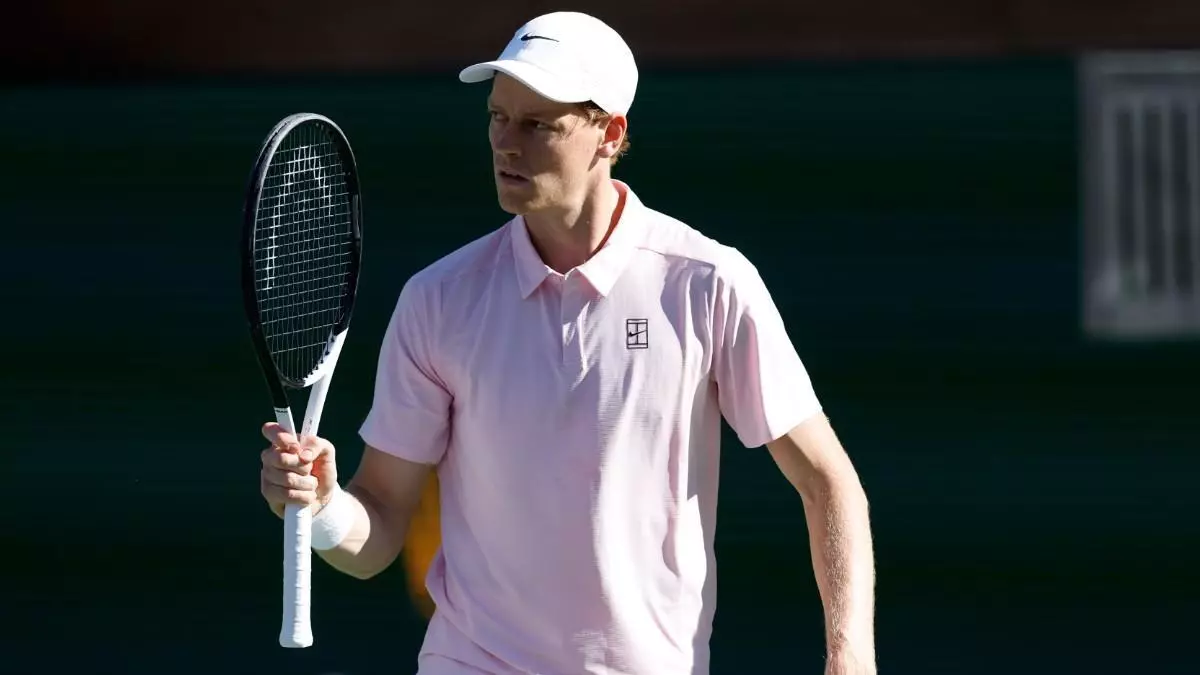
Dominance looks effortless when timing returns.
Indian Wells, March 2026
Jannik Sinner’s latest win in Indian Wells felt less like a routine quarterfinal and more like a demonstration of hierarchy. The Italian moved into the semifinals with a straight-sets victory over Learner Tien, needing barely more than an hour to impose order on the match. The scoreline itself, 6-1, 6-2, tells only part of the story. What mattered more was the manner of the win: clean, fast, and almost clinically untroubled. At a stage of the tournament where tension usually begins to distort rhythm, Sinner played as if the event were narrowing around him rather than challenging him.
That matters because Indian Wells has not always been the easiest terrain for him. Sinner arrived this year chasing his first title in the California desert, but also carrying the pressure of being measured against a field shaped by Carlos Alcaraz’s recent success and by the weight of his own hard-court reputation. ATP Tour coverage framed this run as part of a broader bid for milestone status, which means this tournament is no longer just another Masters 1000 stop on the calendar. For him, it is becoming a site of historical consolidation.
The route into the last four has reinforced that impression. Earlier in the event, Sinner opened with a dominant win in his first match and then advanced through a tougher sequence before handling João Fonseca in two tie-break sets to reach the quarterfinals. That progression is revealing because it shows different versions of control. He has already demonstrated that he can overwhelm an opponent quickly, recover his level after a looser phase, and survive pressure when a younger challenger pushes him into tighter margins. By the time he reached Tien, he was no longer just advancing. He was accumulating evidence that his tournament had found full coherence.
What stands out most in Sinner’s current tennis is the absence of visible strain. That does not mean the work is easy. It means he is playing with the kind of structural clarity that makes difficult things look ordinary. Against Tien, the pace off the ground, the depth of return, and the pressure he applied from neutral exchanges all contributed to a match that never really allowed suspense to develop. In elite tennis, that kind of control is more intimidating than drama. It tells the rest of the draw that the player on the other side is not merely winning points. He is shrinking the space in which the opponent can imagine the match turning.
There is also a broader significance to the timing. Sinner entered Indian Wells as one of the central poles of the men’s tour, while Alcaraz remained a major reference point elsewhere in the draw. That creates a subtle competitive frame around every Sinner match. He is not only trying to win the tournament. He is trying to preserve his place inside a rivalry shaped by comparison, projection, and overlapping claims to future dominance. When one contender moves through rounds with visible turbulence and the other advances almost untouched, the tournament begins to write its own internal narrative. Sinner’s version of that narrative is simple: efficiency as authority.
The Indian Wells setting amplifies that effect. This event has long carried particular symbolic weight on hard courts, partly because of its conditions and partly because it often functions as an early season sorting mechanism among top players. A deep run here does not define an entire year, but it can reveal whose game is already operating with championship density. Sinner’s performances so far suggest that his level is not just good enough to win matches. It is stable enough to absorb different styles without losing shape. That is the more important signal in a Masters event, where the variety of opposition usually exposes unfinished parts of a player’s form.
What makes this especially impressive is that the field itself has offered no shortage of danger. The men’s draw has included established contenders, rising names, and the persistent pressure of expectation that follows any top seed in a major event. Yet Sinner’s tournament has gradually begun to look less like a survival exercise and more like a tightening of control. The quarterfinal against Tien sharpened that perception because it removed one of the most common illusions in tennis: that youth, home support, or sudden momentum can automatically create unpredictability. Sinner did not allow the match to become unstable enough for that possibility to matter.
So this was not simply a comfortable win on the way to the semifinals. It was a reminder of what high-end form actually looks like when it settles in. Sinner is not just striking the ball cleanly or serving efficiently. He is imposing temporal pressure, shortening doubt, and making the court feel smaller for whoever stands across from him. That is what separates a good tournament from a commanding one. Indian Wells has not crowned him yet, and the hardest test may still lie ahead. But the shape of his campaign is already clear: he is no longer just arriving at the latter stages. He is beginning to own them.
Information that anticipates futures. / Information that anticipates futures.