

 Phoenix 24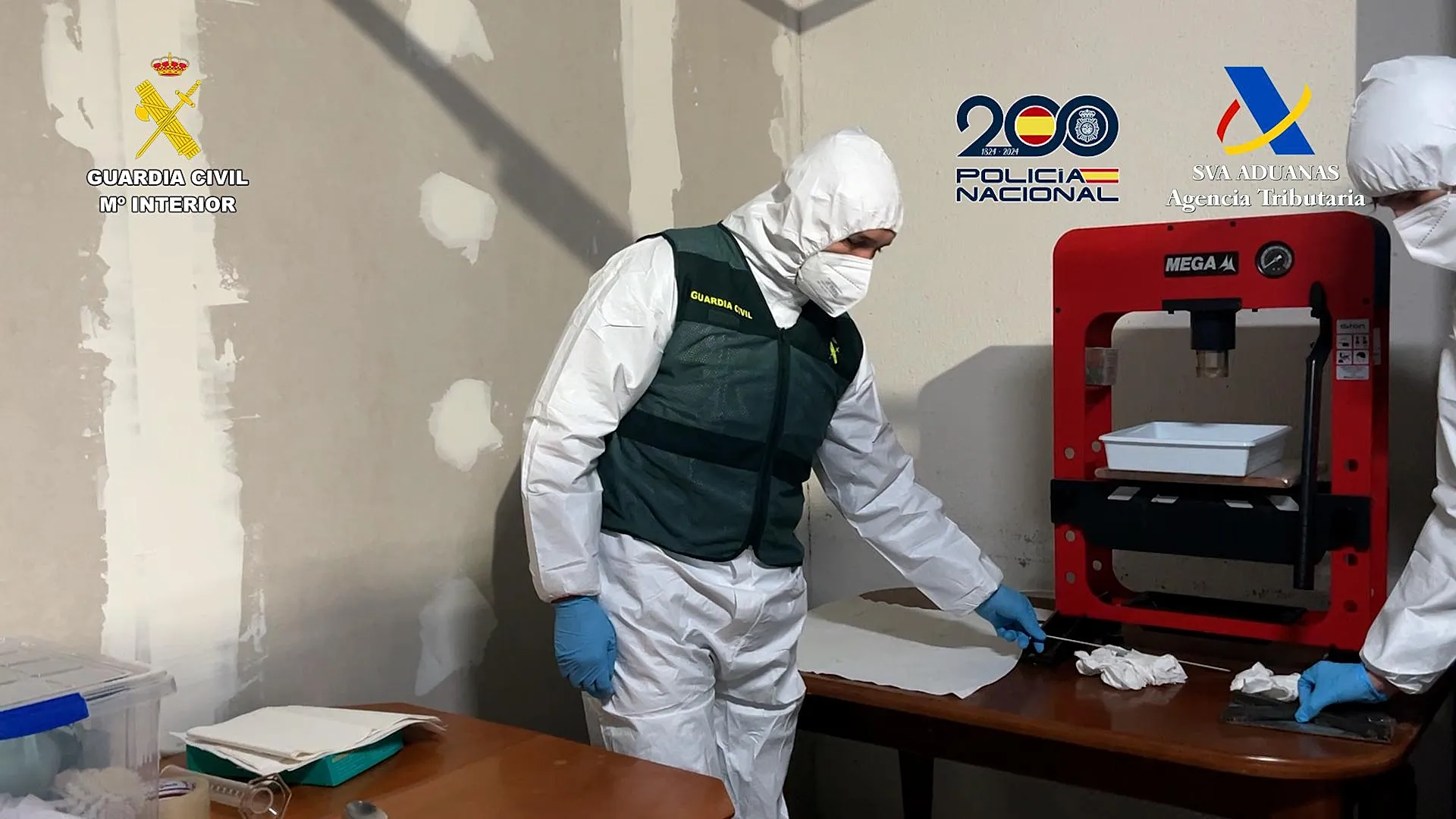
A rural town became a node in global narco logistics.
Toledo, April 2026. Spanish authorities have dismantled a large scale cocaine processing site in Gerindote, a small town in the province of Toledo, in what officials describe as a major international operation against organized drug trafficking. The raid ended with 13 arrests and exposed how transnational criminal infrastructure can embed itself in low profile municipalities far from the stereotypical geography of cartel violence. What appears at first glance to be a local police success is, in fact, a reminder that the cocaine economy now operates through logistics, concealment and industrial processing chains that cross continents before reaching European soil.
The operation involved coordinated action by law enforcement agencies from Spain, Colombia, the United States, Peru and Portugal, underscoring the multinational architecture behind the case. According to the reported details, investigators seized around eight tonnes of corn flour allegedly used to conceal the drug, along with 3,500 kilograms of chemical precursors employed in extraction and processing. They also found nine kilograms of cocaine already prepared for distribution, suggesting the site was not merely a storage point but an active production and refinement node within a broader trafficking network.
That distinction matters because it changes the scale of the story. Europe is not simply receiving narcotics through maritime or border routes. It is increasingly hosting internal conversion, packaging and distribution infrastructure capable of absorbing raw material, masking it within legal trade flows and transforming it into street ready product closer to final markets. The laboratory in Gerindote represents more than a criminal workshop. It reflects the industrialization of narco logistics inside Europe itself, where strategic location, transport access and relative invisibility can be as valuable as firepower.
Authorities also seized 170,000 euros in cash, five firearms, large quantities of ammunition, three bulletproof vests, two electric stun devices, accounting equipment, telephones and high end vehicles. In addition, customs surveillance units adopted precautionary measures affecting seven properties, 17 vehicles and 11 bank accounts linked to the criminal group. The breadth of these seizures suggests a network with financial depth, operational planning and a level of protection consistent with organizations that no longer function as isolated smugglers but as diversified criminal enterprises.
The setting is especially revealing. Gerindote is a small municipality strategically located near major transport routes in Castile La Mancha, between Talavera de la Reina and Toledo. That geographic detail is not incidental. Contemporary trafficking networks often favor spaces that combine logistical accessibility with low public visibility, allowing criminal activity to unfold outside the immediate glare of ports, capitals or border hotspots. Rural and semi rural zones can offer exactly that mix, converting apparently quiet territory into operational terrain for transnational illicit commerce.
There is also a geopolitical dimension beneath the police narrative. The presence of Colombian specialists allegedly linked to the processing stage points to the persistence of knowledge transfer within the cocaine trade, where technical expertise travels alongside product flows. In this model, Europe is not just a destination market. It becomes an extension of the production chain, a place where expertise, chemistry, finance and distribution intersect. That evolution raises the strategic cost of the problem for European states, because it means the continent is no longer only intercepting imports. It is confronting embedded narco capacity.
The case also reinforces a wider pattern visible across global organized crime. Criminal networks increasingly operate through hybrid systems that merge legal trade channels, financial layering, logistical outsourcing and specialized labor. A shipment can move under commercial cover, be chemically treated in one jurisdiction, refined in another and distributed through local cells disconnected from the original source country. What law enforcement uncovered in Toledo therefore belongs to a much larger map, one in which globalization has not weakened illicit markets but given them more sophisticated routes, more discreet platforms and more scalable methods.
For Spain, the operation carries symbolic and strategic weight. Symbolically, it shows state capacity in a country that has long faced pressure as both an entry point and a redistribution hub for narcotics entering Europe. Strategically, it demonstrates that anti narcotics policy can no longer focus only on interdiction at borders. The deeper challenge lies in detecting the hidden industrial ecosystems that enable criminal groups to process, store, finance and move product once it is already inside the European space. In that sense, the raid is as much about internal security as it is about drug enforcement.
What happened in Gerindote should not be read as an isolated anomaly. It should be read as a warning about the adaptability of organized crime in a continent whose infrastructure, trade flows and territorial diversity can be exploited by networks with international reach. The laboratory may be closed, but the structure it revealed remains active as a wider pattern. In the current criminal landscape, the real threat is not only the shipment that enters unseen, but the system that has already learned how to disappear in plain sight.
Geopolitics, unmasked. / Geopolitics, unmasked.