

 Phoenix 24
A nuclear strike in orbit would redefine escalation.
Washington, April 2026. A warning from U.S. military leadership about a potential Russian nuclear anti satellite weapon has reignited concerns over the militarization of space at an unprecedented scale. According to the assessment, Moscow could be exploring the deployment of a nuclear device capable of destroying hundreds of satellites in a single detonation. The significance of this scenario lies not only in its destructive capacity, but in the strategic shift it represents. It would transform space from a support domain into a primary battlefield.
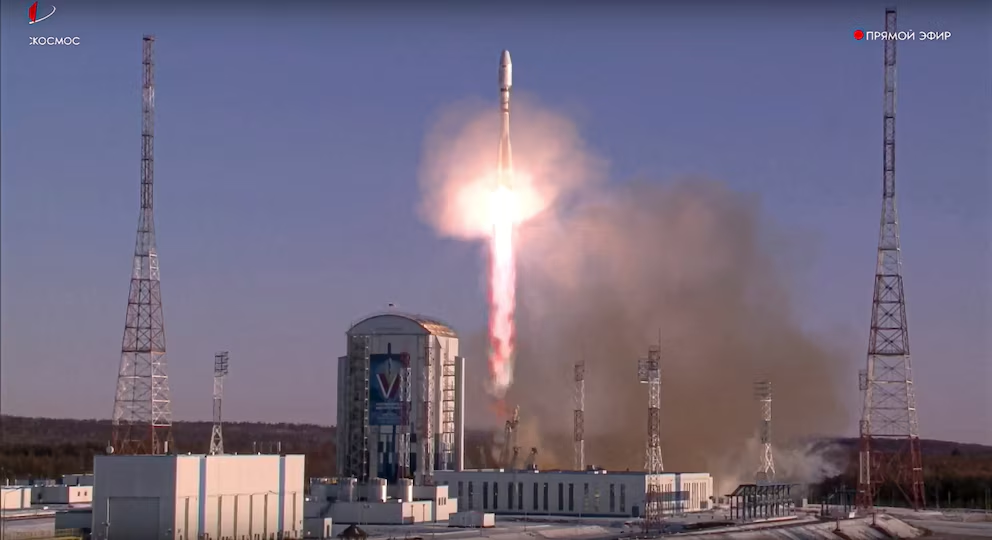
Modern military and civilian systems depend heavily on orbital infrastructure. Communications, navigation, intelligence gathering and real time coordination rely on dense satellite networks operating in low Earth orbit. A nuclear detonation in that environment would not be limited to immediate physical destruction. It could generate a prolonged electromagnetic and radiation effect, degrading satellite functionality over time and disrupting systems far beyond the initial blast zone. The result would be a cascading failure affecting both military operations and civilian life.
What distinguishes this potential weapon is its systemic impact. Traditional anti satellite capabilities focus on targeted destruction through missiles or direct collision. A nuclear device in orbit would operate differently. It would act as a wide area denial mechanism, capable of rendering entire segments of space unusable. That would not only blind adversaries in operational terms, but also contaminate the orbital environment in a way that complicates recovery for months or even years. In effect, it would weaponize space itself.
The strategic logic behind such a system reflects asymmetry. Western military strength relies heavily on networked warfare supported by satellite systems. A weapon capable of disabling that infrastructure would reduce that advantage quickly and dramatically. From this perspective, the objective would not necessarily be total destruction, but the rapid neutralization of an opponent’s informational superiority at the onset of conflict. It is a doctrine that seeks to level the field by targeting the systems that enable modern dominance.

This possibility introduces a more dangerous form of escalation. Nuclear weapons have traditionally functioned as instruments of last resort, designed to deter existential conflict. Deploying a nuclear capability in orbit for anti satellite use would move that threshold closer to the operational phase of warfare. It blurs the line between strategic deterrence and tactical application, increasing the risk that nuclear logic could be introduced earlier in a conflict scenario. That shift would make escalation less predictable and potentially harder to control.
There is also a legal dimension that underscores the gravity of the issue. The placement of nuclear weapons in space would violate long standing international agreements intended to prevent the weaponization of the orbital domain. However, these frameworks rely heavily on compliance and lack robust enforcement mechanisms. In a context of rising geopolitical tension, the strength of such agreements depends less on formal rules and more on political restraint. That makes them increasingly fragile.
The broader implication is structural. Space is no longer a distant or neutral environment. It has become a critical layer of global infrastructure, deeply embedded in economic systems, security frameworks and everyday life. If that layer becomes a target for nuclear strategy, the consequences would extend far beyond military confrontation. The disruption would cascade through financial systems, transportation networks, communications platforms and emergency services, creating a form of conflict with immediate global reach.
What emerges from this warning is not just a new weapons concern, but a shift in how power is projected and contested. The future of conflict may depend less on territory and more on control over invisible systems that sustain modern societies. In that context, the potential weaponization of space at a nuclear level represents a profound escalation, one that challenges existing doctrines and exposes new vulnerabilities.
Beyond the news, the pattern. / Beyond the news, the pattern.