

 Phoenix 24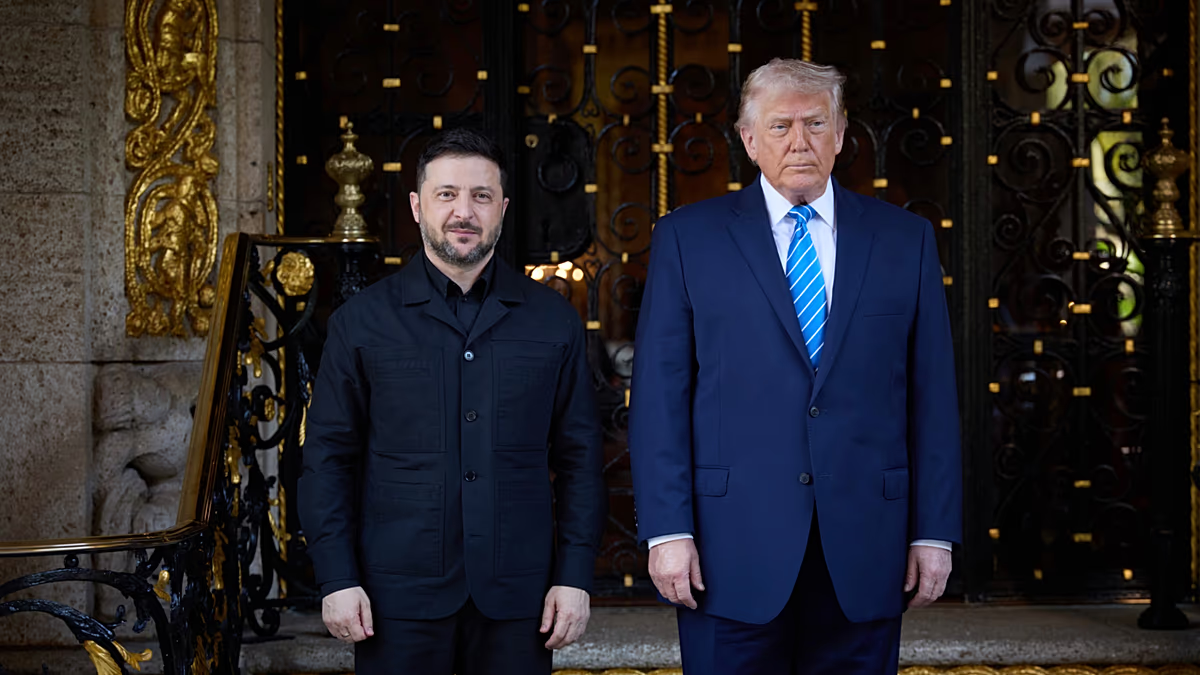
Peace is negotiated only after fear is contained.
Mar-a-Lago, December 29, 2025.
Volodymyr Zelenskyy stated that security guarantees between Ukraine and the United States are fully agreed following his meeting with Donald Trump, marking a decisive moment in Kyiv’s diplomatic strategy as the war enters a phase where political design begins to rival military endurance. The declaration does not announce the end of hostilities, but it redraws the hierarchy of negotiations: security first, territory later, peace last.
For Ukraine, guarantees are not a diplomatic accessory but a structural prerequisite. The experience of previous ceasefires and security memorandums has shaped a strategic doctrine grounded in one lesson: agreements without enforcement invite renewed aggression. By securing explicit commitments from Washington, Kyiv seeks to neutralize the vulnerability that historically followed political concessions unsupported by credible deterrence. The emphasis on guarantees reflects a recalibration away from symbolic alignment toward operational certainty.
The meeting at Mar-a-Lago signals a bilateral consolidation that operates alongside, but not subordinate to, broader alliance structures. While NATO membership remains Ukraine’s long-term strategic objective, the current framework prioritizes immediacy over formal accession. Guarantees are designed to function regardless of alliance timelines, anchoring deterrence in direct commitments rather than deferred institutional processes. This approach reduces ambiguity in moments where hesitation can be exploited.
Zelenskyy’s assertion that the guarantees are fully agreed underscores a shift in negotiating posture. Ukraine is no longer positioning itself as a petitioner seeking protection, but as a state defining the conditions under which political dialogue can proceed. Territorial questions, while unresolved, are deliberately sequenced after security, reversing the logic that often pressures states under attack to trade land for temporary calm. In this framework, sovereignty is preserved not by rhetoric but by deterrence architecture.
For Washington, the agreement represents a strategic signal rather than a tactical maneuver. It reinforces the role of the United States as the central guarantor in Europe’s evolving security landscape, particularly as uncertainty persists around long-term conflict trajectories. The commitment reflects an assessment that unmanaged instability in Eastern Europe carries systemic risk, extending beyond Ukraine’s borders into the credibility of deterrence itself.
The bilateral nature of the guarantees introduces both strength and tension. Direct commitments offer clarity and speed, but they also place responsibility squarely on political leadership rather than on diffuse multilateral mechanisms. This concentration of obligation elevates the stakes of enforcement and continuity, especially across electoral cycles. Yet for Kyiv, this risk is preferable to the strategic vacuum created by abstract assurances.
Russia is absent from these arrangements, but not irrelevant to them. The announcement is calibrated to reshape Moscow’s cost-benefit analysis by narrowing the space for coercive leverage. Guarantees function here as a pre-emptive constraint, signaling that escalation will encounter structured resistance rather than improvised response. Whether this alters Russian behavior remains uncertain, but it establishes a clearer threshold than previously existed.
Domestically, the message is equally targeted. For Ukrainian society, exhausted by prolonged war, the confirmation of guarantees serves as reassurance that political engagement is not occurring from a position of exposure. It reinforces the narrative that negotiation does not equal capitulation, and that external support is being transformed into durable structure rather than episodic aid.
What emerges from Mar-a-Lago is not a peace settlement but a reordered sequence of power. Security is no longer a promise deferred to the end of negotiations; it is the entry condition. Only after that foundation is set can discussions over territory, reconstruction, and post-war governance proceed without replicating the failures of the past.
In this sense, the agreement reflects a broader evolution in conflict diplomacy. Modern wars do not conclude with signatures alone, but with systems capable of sustaining restraint. Ukraine’s insistence on guarantees before compromise illustrates a strategic maturity forged under pressure, redefining how peace is approached when survival remains contested.
Detrás de cada dato, hay una intención. Detrás de cada silencio, una estructura.