

 Phoenix 24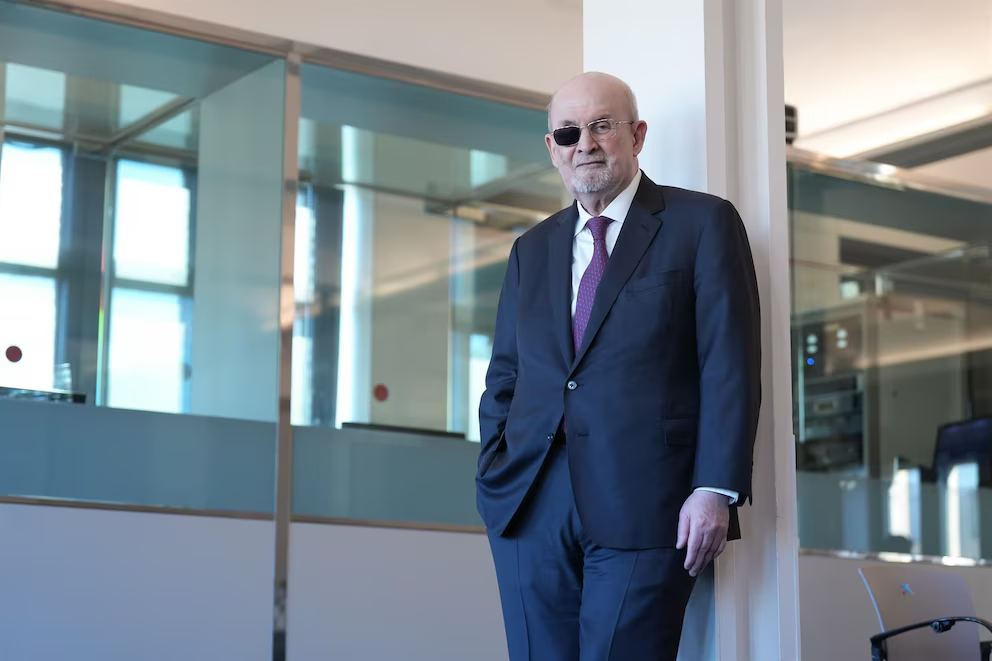
The writer’s reflection turns personal survival into a warning about the fragility of public life.
Park City, January 27, 2026. Salman Rushdie reflected publicly on how violence has become a pervasive presence in contemporary society, stating that “the idea of danger and violence is close to everyone now,” as he addressed audiences during the presentation of a documentary recounting the 2022 attack that nearly cost him his life. Speaking in a measured but firm tone, Rushdie framed his experience not as an isolated act of extremism but as a symptom of broader cultural and political tensions that increasingly normalize hostility toward ideas, dissent and public expression.
Rushdie was stabbed multiple times while preparing to speak at a literary event in New York, an assault that resulted in permanent physical damage and a prolonged recovery process. In revisiting that moment, he emphasized that the violence directed at him was not solely about his identity or past controversies, but about a climate in which aggression has become a readily available response to disagreement. His remarks suggested that public spaces once associated with dialogue, debate and cultural exchange are no longer insulated from the threat of sudden harm.

Throughout his career, Rushdie has lived under the shadow of violence tied to ideas. Decades earlier, the publication of a novel triggered a religious edict calling for his death, forcing him into years of concealment and protection. That period shaped his understanding of how words can provoke fear, anger and physical danger when societies abandon the boundaries that separate belief from coercion. In linking that history to present conditions, Rushdie argued that the mechanisms enabling violence have become more diffuse, less centralized and therefore more unpredictable.
The documentary presented alongside his remarks chronicles both the attack and its aftermath, combining personal testimony with broader reflection on recovery, vulnerability and resilience. Rather than focusing exclusively on trauma, the film examines how individuals and societies respond to violence, and how fear can reshape behavior long after physical wounds begin to heal. Rushdie described the project as an attempt to confront violence without allowing it to define the totality of his existence or silence his engagement with public life.
In his analysis, Rushdie pointed to political polarization and increasingly aggressive rhetoric as contributing factors to the erosion of social restraint. He warned that when public discourse is framed as existential struggle rather than disagreement, it becomes easier to justify harm against those labeled as adversaries. This dynamic, he suggested, places not only writers and artists at risk, but anyone whose presence or ideas are perceived as threatening within polarized environments.
Audience reactions to Rushdie’s words reflected a broader unease about the state of civic life. His assertion that danger feels closer to everyone resonated beyond literary circles, echoing concerns shared by journalists, educators and public figures who operate in increasingly contentious spaces. The discussion that followed underscored how violence no longer appears as an aberration but as a latent possibility embedded within everyday interactions.
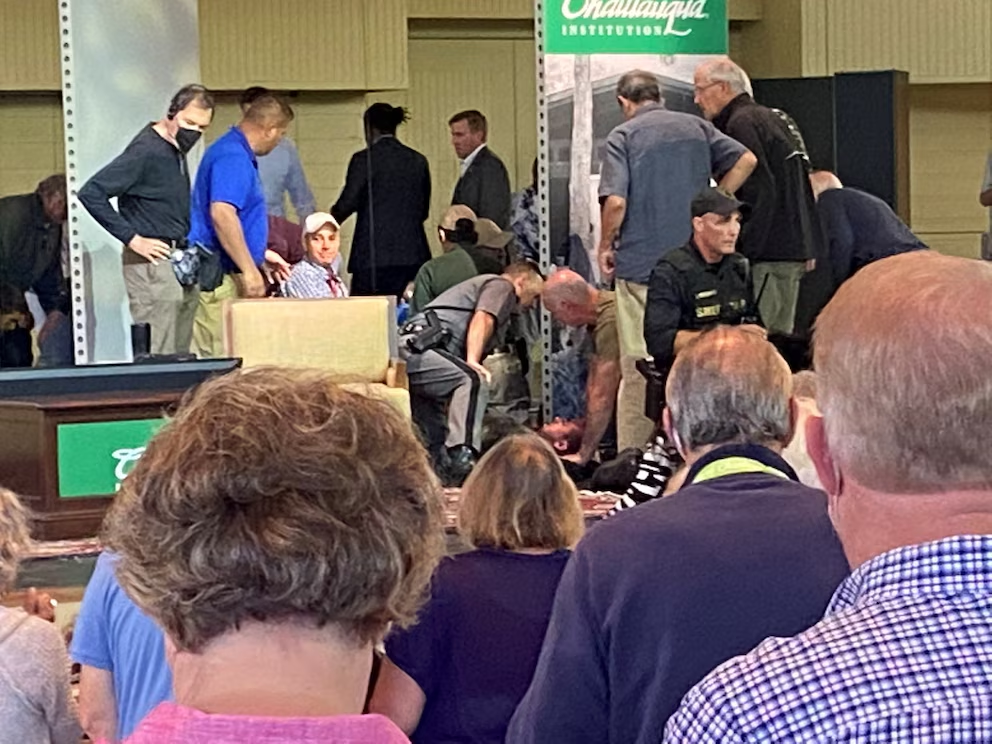
Rushdie was careful to distinguish between fear and silence. He rejected the notion that the appropriate response to violence is withdrawal, arguing instead for continued participation in cultural and intellectual life. His survival, he suggested, carries a responsibility to speak clearly about the conditions that enable violence, even when doing so invites discomfort or controversy. The goal, in his view, is not to dramatize danger but to acknowledge it honestly in order to resist its normalization.
By situating his personal ordeal within a wider social framework, Rushdie transformed a story of victimhood into an argument about collective responsibility. He emphasized that violence does not emerge in a vacuum, but is cultivated through language, institutions and the gradual erosion of empathy. Addressing those roots, he argued, requires more than security measures or condemnation after the fact; it demands a recommitment to pluralism, restraint and the protection of spaces where disagreement does not escalate into harm.
Rushdie’s intervention stands as both testimony and warning. It reminds audiences that cultural freedom and physical safety are intertwined, and that when societies tolerate the erosion of one, the other soon follows. His message was not one of despair, but of vigilance, urging individuals and institutions alike to recognize how close violence has come to the everyday, and to act before proximity becomes inevitability.
Detrás de cada dato, hay una intención. Detrás de cada silencio, una estructura.